

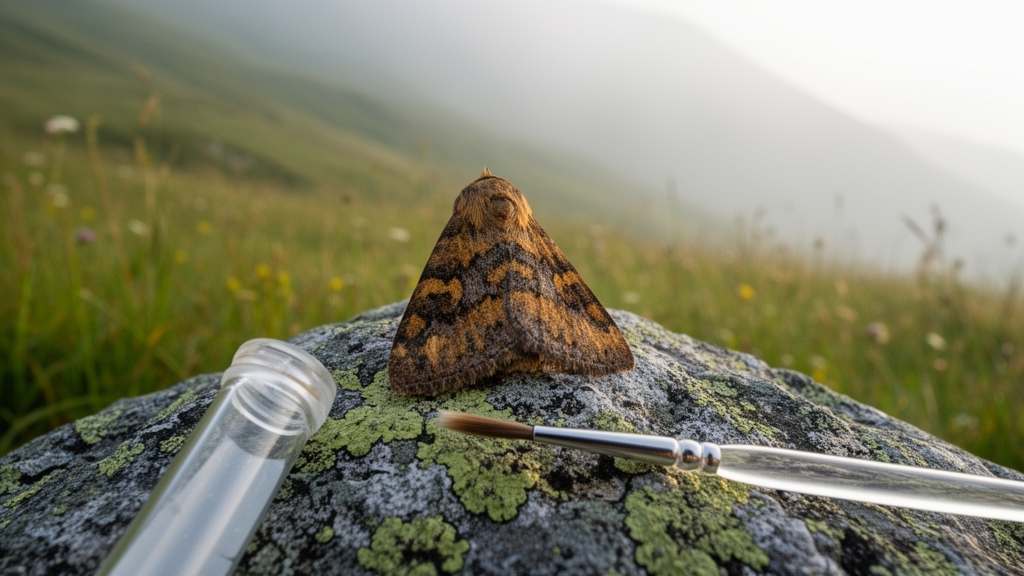
A taxonomic review of the European Cochylimorpha perfusana species group concluded that the group contains four species rather than one. The study reinstated Cochylimorpha dorsimaculana and Cochylimorpha callosana to species rank and described Cochylimorpha bucegiana, a new species from Romania’s Southern Carpathians.
The authors combined examination of 157 specimens with external morphology, male and female genitalia, type material, DNA barcodes and a reassessment of geographic records. The specimens came from the Austrian, Slovenian, Italian and French Alps; the Romanian Carpathians; Bulgaria’s Pirin Mountains; and the Velebit Mountains and neighboring low-mountain habitats in Croatia, Slovenia and Italy. The review was limited to European material, and some published geographic records could not be verified because the associated voucher specimens were unavailable or required re-examination.
The taxonomic problem arose after three European taxa described between 1845 and 1908 were combined under C. perfusana in a 1970 revision. The authors traced part of this history to an incorrect cross-reference in Herrich-Schäffer’s index, which directed both C. perfusana and C. callosana to the page containing only the former description. Later treatments consequently cited an incorrect year and publication for C. callosana and gave the wrong type locality. The three named taxa remained synonymized for more than 50 years.
Evidence of distinct Romanian populations had been reported more than 20 years earlier, when two populations assigned to C. perfusana were treated as typical and “callosana” forms. When female genitalia became available for study, material from the Eastern Carpathians resembled Austrian specimens and the figures published by Razowski, whereas material from the Southern Carpathians differed from the genitalia illustrated in his works. Subsequent examination of collections, type specimens and molecular data supported the presence of four related taxa.
DNA from 19 specimens was processed at the Canadian Centre for DNA Barcoding. Seven complete 658-base-pair cytochrome c oxidase I sequences and four shorter sequences were obtained, while eight samples failed to yield barcodes. The neighbour-joining tree was based on sequences longer than 600 base pairs and used the Kimura 2-parameter model, with two Cochylimorpha jucundana sequences as the outgroup. Two of the four shorter sequences were excluded from that tree because they were only 145 base pairs long.
External morphology and genitalia distinguished all four species. C. perfusana has a fine olive-green reticulate forewing pattern without brown scales and a straight phallus. C. dorsimaculana has a less contrasting brownish-yellow pattern, a prominent dorsal blotch and an S-shaped phallus. C. callosana has an extensive straw-yellow pattern with scattered brown scales. The newly described C. bucegiana has a yellowish-brown pattern forming a basal blotch, median transverse fascia, subapical blotch, subterminal blotch and narrow terminal fascia. Differences in the female genitalia, including the form and position of the signum and associated thorns, also separated the taxa.
The DNA results broadly supported the morphological divisions, although the barcode patterns were not identical to the species boundaries. C. perfusana and C. dorsimaculana shared one Barcode Index Number but formed separate sister groups with a minimum barcode distance of 1.07%. C. callosana had a minimum distance of 3.12% from C. dorsimaculana and 3.13% from C. perfusana. The new species occupied a separate BIN, BOLD:AEH6249, with minimum distances of 3.62% from C. dorsimaculana, 3.73% from C. perfusana and 4.43% from C. callosana. The authors considered the conspicuous morphological and habitat differences between the two species sharing a BIN sufficient to maintain them as separate species.
The revised distributions and habitats also separated the taxa. C. dorsimaculana is known only from Wachau and Retz in Lower Austria, where it occupies dry to semi-open meadows at approximately 200–300 metres. Larvae were reared from the flower heads of Centaurea triumfettii, and adults emerged between 8 and 10 May. C. perfusana inhabits mountain and high-mountain meadows at roughly 550–2100 metres across parts of the Alps, Carpathians and Pirin Mountains. C. callosana occurs mainly in Croatia, Slovenia and north-eastern Italy, with localized records in eastern France, Corsica and Hungary, generally in drier open slopes and meadows between 350 and 1500 metres.
C. bucegiana was described from the Bucegi and Făgăraș Mountains of Romania’s Southern Carpathians, with its type locality in Jepii Valley in the Bucegi Mountains. It is known from high-mountain to subalpine meadows at 1500–2200 metres. The examined material includes Bucegi specimens collected from 1986 onward and one specimen collected in the Făgăraș Mountains in 1994. The species is known only from Romania and may be a Southern Carpathian endemic, although its presumed host plant, Centaurea kotschyana, occurs more widely in the Carpathians and Balkan Peninsula. Biology remains incompletely known for several members of the group, but the available observations indicate one generation annually, daytime adult activity and an association with Centaurea host plants.
Subject of Research: Taxonomic review of four European species in the Cochylimorpha perfusana moth group
Article Title: A review of the Cochylimorpha perfusana (Guenée, 1845) species group ( Lepidoptera , Tortricidae ) in Europe, with the description of a new species from the Southern Carpathians (Romania)
Article References: Kovács, Z., Kovács, S., Buchner, P., & Junnilainen, J. (2024). A review of the Cochylimorpha perfusana (Guenée, 1845) species group (Lepidoptera, Tortricidae) in Europe, with the description of a new species from the Southern Carpathians (Romania). Nota Lepidopterologica, 47, 125-162. https://doi.org/10.3897/nl.47.122906
Image Credits: AI Generated
DOI: 10.3897/nl.47.122906
Keywords: Cochylimorpha perfusana, taxonomic review, moth species, Cochylimorpha bucegiana, Southern Carpathians, DNA barcoding, species delimitation, genital morphology, Romania, Tortricidae, review, Cochylimorpha
Cite Scienmag News
Scienmag. (October 21, 2026). European moth review identifies four species and describes a Romanian taxon. https://scienmag.com/european-moth-review-identifies-four-species-and-describes-a-romanian-taxon/
Scienmag. "European moth review identifies four species and describes a Romanian taxon." Scienmag, 21 October 2026, https://scienmag.com/european-moth-review-identifies-four-species-and-describes-a-romanian-taxon/. Accessed 21 October 2026.
Scienmag. "European moth review identifies four species and describes a Romanian taxon." Scienmag. October 21, 2026. https://scienmag.com/european-moth-review-identifies-four-species-and-describes-a-romanian-taxon/


