


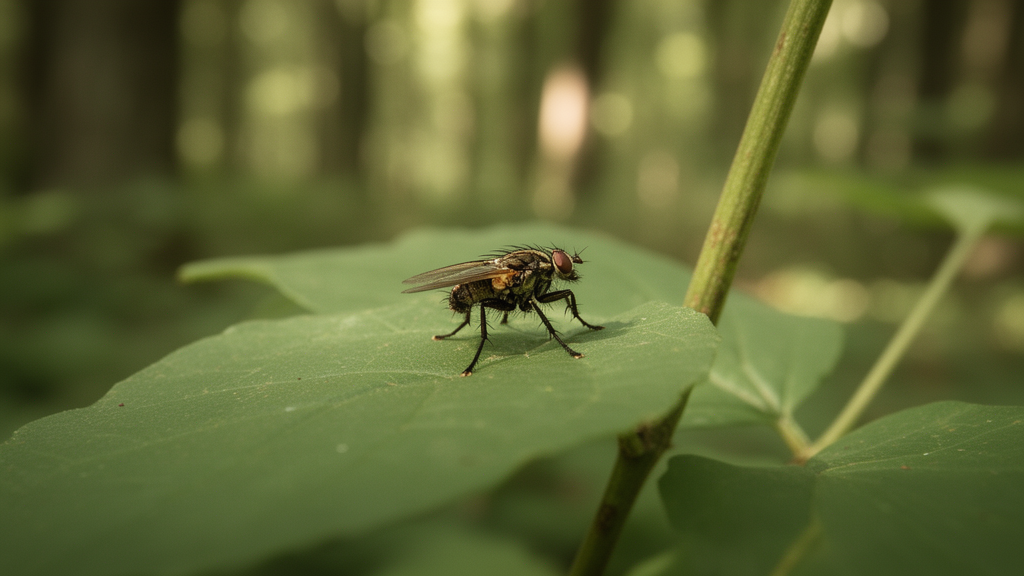
A survey of flies in southern Switzerland has produced the first confirmed European record of Cooka incisa, a species previously known only from North America. The identification was based on 16 preserved specimens—12 males and four females—collected at five localities in the canton of Ticino between 2000 and 2016. All of the sites lie within a radius of about 20 km around Locarno, in an area with a relatively mild, warm Insubrian climate.
The specimens closely matched published descriptions and illustrations of North American C. incisa, particularly the distinctive form of the male genital capsule. The discovery extends both the species and its genus into the Palaearctic region, but the available evidence does not establish whether the fly is an indigenous European species or an alien introduction from North America. The record is based on material gathered over more than 15 years rather than on a single recent find.
The earliest specimen was collected at Bolle di Magadino, a riverine forest near Gordola, in 2000. Further individuals were taken at the same locality in 2001, 2004 and 2005. A male was collected in Lugano in 2006 during the national BiodiverCity research program, which sampled urban landscapes in Lugano, Lucerne and Zurich.
The authors note that the absence of C. incisa from older Ticino surveys is puzzling, given that its first known Swiss capture occurred in 2000, and suggest that further records could help clarify its biogeographic history. The collecting methods varied according to the program that produced each specimen. The 2015–16 survey near Locarno used Malaise traps, aerial Malaise traps known as SLAM traps, and three slightly different beer- or wine-baited traps.
At the Arcegno sites, the flies were captured with traps containing white beer or yellow wine. Earlier material from the general Swiss faunistic survey of 1999–2006 had been collected with “Kombifallen,” devices combining window traps with yellow pans. The 2006 BiodiverCity program used combined traps and pitfall traps.
The insects were initially stored in 70% alcohol. Selected specimens were later cleared in potassium hydroxide, dissected and slide-mounted for anatomical examination and the production of figures. Material from the 2015–16 survey is held in the Museo cantonale di storia naturale in Lugano, while other identified specimens are retained in the Gerhard Bächli collection, now partly transferred to the Muséum d’histoire naturelle de Neuchâtel.
Cooka incisa was recognized through a combination of external morphology and anatomical characters. Its body is elongate and generally dull, although the male has a contrasting, shining seventh abdominal tergite and a basally sub-shining seventh sternite. Its wing venation closely resembles that of species in the genus Rhexoza and of the cosmopolitan Coboldia fuscipes.
In the male, the seventh tergite has a broad median posterior projection, while the seventh sternite is deeply incised along the midline. The genital capsule bears elongate, pointed lateral projections directed toward the rear, and the aedeagus is short. Female specimens have a deeply incised eighth tergite.
Their eighth sternite is divided into two lateral lobes that are broad at the base and pointed toward the apex. The shape of the male genital capsule was considered especially diagnostic and closely matched the illustration published in Cook’s 1981 treatment of Nearctic Diptera. The species can also be distinguished from related genera using the structure of the male genitalia, the number of unsclerotized abdominal sternites and the shape of the anterior thoracic region.
In Cooka, sternites 1–4 are unsclerotized, whereas only sternites 1–3 are unsclerotized in Rhexoza. The antepronotum of Cooka is deeply indented on its ventral surface, a feature visible in the article’s anatomical figure. When C. incisa is followed through the available key to Palaearctic scatopsid genera, it runs toward Rhexoza, but the abdominal and genital characters separate it from the four European Rhexoza species recognized in that key.
One additional distinction is the shine of the male’s pregenital segment, which contrasts strongly with the dull anterior tergites; in females it is only partly shining. The abdominal tergites of Rhexoza are described as dull throughout. Cooka incisa was first described by Cook in 1956 under the name Rhexoza incisa.
The genus Cooka was established later for six species that had previously been placed within Rhexoza in the broad sense. Until the Swiss discovery, the genus was regarded as purely Nearctic in distribution. The new observations therefore document a European and Palaearctic occurrence for both C. incisa and Cooka.
The authors describe the finding as significant from zoogeographical and phylogenetic perspectives because it adds an apparently Nearctic lineage to the European fauna while leaving unresolved whether that distribution reflects a native Holarctic pattern or a more recent connection. Information about the biology of C. incisa is limited. Larvae have been collected in the United States from beneath the bark of dead American elm, box elder and cottonwood trees, and the species has been associated there with wet areas.
Bolle di Magadino provides a superficially similar Swiss habitat: it is a riverine forest containing common alder, European ash, pedunculate oak, elm, white willow and poplar, while box elder is also present in the region. The Arcegno specimens came from a different forest community, described as a stand of chestnut with oaks, including sessile oak, downy oak, pedunculate oak and northern red oak. Thus, the European captures came from both a riverine woodland and a chestnut–oak forest.
However, the collection records do not establish where the larvae developed, whether the flies reproduce in these habitats or whether the adults were merely visiting them. Other scatopsid species offer precedents for a distribution spanning Europe and North America. Arthria analis, Pharsoreichertella simplicinervis, Scatopse lapponica and Thripomorpha borealis have Holarctic distributions, but the source notes that these species have more or less marked boreal affinities and circumpolar ranges.
Ectaetia clavipes also occurs widely in both Europe and North America. C. incisa presents a less readily explained pattern: its confirmed European material is confined to Ticino, the first capture was in 2000, and the known sites occupy a relatively small area in southern Switzerland. These observations are compatible with an alien origin, and the authors state that accidental introduction from North America cannot be immediately dismissed.
At the same time, absence from earlier surveys does not by itself demonstrate that the species was introduced, and the restricted Swiss record provides no direct evidence about how the fly reached Europe. Additional observations from other parts of Europe, together with the examination of more material in collections, could bear on the unresolved question of origin. The present study is a taxonomic and faunistic report based on 12 males and four females, rather than an analysis of population size, life history, reproduction or ecological effects.
It also does not provide a complete inventory of the species’ European distribution, which remains confined to the reported Ticino localities. Even so, the record demonstrates that Switzerland’s scatopsid fauna remains incompletely known despite the country’s wealth of biodiversity data. Including poorly documented fly families in regional and national surveys can reveal overlooked species, expand known geographic ranges and generate new questions about the origins and relationships of insect lineages.
Subject of Research: First European record and uncertain biogeographic origin of the Nearctic scatopsid fly Cooka incisa
Article Title: First report of Cooka incisa (Beekey, 1937) from Europe ( Diptera , Scatopsidae )
Article References: Haenni, J.-P., & Paltrinieri, L. P. (2021). First report of Cooka incisa (Beekey, 1937) from Europe (Diptera, Scatopsidae). Alpine Entomology, 5, 1-4. https://doi.org/10.3897/alpento.5.60974
Image Credits: AI Generated
Keywords: Cooka incisa, Scatopsidae, European first record, Ticino, Swiss biodiversity survey, Nearctic species, faunistic survey, alien species, forest insects, taxonomic discovery, First, report
Cite Scienmag News
Gavin Prescott. (October 21, 2026). Nearctic fly Cooka incisa recorded in Europe for the first time. Scienmag. https://scienmag.com/nearctic-fly-cooka-incisa-recorded-in-europe-for-the-first-time/
Gavin Prescott. "Nearctic fly Cooka incisa recorded in Europe for the first time." Scienmag, 21 October 2026, https://scienmag.com/nearctic-fly-cooka-incisa-recorded-in-europe-for-the-first-time/. Accessed 21 October 2026.
Gavin Prescott. "Nearctic fly Cooka incisa recorded in Europe for the first time." Scienmag. October 21, 2026. https://scienmag.com/nearctic-fly-cooka-incisa-recorded-in-europe-for-the-first-time/


