


A sweeping analysis of more than 8,400 scientific publications has revealed how research into suicide and depression among children and adolescents has changed over the past two decades—from studies centered largely on diagnosis and epidemiology to an increasingly data-driven effort to predict risk, detect warning signs earlier and tailor prevention to individual young people.
The study, published in Discover Mental Health, examined 8,454 original research articles and review papers indexed in the Web of Science Core Collection between 2005 and April 6, 2026. Rather than testing a treatment or estimating the prevalence of suicidal behavior, the researchers mapped the structure of the scientific literature itself. This approach, known as bibliometric analysis, uses publication records, citation patterns, author networks, institutional affiliations and keyword relationships to show how a research field grows and where its attention is moving.
The investigators used several complementary computational tools. Bibliometrix, an R-based software package, was used to quantify publication trends and identify influential contributors. VOSviewer generated visual maps of collaboration networks and keyword co-occurrence, allowing concepts that frequently appear together to be grouped into thematic clusters. InCites was used to evaluate research performance, including productivity, citation impact and international collaboration. Together, these methods provided a high-level view of not only what researchers have studied, but also how ideas have connected and which subjects are becoming prominent.
The publication record showed a steady expansion of interest, with especially strong growth after 2018. That acceleration reflects a broader recognition that depression and suicide in young people cannot be understood through a single clinical lens. Depression may involve persistent low mood, loss of pleasure, sleep and appetite changes, impaired concentration and feelings of worthlessness, but suicidal thoughts and behavior can also be shaped by impulsivity, trauma, social isolation, family conflict, bullying, substance use, chronic illness and rapid changes in the social environment. For researchers, the rising output signals both the urgency of the problem and the increasing complexity of the questions being asked.
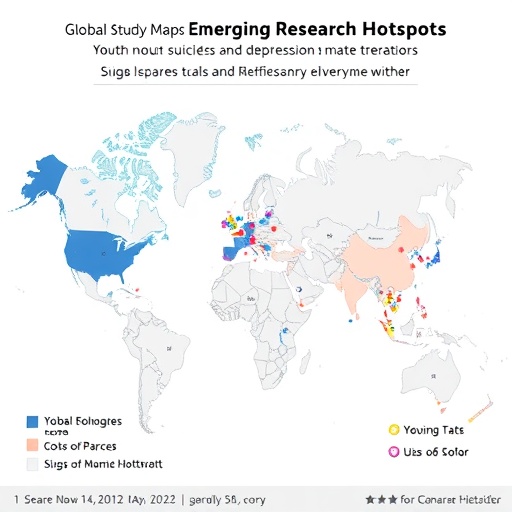
The United States and China emerged as the leading contributors when publication volume, citations and international collaboration were considered. Their prominence demonstrates the concentration of research capacity in a small number of countries, even as the mental-health challenges under investigation are global. The authors warn that uneven participation across regions may leave important populations underrepresented, especially children and adolescents living in countries with limited research funding, restricted access to specialist care or different cultural and social conditions. A literature dominated by wealthy research systems may produce powerful tools while still failing to capture how risk appears in other communities.
At the center of the field were three closely linked concepts: depression, suicide and adolescent mental health. The analysis identified five broad thematic clusters that organize much of the existing research. One focused on clinical comorbidity, or the presence of multiple conditions in the same young person, such as depression alongside anxiety, substance misuse or other psychiatric disorders. Another examined self-harm behaviors, which may occur with or without suicidal intent and require careful clinical distinction. A third addressed social determinants and prevention, including the effects of family, school, community and broader social conditions. The remaining clusters concentrated on psychological mechanisms and applications driven by artificial intelligence.
This organization matters because suicidal behavior is not a single, uniform outcome with one measurable cause. Bibliometric clusters do not prove that one factor causes another; instead, they reveal recurring connections in the scientific record. For example, a group of papers linking self-harm, emotional regulation and psychological distress indicates that researchers are examining pathways through which intense or persistent emotions may become dangerous. Work on social determinants points toward factors outside the individual, such as access to care, discrimination, adverse childhood experiences and support systems. By showing how these themes overlap, the analysis highlights why prevention must combine clinical treatment with interventions in homes, schools, digital environments and communities.
The most conspicuous shift in the field was the rise of machine learning, prediction models, ecological momentary assessment and digital phenotyping. Machine-learning systems can analyze large numbers of variables and identify statistical patterns associated with later outcomes. Prediction models may combine clinical histories, symptom scores, demographic information and other observations to estimate risk. Ecological momentary assessment repeatedly asks people about mood, thoughts and experiences in real time, rather than relying only on a single retrospective interview. Digital phenotyping extends this idea by examining behavioral signals gathered from digital devices, potentially including changes in activity, communication or sleep-related patterns when such data are available and ethically collected.
These technologies could reshape early detection because mental states fluctuate, while conventional assessments often provide only a snapshot. A young person may appear relatively well during a clinical appointment yet experience rapidly changing distress between visits. Repeated measurements could help identify deviations from an individual’s usual pattern, and algorithms might assist clinicians by bringing together information that is difficult to process manually. But the analysis does not show that artificial intelligence is already capable of reliably predicting suicide or replacing professional judgment. Prediction is different from explanation, and correlation is not causation. A model may detect a statistical association without revealing why it exists or whether acting on it improves outcomes.
The researchers therefore emphasize that technological progress must be matched by real-world implementation, longitudinal data and equitable collaboration. Longitudinal research follows participants over time, making it better suited to studying how symptoms, environments and behaviors evolve than one-time surveys. Integrating repeated clinical and behavioral measurements could improve understanding of changing risk, but it also raises serious questions about privacy, consent, data security, false alarms and potential stigma. An algorithm trained on data from one population may perform poorly in another, while biased or incomplete records can reproduce existing inequalities. Children and adolescents require particularly strong safeguards because they may have limited control over how sensitive information is collected and used.
The study’s message is ultimately less about a single breakthrough than about a field undergoing a major transition. Research on youth suicide and depression is becoming more interdisciplinary, combining psychiatry, psychology, epidemiology, computer science, public health and social science. The authors argue that the next phase should connect advanced analytics with accessible, evidence-based care rather than treating technology as an end in itself. Tools developed in laboratories will matter only if clinicians can interpret them, families and young people can trust them, and health systems can respond when they identify concern. The bibliometric map points toward a future of precision-oriented prevention, but it also exposes the work still required: broader international participation, better long-term datasets and rigorous testing in ordinary clinical settings. Liu, Zhu and Geng conclude that progress will depend on translating increasingly sophisticated signals into timely, humane and effective support for young people at risk.
Cite Scienmag News
Glenn Wilkins. (August 27, 2026). Global Study Maps Emerging Research Hotspots on Youth Suicide and Depression. Scienmag. https://scienmag.com/global-study-maps-emerging-research-hotspots-on-youth-suicide-and-depression/
Glenn Wilkins. "Global Study Maps Emerging Research Hotspots on Youth Suicide and Depression." Scienmag, 27 August 2026, https://scienmag.com/global-study-maps-emerging-research-hotspots-on-youth-suicide-and-depression/. Accessed 3 September 2026.
Glenn Wilkins. "Global Study Maps Emerging Research Hotspots on Youth Suicide and Depression." Scienmag. August 27, 2026. https://scienmag.com/global-study-maps-emerging-research-hotspots-on-youth-suicide-and-depression/


