


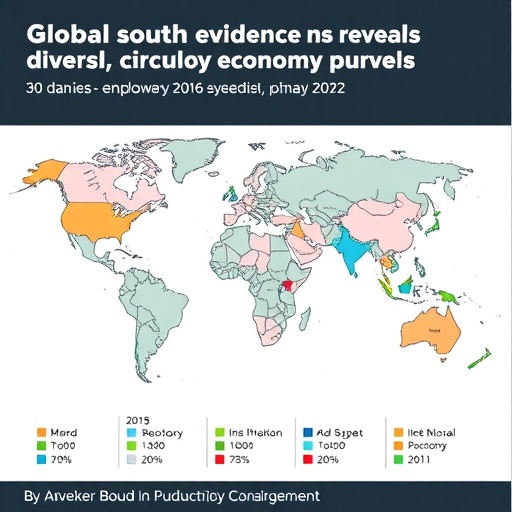
The circular economy is often presented as a sleek solution to a wasteful world: design products to last, recover their materials, and keep resources moving through the economy instead of extracting, using and discarding them. But new research argues that this globally influential idea looks very different depending on where it is studied. Evidence from countries across the Global South reveals not one circular economy, but a diverse collection of systems shaped by informal work, local livelihoods, resource scarcity, community institutions and uneven access to technology.
In a study published in Nature Sustainability, L. Straub, P. Trotter, E. Onsongo and colleagues examine how circular-economy practices are understood and implemented in the Global South. Their work challenges the assumption that circularity follows a single pathway designed in wealthy industrial economies and then exported elsewhere. Instead, the researchers show that circular economies can emerge from very different social and economic conditions, including environments where repair, reuse, remanufacturing and material recovery are not new innovations but long-standing necessities.
The basic concept of a circular economy is to decouple human prosperity from the continuous extraction of finite resources. In a conventional “linear” model, raw materials are taken from the environment, transformed into products, consumed and eventually discarded. A circular system attempts to slow, narrow or close these flows. Slowing means extending product lifetimes through maintenance and repair. Narrowing means using fewer materials and less energy to provide the same service. Closing means recovering materials or components so they can re-enter production. In practice, however, these strategies depend on infrastructure, markets, laws and social relationships that vary dramatically between regions.
The Global South is not a single economic or cultural category, and the researchers’ central message is that its circular practices cannot be reduced to a single development story. Cities and rural communities across Africa, Asia and Latin America contain highly different industries, governance structures and consumption patterns. Some circular activities are organized by governments or formal companies, while others are carried out by households, cooperatives, repair specialists, farmers, traders and waste pickers. These systems may operate outside official statistics, yet they can prevent large quantities of materials from entering dumpsites and can provide income to people excluded from formal employment.
That informal dimension is particularly important. In many cities, workers collect, sort, repair and resell materials through networks that connect households, streets, small workshops, markets and industrial buyers. Their work can involve detailed knowledge of material quality and local demand, even when it is not recognized as an advanced environmental service. A discarded appliance may be dismantled for valuable components, a damaged garment may be altered for a new user, and packaging may be repeatedly reused. Such activities extend the useful life of products and recover resources, but workers may face dangerous conditions, unstable prices, discrimination and a lack of legal protection.
The study also highlights why simply transferring high-income-country models of circularity can fail. A policy built around sophisticated recycling plants, digital product passports or capital-intensive reverse-logistics systems may be unsuitable where collection services are limited, electricity is unreliable or most businesses are small and informal. Conversely, locally organized repair and reuse may achieve major environmental and economic benefits with little formal infrastructure. Circularity therefore cannot be measured only by the presence of advanced technology. Its performance must also be assessed through material savings, avoided emissions, livelihood creation, affordability, resilience and the distribution of risks and benefits.
Technically, this means that researchers and policymakers need to examine entire material-flow systems rather than isolated activities. Life-cycle assessment can estimate the energy use, emissions and environmental impacts associated with products from extraction to disposal, while material-flow analysis tracks the quantities and destinations of resources moving through an economy. But both tools can miss activities that are poorly documented, especially informal repairs, resale markets and household-level reuse. The authors’ focus on evidence from the Global South points to the need for methods that combine quantitative measurements with interviews, ethnographic research, local knowledge and participatory mapping.
A more inclusive approach could also change how circular-economy success is defined. If the only goal is to maximize the percentage of material recycled, policies may encourage low-value processing while overlooking options that preserve more of a product’s original function. In a typical hierarchy of resource strategies, preventing waste and extending product life generally conserve more embedded energy and labor than shredding an object into raw material. A repaired machine, for example, retains its manufactured components and the energy used to produce them, whereas recycling may require transport, sorting and additional industrial processing before a new product can be made.
The authors’ argument arrives as governments, businesses and international institutions increasingly promote circularity as a response to climate change, biodiversity loss and supply-chain insecurity. Demand for critical minerals is rising as economies electrify, while discarded electronics, plastics, textiles and construction materials are accumulating at unprecedented scales. Yet a circular economy designed without attention to power may reproduce existing inequalities. If companies extract value from community-based recycling without improving wages or safety, or if new regulations eliminate informal workers without providing alternatives, an environmental policy can create social harm. The Global South evidence instead suggests that circular transitions should be designed with the people already maintaining material cycles.
The research does not imply that every existing reuse or recycling practice is automatically sustainable. Some second-hand goods may be transported long distances, inefficient repair processes may consume substantial energy, and poorly controlled recycling can release toxic substances into air, soil or water. Circular strategies must therefore be evaluated within their specific technological and social contexts. The same practice may deliver benefits in one location and create new burdens in another, depending on transport distances, energy sources, product quality, labor conditions and what happens at the end of the next use cycle.
What emerges is a more expansive vision of circularity: not a universal package of technologies, but a field of locally adapted systems. In some places, the priority may be formal recognition and safer working conditions for waste pickers. Elsewhere, it may be support for repair businesses, community enterprises, agricultural residue markets or small manufacturers that reuse components. Governments could strengthen these systems through access to finance, public procurement, technical training, fair taxation, producer responsibility rules and infrastructure that complements rather than displaces local expertise.
The study’s most provocative implication is that the future of circularity may be found not only in laboratories, corporate sustainability departments or smart factories, but also in workshops, neighborhood markets and informal supply chains that have kept materials in use for generations. By bringing evidence from the Global South to the center of the debate, Straub and colleagues call for a circular economy that is plural, empirically grounded and socially accountable. The viral promise of “zero waste” will ultimately depend less on a single breakthrough than on whether societies can recognize, improve and fairly govern the many different ways people already make resources last.
Cite Scienmag News
Sloane Callahan. (August 25, 2026). Global South Evidence Reveals Diverse Circular Economy Models. Scienmag. https://scienmag.com/global-south-evidence-reveals-diverse-circular-economy-models/
Sloane Callahan. "Global South Evidence Reveals Diverse Circular Economy Models." Scienmag, 25 August 2026, https://scienmag.com/global-south-evidence-reveals-diverse-circular-economy-models/. Accessed 4 September 2026.
Sloane Callahan. "Global South Evidence Reveals Diverse Circular Economy Models." Scienmag. August 25, 2026. https://scienmag.com/global-south-evidence-reveals-diverse-circular-economy-models/


