


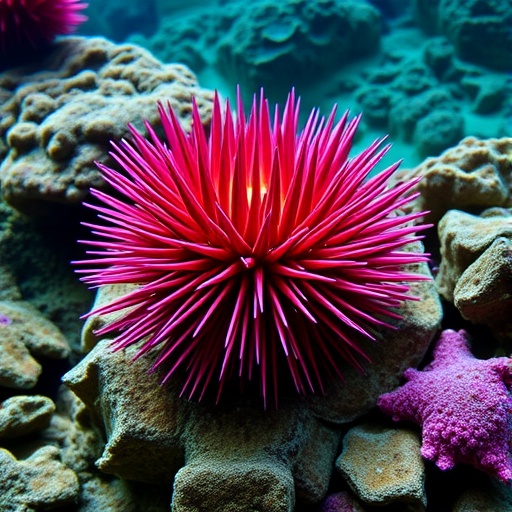
In a groundbreaking study recently published in Communications Earth & Environment, researchers have unveiled comprehensive global patterns of sea urchin diversity that challenge long-held assumptions about benthic assemblages across marine ecosystems. This study, led by He, L., Cheng, J., Xiao, N., and colleagues, sheds new light on the dynamic shifts occurring between shallow-water and deep-water habitats, revealing complex biogeographic trends that reflect both environmental gradients and evolutionary processes. The extensive data underpinning these findings offer unprecedented insights into marine biodiversity, ecological connectivity, and the consequences of anthropogenic impact on key benthic species.
Sea urchins, renowned for their ecological roles as grazers and ecosystem engineers, inhabit an impressive range of marine environments, yet until now, their distribution patterns on a global scale have remained incompletely understood. The authors deployed state-of-the-art analytical methods, integrating comprehensive species occurrence databases with environmental variables derived from satellite and in situ observations. This holistic approach allowed the team to rigorously quantify diversity patterns and community composition shifts, disentangling the influences of depth, temperature, substrate type, and oceanographic processes.
One of the pivotal revelations of this study is the stark contrast in assemblage structure between shallow-water reefs and deep-sea benthic communities. Shallow-water sea urchin populations exhibit pronounced species richness and functional diversity, often linked to the complexity of coral reef habitats and their robust primary productivity. In contrast, deep-water urchin assemblages, which inhabit aphotic zones characterized by cold temperatures and limited food availability, display a surprisingly distinct compositional signature, favoring fewer but highly specialized taxa.
The researchers argue that these patterns are not simply a function of depth-related environmental gradients but reflect historical colonization events, adaptive radiations, and speciation processes that have led to diversification specifically suited to ecological niches in both depth extremes. Molecular phylogenetics combined with paleoceanographic reconstructions suggest iterative range expansions and contractions in response to glacial cycles, with deep-water species often representing ancient lineages that have persisted in relatively stable habitats over geological timescales.
Importantly, the study highlights how global climate change and anthropogenic stressors may potentially disrupt these finely balanced assemblages. Rising ocean temperatures, acidification, and habitat degradation disproportionately threaten shallow-water reef communities, whose species rely heavily on calcification processes and nutrient-rich conditions. Meanwhile, alterations in deep-sea environments remain harder to monitor but could dramatically affect cold-adapted taxa with narrow ecological tolerances, thereby impacting ecosystem functioning at profound depths.
By mapping these shifts comprehensively, the study delivers critical guidance for marine conservation priorities. The researchers underscore the need for integrated management strategies that consider connectivity between shallow and deep habitats, as well as the importance of protecting biodiversity hotspots that act as refugia for vulnerable sea urchin species. These findings are instrumental for informing global marine protected area (MPA) design and for predicting resilience or vulnerability under future ocean scenarios.
The analytical framework employed involved advanced niche modeling techniques, ecological network analysis, and Bayesian hierarchical modeling, providing robust predictive capacity for species distributions under varying climatic and anthropogenic scenarios. This methodological rigor enhances confidence in projecting future biodiversity trajectories and serves as a blueprint for analogous studies across other benthic taxa.
Sea urchins occupy a crucial trophic position by mediating benthic-pelagic coupling and influencing algal growth, calcification rates, and sediment stability. Hence, shifts in their spatial and functional diversity have cascading effects on ecosystem dynamics. This research emphasizes the nuanced interplay between biotic and abiotic factors shaping benthic community structure, advocating for an ecosystem-based rather than species-centric approach in marine ecology.
Moreover, the global scope of the study enables unprecedented cross-ecosystem comparisons, highlighting biogeographical barriers such as oceanic fronts and thermal gradients that govern dispersal and gene flow. This biogeographic lens reveals unexpected similarities and divergences between geographically isolated regions, offering insights into evolutionary constraints and adaptive potential.
The comprehensive dataset compiled includes over 15,000 occurrence records and spans dozens of environmental layers, an invaluable resource for the scientific community. By making this dataset openly accessible, the authors facilitate further research into marine biodiversity and underscore the importance of international collaboration in addressing complex environmental challenges.
This study also emphasizes the importance of incorporating deep-sea ecology into broader biodiversity frameworks. Historically underrepresented in global biodiversity assessments, deep benthic habitats serve as reservoirs of evolutionary novelty and biological complexity. A deeper understanding of these environments is critical as technological advances increasingly allow for their exploration.
The findings also provoke new questions related to how ecological interactions among sea urchins, their predators, parasites, and symbionts vary across the depth gradient. Understanding these interactions is key to unraveling community assembly rules and predicting shifts under altered environmental regimes.
Furthermore, integration of functional trait analyses reveals that shallow-water species typically display more generalized feeding strategies and higher reproductive output, traits associated with more dynamic and variable environments. Deep-water species often possess slower growth rates and specialized morphologies, adaptations presumably evolved to cope with resource scarcity and high-pressure conditions.
The implications of this study extend beyond sea urchins, offering a model for understanding biodiversity patterns in other benthic fauna and contributing to broader hypotheses about biodiversity gradients in the marine realm. The researchers anticipate that continued monitoring and modeling will refine these patterns and aid in forecasting biological responses to ongoing global change.
In conclusion, this landmark research enriches our understanding of marine biodiversity by unveiling how sea urchin diversity fluctuates markedly between shallow and deep benthic zones, shaped by environmental and evolutionary factors. As oceanic conditions evolve rapidly under human influence, such detailed biogeographic and ecological knowledge is indispensable for safeguarding marine ecosystems and the vital services they provide to humanity.
Cite Scienmag News
Gavin Prescott. (May 3, 2026). Global Sea Urchin Diversity Shifts Between Depths. Scienmag. https://scienmag.com/global-sea-urchin-diversity-shifts-between-depths/
Gavin Prescott. "Global Sea Urchin Diversity Shifts Between Depths." Scienmag, 3 May 2026, https://scienmag.com/global-sea-urchin-diversity-shifts-between-depths/. Accessed 4 September 2026.
Gavin Prescott. "Global Sea Urchin Diversity Shifts Between Depths." Scienmag. May 3, 2026. https://scienmag.com/global-sea-urchin-diversity-shifts-between-depths/


