


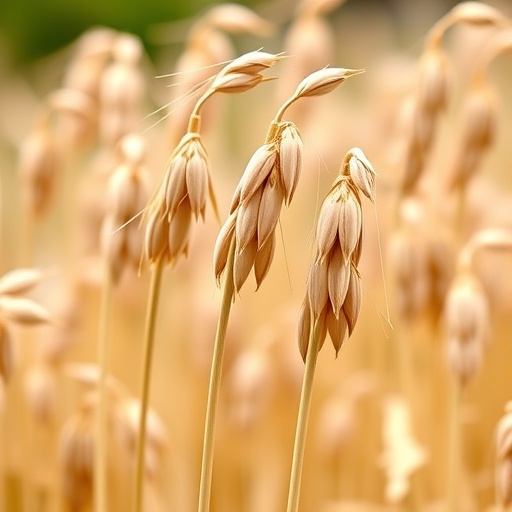
In a groundbreaking advancement in plant genomics, researchers have successfully constructed a comprehensive pangenome and pantranscriptome for hexaploid oats, revealing the immense genetic diversity and intricate gene expression profiles that underlie this vital crop. Oats, a staple grain with rich nutritional qualities, have long presented genomic challenges due to their complex hexaploid nature – harboring six sets of chromosomes derived from three distinct ancestral species. This complexity has historically impeded detailed genetic analyses and the breeding of improved oat varieties.
The newly developed pangenome encompasses the entire spectrum of genetic variation found across 33 different oat lines, including both cultivated strains and their wild relatives. By integrating this expansive dataset, researchers have created a high-resolution genetic map that captures not only the core genes shared by all oat varieties but also the accessory genes that vary between them. Such a map is crucial for understanding evolutionary adaptations, identifying traits linked to yield and stress resistance, and guiding future breeding strategies.
Complementing the pangenome, the team generated a pantranscriptome by analyzing gene expression across multiple tissues and developmental stages in 23 oat lines. Through state-of-the-art sequencing technologies, they profiled transcriptomes in six different tissues, revealing distinct patterns of gene activation. This atlas of gene expression provides unprecedented insight into the temporal and spatial dynamics of oat gene regulation, which is essential for decoding complex traits such as flowering time, seed development, and responses to environmental stress.
A key challenge addressed in this work is the identification of structural genomic variation. The oat genome exhibits numerous chromosomal rearrangements, including inversions, where sections of DNA are rotated, and translocations, involving subsequences that have moved to new positions. These structural variants can have profound effects on gene function and expression. By leveraging advanced sequencing methodologies, the team cataloged these variations, elucidating their impacts on agronomically important traits.
Among the most striking findings is the observation of gene loss in one of the three subgenomes, a phenomenon that was previously poorly understood. Despite the absence of certain gene copies, the hexaploid oat maintains productivity, suggesting functional redundancy where homologous genes in other subgenomes compensate for the losses. This redundancy highlights an evolutionary resilience that has allowed oats to adapt and thrive across diverse environments.
The implications of structural variations extend to critical developmental processes. For example, the research uncovered how rearrangements in genomic regions influence genes that regulate flowering time. Flowering time is a key agricultural trait that dictates adaptability to different climates and affects yield. Understanding the genetic control behind this trait provides actionable targets for breeding programs aiming to optimize oat cultivation under changing environmental conditions.
In addition to foundational biological insights, the oat pangenome project exemplifies how modern genomics can bridge basic research and applied agriculture. By constructing a detailed genomic framework, scientists can accelerate the breeding of oat varieties with enhanced yield, nutritional profiles, and resistance to biotic and abiotic stresses. This integrative approach paves the way for precision breeding that leverages natural genetic diversity rather than relying solely on traditional selection.
The team achieved these results by applying cutting-edge sequencing technologies tailored to the complexities of polyploid genomes. Complex assembly algorithms reconciled the immense volume of sequencing reads to accurately reconstruct chromosome-level sequences and expression profiles. Such technological sophistication was indispensable for untangling the interwoven subgenomes in hexaploid oats, setting a new standard in crop pangenomics.
This extensive dataset, encompassing both the static DNA sequence and the dynamic gene expression, sets a new benchmark for plant science. It provides a valuable resource for the international research community, serving as a reference for comparative studies in cereals and enriching our understanding of polyploid genome evolution and function.
The research, led by Dr. Raz Avni and Dr. Martin Mascher among others, culminates in a detailed genomic atlas that not only catalogs natural variation but also illuminates the functional landscape of oat genetics. Their work, coordinated under the PanOat consortium, exemplifies the synergy of international collaboration, bringing together expertise in genetics, bioinformatics, agriculture, and molecular biology.
Ultimately, this work underscores how pangenome and pantranscriptome analyses can unlock the genetic potential of complex crops, driving innovations that may contribute significantly to global food security. Oats, often overshadowed by other major cereals, now stand at the forefront of genomics research with a robust framework ready to support breeding tailored to future agricultural demands.
As the scientific community continues to harness the power of genomics, this research on hexaploid oats demonstrates the transformative impact of integrating structural genomics and transcriptomics. It opens avenues for deeper exploration into polyploid genetics, crop adaptation, and sustainable agriculture.
This study was published in the prestigious journal Nature on October 29, 2025, marking a milestone in plant genomics and crop improvement research. It sets a foundation for future studies aimed at unlocking the full biological potential of oats and other polyploid species, thus fueling advances in agricultural science for years to come.
Cite Scienmag News
Juliet Wilcox. (October 29, 2025). Global Research Team Unlocks the Complete Pangenome of Oats. Scienmag. https://scienmag.com/global-research-team-unlocks-the-complete-pangenome-of-oats/
Juliet Wilcox. "Global Research Team Unlocks the Complete Pangenome of Oats." Scienmag, 29 October 2025, https://scienmag.com/global-research-team-unlocks-the-complete-pangenome-of-oats/. Accessed 5 September 2026.
Juliet Wilcox. "Global Research Team Unlocks the Complete Pangenome of Oats." Scienmag. October 29, 2025. https://scienmag.com/global-research-team-unlocks-the-complete-pangenome-of-oats/


