


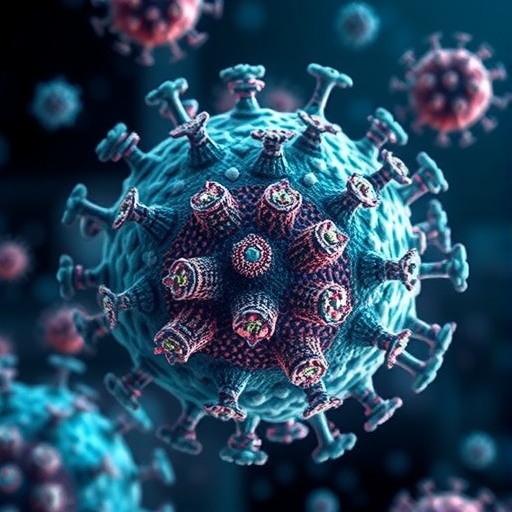
The vast expanse of the world’s oceans harbors an astonishing variety of viral life forms, many of which remain enigmatic despite their profound influence on marine ecosystems and global biogeochemical cycles. In a groundbreaking study published in npj Viruses, Minch and Moniruzzaman unveil a striking expansion in both the genomic and functional diversity of giant viruses that inhabit the world’s oceans. These viruses, remarkable not just for their size but for their complex genetic repertoires, challenge conventional paradigms about viral evolution, ecology, and their role in marine environments. By employing comprehensive metagenomic analyses, coupled with cutting-edge bioinformatic tools, the researchers have illuminated previously unexplored domains of viral biodiversity, opening new horizons for marine virology and microbial ecology.
Giant viruses, often dwarfing typical viral particles in size and genetic content, have emerged in recent decades as intriguing subjects that blur the lines between viruses and cellular life. Unlike the minimalist genomes of many viruses, these oceanic leviathans encode thousands of genes, some of which resemble those found in cellular organisms, suggesting complex evolutionary histories involving horizontal gene transfer and co-evolution with hosts. Minch and Moniruzzaman’s study significantly extends the known diversity of such giant viruses by analyzing expansive oceanic metagenomic datasets, sourced from numerous global expeditions encompassing a wide array of marine environments, from surface waters to the deep sea.
This research leverages state-of-the-art sequencing technology, which allows for the assembly of large viral genomes from fragmented environmental samples. Through meticulous genome reconstruction, the team identified an unprecedented number of new viral lineages, many displaying unique gene clusters previously unseen in viral genomes. These newly discovered genetic elements include those responsible for metabolic processes traditionally attributed only to cellular life, implying that these giant viruses could modulate host metabolic pathways during infection, a feature that has profound implications for understanding marine food webs and nutrient cycling.
One of the study’s most captivating revelations pertains to the functional repertoire encoded within these giant virus genomes. Beyond genes for structural proteins and replication machinery, many genomes encode an array of auxiliary metabolic genes (AMGs). These AMGs, involved in photosynthesis, nitrogen and sulfur metabolism, and host cellular signaling pathways, hint at a sophisticated viral strategy to manipulate host cellular environments, effectively reprogramming host metabolism to optimize viral replication. The presence of such genes underscores a subtle yet powerful ecological role of giant viruses as modulators of marine microbial communities and contributors to ecosystem dynamics.
Moreover, the distribution patterns of these giant viruses were found to be highly heterogeneous across global ocean basins. Variations in viral community composition appear to be influenced by factors such as temperature, salinity, nutrient availability, and host population dynamics. The study’s expansive geographic scope revealed viral assemblages adapted to distinct ecological niches, suggesting that these marine viruses have evolved specialized roles in diverse marine habitats ranging from nutrient-rich coastal waters to oligotrophic open ocean gyres.
Intriguingly, some viral genomes contained genes related to nucleotide and amino acid biosynthesis pathways, a remarkable finding that hints at viral autonomy and complexity. These genomes blur the distinction between viral and cellular metabolic capabilities, challenging the traditional view of viruses as strictly dependent on host metabolic machinery for replication. The functional consequences of such metabolic genes remain a tantalizing subject for future research, potentially reshaping our understanding of viral-host interactions in marine biogeochemistry.
In terms of evolutionary biology, the study sheds new light on the origins and diversification of giant viruses. Phylogenomic analyses suggest multiple independent evolutionary trajectories leading to the emergence of diverse giant virus lineages. This diversification likely reflects a mosaic pattern of gene acquisition from various microbial hosts, enabling these viruses to adapt to a wide range of environmental conditions and host species. Such evolutionary dynamics contribute to the ecological success and resilience of giant viruses in the competitive marine milieu.
The researchers also emphasize the potential implications of this expanded genomic and functional diversity for global ocean health and climate regulation. Giant viruses, through their influence on microbial host population dynamics and metabolic processes, may modulate carbon sequestration and nutrient turnover in ways that are only beginning to be appreciated. By forcing host cells to divert energy and resources towards viral production, these viruses can trigger significant shifts in microbial community structure, with cascading effects on ecosystem productivity and carbon cycling.
Furthermore, the discovery of novel viral genes and metabolic capabilities opens exciting avenues for biotechnological applications. Enzymes encoded by giant viruses may possess unique catalytic properties suitable for industrial and pharmaceutical purposes. Additionally, understanding viral manipulation of host metabolism offers new perspectives on harnessing viral components for synthetic biology and environmental biotechnology.
Technological advancements were critical to this research breakthrough. Minch and Moniruzzaman utilized deep metagenomic sequencing coupled with innovative genome assembly algorithms to reconstruct complex viral genomes from mixed environmental DNA. This approach overcame longstanding challenges in marine virology, where the lack of cultured representatives and limited genome references have hindered comprehensive studies. The integration of machine learning models for gene prediction and functional annotation further enhanced the identification of novel viral genes and their potential biological roles.
The study also addresses the implications for marine ecosystem monitoring and the prediction of biological responses to environmental change. Given the sensitivity of viral community composition to oceanographic variables, giant viruses could serve as bioindicators of marine ecosystem states and environmental disturbances. Assessing shifts in viral diversity and function may provide early warning signs of ecosystem stress or resilience in the face of climate change and anthropogenic impacts.
Importantly, this work underscores the interconnectedness of viruses and their microbial hosts as fundamental components of oceanic life. It challenges the classical view of marine microbes as independent entities by highlighting the intricate viral-host symbioses that drive ecological and evolutionary processes. Viruses emerge not merely as pathogens but as pivotal agents facilitating genetic exchange, metabolic innovation, and ecosystem regulation.
The authors advocate for expanded sampling efforts integrating different oceanic zones, seasons, and environmental conditions to further map the diversity and functional landscape of marine giant viruses. They also call for multidisciplinary collaborations that combine genomics, chemistry, microscopy, and ecological modeling to decode the complex interactions between viruses, hosts, and their environment.
In the context of future research, the elucidation of viral infection mechanisms and host-range specificity represents a critical frontier. Understanding how these giant viruses attach, invade, and alter host cells at molecular levels will illuminate the regulatory networks underlying marine microbial community structure. Such insights may also have implications for managing viral impacts on fisheries, aquaculture, and marine biodiversity conservation.
As a concluding reflection, the expansion of known genomic and functional diversity of global ocean giant viruses as documented by Minch and Moniruzzaman heralds a paradigm shift in marine virology. It opens a dynamic window into the hidden viral majority that shapes ocean life on scales from molecular to global. This study not only enriches our comprehension of marine virus ecology but also inspires a deeper appreciation of the ocean’s microbial tapestry and its integral role in sustaining Earth’s biosphere.
Cite Scienmag News
Juliet Wilcox. (June 1, 2025). Global Ocean Giant Viruses: Expanding Genomic Diversity. Scienmag. https://scienmag.com/global-ocean-giant-viruses-expanding-genomic-diversity/
Juliet Wilcox. "Global Ocean Giant Viruses: Expanding Genomic Diversity." Scienmag, 1 June 2025, https://scienmag.com/global-ocean-giant-viruses-expanding-genomic-diversity/. Accessed 3 September 2026.
Juliet Wilcox. "Global Ocean Giant Viruses: Expanding Genomic Diversity." Scienmag. June 1, 2025. https://scienmag.com/global-ocean-giant-viruses-expanding-genomic-diversity/


