


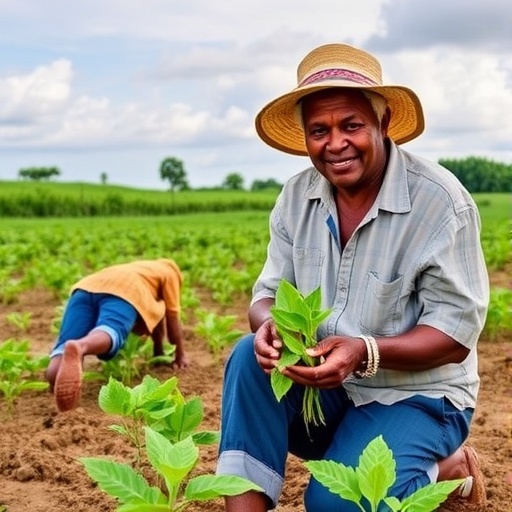
In the evolving discourse surrounding sustainable agriculture, the perspectives of smallholder farmers remain pivotal yet often underrepresented. A groundbreaking study by Batas, Flor, Khumairoh, and colleagues, recently published in npj Sustainable Agriculture, sheds vital light on how these farmers perceive agroecology—a framework that integrates ecological principles into farming practices, aiming not only for environmental sustainability but also for socioeconomic resilience. This research offers a profound exploration into the nuanced attitudes of small-scale farmers toward agroecological methods, providing invaluable insights that could reshape agricultural policies and grassroots initiatives across developing regions.
Smallholder farmers constitute the backbone of global food systems, especially in the Global South, where their labor and local knowledge sustain communities and biodiversity alike. Despite their critical role, there has been a persistent gap in understanding how these farmers interpret the principles and practices of agroecology. The study under discussion fills this gap by employing an empirical, multidimensional approach to capture the complexities of farmers’ perceptions. Their insights underscore that agroecology is not merely an academic or policy construct but a lived experience intersecting with culture, economy, and environmental stewardship.
The research methodology involved extensive field interviews, participatory observations, and surveys across several rural communities. Researchers engaged directly with smallholder farmers to articulate their understanding of agroecological principles such as crop diversification, soil health management, integrated pest control, and the reduction of synthetic inputs. These dimensions formed the core thematic areas through which farmers’ voices were systematically analyzed. The qualitative data helped reveal underlying motivations, apprehensions, and aspirations tied to the adoption or rejection of agroecological practices.
One of the pivotal revelations from the study is the divergence in how agroecology is conceptualized between scientific discourse and on-the-ground realities. Farmers frequently interpret agroecology not just as an environmental agenda but as a holistic system intertwined with social networks, tradition, and livelihood security. This holistic vision challenges the reductionist views often employed in agronomic research and points toward a need for more context-sensitive policies that acknowledge social fabric and local knowledge systems.
Crucially, the study highlights the role of knowledge exchange and extension services in shaping farmers’ perceptions. Access to training tailored to agroecological techniques was found to significantly enhance willingness to adopt sustainable practices. Conversely, inadequate or generic agricultural advisories often left farmers confused or skeptical. This finding emphasizes the necessity of co-creation between agricultural experts and farmers, ensuring that knowledge transfer is a bidirectional dialogue rather than a top-down imposition.
The study also delves into the economic calculus of smallholder farmers considering agroecology. While many express appreciation for the environmental benefits, concerns about short-term productivity and market viability persist. Agroecological methods sometimes require labor-intensive practices or adjustment periods before tangible gains materialize, posing risk factors for farmers with limited financial buffers. The research thus advocates for policy frameworks that include financial incentives, risk-sharing mechanisms, and access to markets that reward sustainable produce.
Environmental sustainability, as reported by the interviewed farmers, is deeply connected to their lived experiences of climate variability, soil degradation, and biodiversity loss. Agroecology, from their perspective, represents a strategy for resilience against these pressing challenges. Farmers often cited improvements in soil fertility, pest control through natural predators, and diversified cropping as concrete proofs of agroecology’s benefits. This empirical evidence supports broader ecological theories, reinforcing that agroecological systems can contribute to sustainable food production while restoring ecosystem health.
However, the study acknowledges the limitations and barriers faced by smallholders. Land tenure insecurity, lack of infrastructural support, and limited access to credit remain significant constraints that undermine the scalability of agroecological approaches. Moreover, socio-cultural factors, including gender dynamics and community leadership structures, influence how agroecological innovations diffuse through rural landscapes. Addressing these systemic challenges is imperative if agroecology is to fulfill its promises on a wide scale.
Importantly, the research underscores the heterogeneity among smallholder farmers—both in their ecological contexts and socioeconomic conditions. This diversity necessitates tailored agroecological solutions rather than one-size-fits-all prescriptions. Adaptive management and iterative feedback loops between farmers, scientists, and policymakers are critical to co-develop site-specific strategies that accommodate variability in climate, culture, and market access.
The role of indigenous knowledge and traditional farming practices emerges as a central theme throughout the study. Farmers’ narratives elucidate how agroecology resonates with long-held customs of crop rotation, intercropping, and natural resource stewardship. Recognizing and integrating these ancestral practices with contemporary scientific approaches can produce hybrid systems that respect cultural heritage while advancing sustainability goals.
Another compelling aspect explored is the social dimension of agroecology adoption. Community cohesion, collective labor arrangements, and local governance bodies often mediate the diffusion and success of agroecological initiatives. The study’s findings indicate that fostering strong social capital and participatory decision-making can amplify positive outcomes, facilitating the formation of resilient farming communities capable of navigating ecological and economic uncertainties.
Technological innovation is also part of the narrative. While agroecology emphasizes low-input farming, farmers showed interest in affordable, context-appropriate technologies that enhance productivity without compromising sustainability. Examples include mobile apps for weather forecasting, soil testing kits, and low-cost irrigation methods. The integration of such technologies within agroecological frameworks could stimulate broader adoption and improve livelihoods.
Furthermore, the authors discuss the policy implications of their findings, advocating for agricultural development models that prioritize smallholder inclusion. They stress that governments and international agencies should recognize the value of farmers’ experiential knowledge, co-creating policies that empower rather than marginalize small-scale producers. Such an inclusive approach aligns with global agendas like the Sustainable Development Goals and the UN Decade of Ecosystem Restoration.
The emotional and cultural attachments farmers hold toward their land also permeate the study’s insights. Agroecology is not simply an economic activity but part of an identity, connecting families to generations of stewardship. This intimate relationship fuels both motivation and resilience in the face of climate stresses and market uncertainties, underscoring that sustainable farming is as much a social endeavor as it is ecological.
In conclusion, this research offers a timely and comprehensive understanding of smallholder farmers’ perceptions of agroecology, revealing complex interplays between ecological knowledge, socio-economic realities, and cultural values. Such insights are crucial for designing meaningful interventions that support sustainable agriculture from the ground up. By centering farmers’ voices in the narrative, the study advances a more democratic and effective path toward a resilient food future, where agroecology serves as both a science and a social movement.
The implications extend well beyond academic circles, resonating with policymakers, NGOs, agritech developers, and climate activists alike. As the global community grapples with environmental degradation and food insecurity, embracing the lived realities and wisdom of smallholder farmers may prove to be one of the most potent catalysts for sustainable transformation. The study by Batas and colleagues thus represents a landmark contribution to the nexus of agriculture, ecology, and rural development—one that promises to inspire further research and action worldwide.
Batas, M.A.A., Flor, R.J., Khumairoh, U. et al. Understanding smallholder farmers’ perceptions of agroecology.
npj Sustain. Agric. 3, 13 (2025). https://doi.org/10.1038/s44264-025-00056-2
Cite Scienmag News
Alan Morgan. (June 1, 2025). Smallholder Farmers’ Views on Agroecology Revealed. Scienmag. https://scienmag.com/smallholder-farmers-views-on-agroecology-revealed/
Alan Morgan. "Smallholder Farmers’ Views on Agroecology Revealed." Scienmag, 1 June 2025, https://scienmag.com/smallholder-farmers-views-on-agroecology-revealed/. Accessed 4 September 2026.
Alan Morgan. "Smallholder Farmers’ Views on Agroecology Revealed." Scienmag. June 1, 2025. https://scienmag.com/smallholder-farmers-views-on-agroecology-revealed/


