


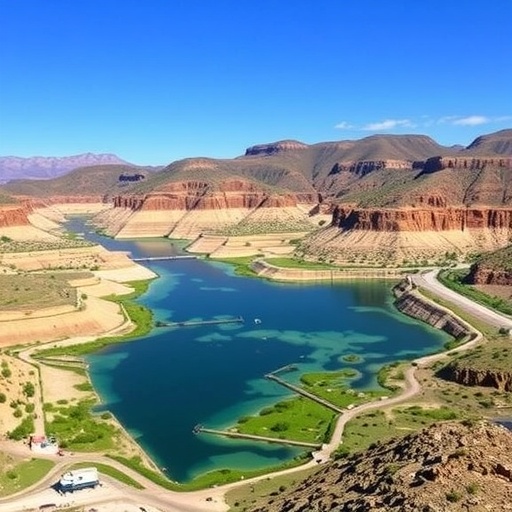
In a world increasingly reliant on irrigation reservoirs to sustain agricultural productivity, new research unveils a troubling vulnerability: global irrigation reservoirs are facing a significantly heightened risk of water shortages. This development underscores critical challenges to food security and water management strategies as climate variability intensifies and demographic pressures escalate across diverse regions.
Irrigation reservoirs serve as essential repositories of freshwater, enabling farmers to regulate water supply to crops, mitigate seasonal drought impacts, and stabilize yields. These engineered systems are crucial in buffering erratic precipitation patterns, which have become more frequent and severe under climate change scenarios. However, the delicate balance maintained by these infrastructure assets is now under threat by a confluence of climatic, hydrological, and anthropogenic factors.
Key insights from the groundbreaking study conducted by Shah, Mishra, and Gao reveal that widespread depletion of irrigation reservoirs is already occurring globally with alarming frequency. The researchers employed advanced hydrological modeling coupled with satellite-derived observations to quantify water storage dynamics in reservoirs pivotal to irrigation worldwide. Their findings indicate that reservoir refill rates are diminishing while evaporative losses and water withdrawals are escalating, creating a scenario where supply increasingly lags behind demand.
The crux of the problem stems from declining runoff inputs due to shifting precipitation regimes alongside escalating temperatures that accelerate evapotranspiration rates. Reservoirs traditionally replenished by snowmelt and steady rainfall are now subject to erratic hydrological cycles. Warmer conditions not only reduce the volume of water captured but also enhance losses via surface evaporation. This hydrometeorological transformation exacerbates the existing stresses imposed by expanding agricultural water use driven by burgeoning global food demands.
Moreover, the research highlights disparities in reservoir stress among different geographic regions. Areas already characterized by aridity—such as parts of South Asia, the American Southwest, and North Africa—demonstrate markedly higher susceptibility to sustained water shortages in their irrigation reservoirs. Conversely, some high-latitude zones benefit from increased precipitation, but these gains are insufficient to offset overall global vulnerability trends. This spatial heterogeneity complicates the global water management landscape, demanding regionally tailored adaptation approaches.
Compounding the climatic pressures are socio-economic factors such as inefficient water use practices, suboptimal reservoir management, and infrastructural degradation. Aging reservoir systems with limited capacity expansion struggle to accommodate increasing irrigation demands. Furthermore, inadequate policy frameworks constrain adaptive water governance, impairing coordinated responses to emergent scarcity scenarios.
The implications of continuing reservoir water deficits are profound and multifaceted. Agricultural productivity hinges critically on reliable irrigation supply; hence, reservoir shortages threaten crop yields, food availability, and farmer livelihoods. Given that irrigation accounts for approximately 70% of global freshwater withdrawals, sustained reservoir impairment may cascade into broader water security crises affecting urban populations and ecosystems.
From a technical perspective, the study’s integration of remote sensing data—such as satellite altimetry and gravimetric measurements—with hydrological simulation models offers a powerful methodology for real-time reservoir monitoring. This approach enables precise quantification of storage volumes and water fluxes, facilitating early warning systems to preempt acute shortages. Such innovations are integral to modernizing reservoir management and optimizing water allocation amidst growing uncertainties.
In confronting these risks, stakeholders must embrace multifaceted mitigation strategies. Enhancing reservoir inflow by restoring upstream watershed health can improve runoff retention. Technological interventions like lining canals and deploying advanced irrigation methods (e.g., drip or deficit irrigation) promise water use efficiency gains. Simultaneously, upgrading reservoir infrastructure to minimize seepage and evaporation losses is crucial.
Effective governance also requires strengthening institutional capacity to implement integrated water resource management frameworks. These frameworks should incorporate climate projections, socio-economic trends, and adaptive prioritization of water needs to balance agricultural, environmental, and domestic demands. Cross-border cooperation in transboundary basins further enhances resilience, given that many irrigation systems span multiple countries.
Crucially, the research stresses the necessity of climate adaptation policies that explicitly address irrigation reservoir sustainability. Without urgent action, reservoir depletion will undermine regional agricultural resilience, undermine food security, and amplify socio-economic disparities, particularly in vulnerable rural communities dependent on irrigated farming.
The study’s forward-looking projections cadence the urgency: under high emission scenarios, many irrigation reservoirs could experience more frequent and severe water deficits by the mid-21st century. This would precipitate cascade effects, including increased competition for scarce water resources, heightened risk of crop failure, and destabilization of agrarian economies. Consequently, proactive reservoir risk assessment and management emerge as priorities on the global environmental agenda.
In conclusion, this comprehensive research sheds critical light on an often-overlooked dimension of water security—the frailty of global irrigation reservoirs amidst intensifying climate and human pressures. By combining detailed hydrological analyses with satellite monitoring, the authors illuminate the pathways through which these vital water infrastructure assets may falter. The looming threat to irrigation reservoirs calls for concerted scientific, technical, and policy innovation to safeguard agricultural productivity and secure water resources for future generations.
As the nexus of climate change, water scarcity, and food security grows ever more complex, the findings underscore an imperative: maintaining the resilience of irrigation reservoirs is not merely an agricultural concern but foundational to global sustainability. Addressing this challenge demands immediate, coordinated, and sustained action spanning disciplines, sectors, and borders.
Shah, D., Mishra, V. & Gao, H. Global irrigation reservoirs are at a higher risk of water shortages. Commun Earth Environ (2026). https://doi.org/10.1038/s43247-026-03571-3
Cite Scienmag News
Violet Maxwell. (May 13, 2026). Global Irrigation Reservoirs Face Rising Water Shortages. Scienmag. https://scienmag.com/global-irrigation-reservoirs-face-rising-water-shortages/
Violet Maxwell. "Global Irrigation Reservoirs Face Rising Water Shortages." Scienmag, 13 May 2026, https://scienmag.com/global-irrigation-reservoirs-face-rising-water-shortages/. Accessed 3 September 2026.
Violet Maxwell. "Global Irrigation Reservoirs Face Rising Water Shortages." Scienmag. May 13, 2026. https://scienmag.com/global-irrigation-reservoirs-face-rising-water-shortages/


