


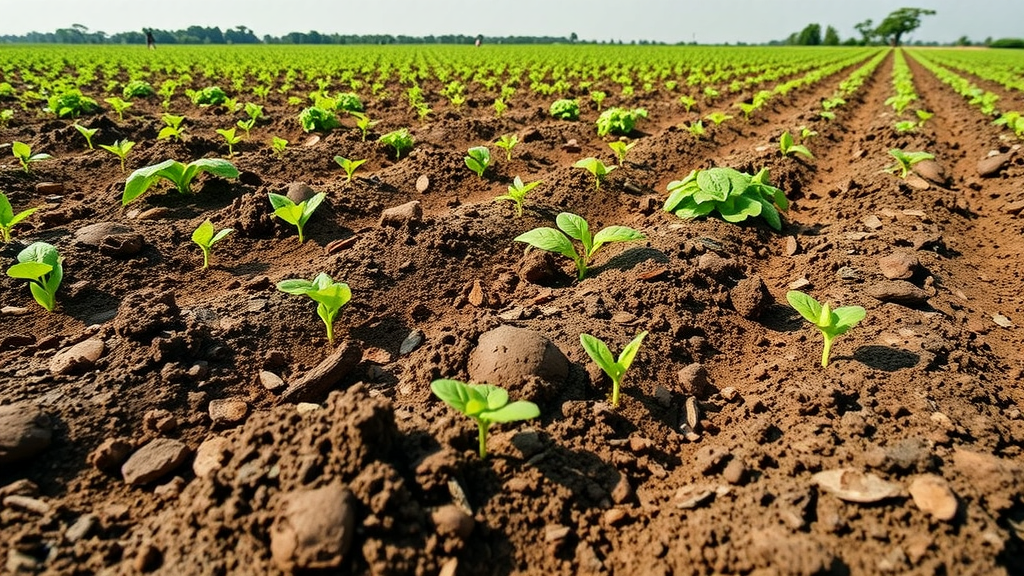
Beneath every harvested field lies an invisible workforce that determines whether agriculture thrives or declines. Soil microorganisms, bacteria and fungi packed into every handful of earth, store carbon in their living cells and drive the nutrient cycles on which crops depend. A new global synthesis published in Environmental Management suggests that the way farmers manage their land can substantially enlarge this microbial carbon reservoir, offering a surprisingly powerful lever for soil health and climate resilience at the same time.
The study, led by Demesew A. Mhiret of Bahir Dar University and Tottori University together with an international team of soil scientists, compiled data from 221 peer-reviewed studies spanning 1988 to 2024. The researchers evaluated six categories of sustainable land management practices in croplands worldwide: organic amendments such as manure and compost, inorganic fertilization, integrated fertilization combining organic and mineral inputs, conservation tillage, crop diversification, and crop residue management. Their goal was to quantify how each practice affects soil microbial biomass carbon, or SMBC, a widely used indicator of microbial activity and overall soil health.
The headline finding is striking. Across the compiled global database, treatment plots under sustainable management exhibited on average 23.5 percent higher SMBC concentration than control plots. Every practice category except inorganic fertilization was associated with higher microbial biomass carbon, and inorganic fertilization alone showed a slight negative effect. In other words, feeding soils with mineral fertilizer alone does not nourish the microbial community, while practices that add organic matter, diversify crops, or disturb the soil less tend to build microbial populations and the carbon they hold.
SMBC matters because it functions as the living engine of the soil. Microbial biomass represents a small but dynamic fraction of total soil organic carbon, yet it controls decomposition, nutrient mineralization, and the formation of stable soil aggregates. When microbial biomass declines, soils lose fertility, structure, and resilience to drought. Because microbial cells turn over relatively quickly, SMBC responds to management changes faster than bulk soil organic carbon, making it a sensitive early-warning indicator for land degradation or recovery.
The synthesis also revealed that environmental context strongly modulates these effects. The degree of SMBC response varied primarily with aridity and soil texture. Subgroup analyses confirmed that soil texture, aridity, and management practices each significantly affected microbial biomass carbon. However, the researchers observed notable combined effects on SMBC only when two environmental factors changed at the same time. This suggests that while sustainable land management can buffer the harms of single stressors, the simultaneous action of multiple stressors, for instance high aridity combined with unfavorable texture, can substantially alter microbial carbon dynamics in ways that are harder to predict.
Two practices stood out for their consistency. Integrated fertilization, which blends organic inputs with mineral fertilizers, and crop diversification proved particularly effective across all aridity classes, from humid to dry regions. This is a meaningful result for dryland agriculture, where water scarcity and organic matter depletion often undermine soil biology. Prior research has shown that increasing aridity reduces soil microbial diversity and abundance globally, so finding management strategies that lift microbial biomass even in drier climates carries considerable practical weight for the world’s semi-arid farming regions.
Scaling the results from plots to the planet, the team used a compiled dataset and an extrapolation approach to estimate that adopting sustainable land management practices could be associated with roughly a 27 percent increase in global SMBC stocks. That corresponds to approximately 322 million tonnes of microbial carbon across the world’s croplands. The authors are careful to caution that this estimate should be interpreted with restraint, because data coverage is spatially heterogeneous and the extrapolation relies on generalized assumptions about bulk density and soil depth that introduce uncertainty. Even so, the order of magnitude underscores how much living carbon is at stake in everyday farm decisions.
The implications extend beyond soil biology into climate policy. Soil microbial biomass is intimately linked to the stabilization of soil organic matter, and agricultural soils represent one of the few carbon pools that land managers can deliberately influence within a human timescale. Practices that enlarge the microbial carbon pool tend also to enhance carbon sequestration, reduce erosion, and improve water retention. International initiatives on soil health, including efforts by the Food and Agriculture Organization and the European Commission’s soil mission, have emphasized the need for measurable indicators of soil biological quality, and SMBC fits that role well.
For farmers and policymakers, the central message is that one-size-fits-all prescriptions will not work. The authors highlight the importance of developing context-specific sustainable land management strategies tailored to local aridity, soil texture, and cropping systems. In practice, that could mean prioritizing manure or compost applications where organic resources are available, combining them with judicious mineral fertilization rather than relying on either input alone, diversifying rotations, retaining crop residues on the field, and minimizing tillage. Such integrated approaches appear to deliver the largest gains in microbial carbon across the widest range of environments.
The study also exposes gaps that future research must fill. Data coverage remains uneven across regions, particularly in parts of Africa, South America, and Central Asia where cropland degradation pressures are acute. Long-term experiments tracking SMBC under combined practices are scarce, and the interactions between multiple environmental stressors deserve closer study. Nevertheless, by synthesizing more than three decades of field measurements into a coherent global picture, the work provides land managers, policymakers, and farmers with evidence that rebuilding the living fraction of soil carbon is achievable, measurable, and central to creating more resilient and sustainable agricultural systems worldwide.
Subject of Research: Effects of sustainable land management practices on soil microbial biomass carbon in global croplands
Article Title: Sustainable Land Management Practices Enhance Soil Microbial Biomass Carbon in Global Croplands
Article References: Mhiret, D. A., Tsunekawa, A., Haregeweyn, N., Fenta, A. A., Sultan, D., Abe, T., Kassa, S. B., Hailu, Y. B., Endalamaw, B., Abebe, G., & Meshesha, T. M. (2026). Sustainable Land Management Practices Enhance Soil Microbial Biomass Carbon in Global Croplands. Environmental Management, 76(10), Article 329. https://doi.org/10.1007/s00267-026-02631-w
Image Credits: AI Generated
DOI: 10.1007/s00267-026-02631-w
Keywords: soil microbial biomass carbon, sustainable land management, croplands, soil health, meta-analysis, aridity, soil texture, integrated fertilization, crop diversification, organic amendments, carbon sequestration, drylands
Cite Scienmag News
Morgan Morrow. (September 25, 2026). Global Farming Overhaul Boosts Microbial Carbon in World’s Cropland Soils. Scienmag. https://scienmag.com/global-farming-overhaul-boosts-microbial-carbon-in-worlds-cropland-soils/
Morgan Morrow. "Global Farming Overhaul Boosts Microbial Carbon in World’s Cropland Soils." Scienmag, 25 September 2026, https://scienmag.com/global-farming-overhaul-boosts-microbial-carbon-in-worlds-cropland-soils/. Accessed 4 October 2026.
Morgan Morrow. "Global Farming Overhaul Boosts Microbial Carbon in World’s Cropland Soils." Scienmag. September 25, 2026. https://scienmag.com/global-farming-overhaul-boosts-microbial-carbon-in-worlds-cropland-soils/


