


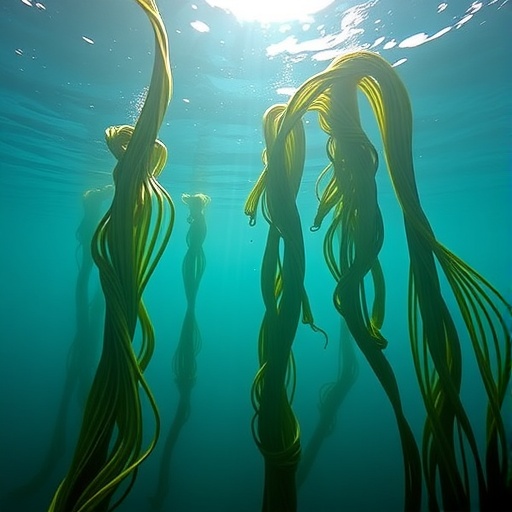
A landmark international consortium of marine scientists and conservationists has issued a clarion call for a substantial US $14 billion investment aimed at halting the decline and fostering the restoration of one of Earth’s most invaluable and yet underappreciated marine ecosystems: kelp forests. This unprecedented financial target emerges from rigorous research conducted by UNSW scholars in collaboration with the Kelp Forest Alliance, culminating in a milestone publication that systematically quantifies the economic imperatives underpinning global kelp conservation.
Kelp forests, sprawling across nearly one-third of the world’s temperate coastal waters, represent vibrant underwater habitats that perform critical ecological functions. They act as natural carbon sinks, sequestering substantial amounts of CO2 and thereby mitigating climate change, while simultaneously providing sanctuary and sustenance for diverse marine species integral to commercial and subsistence fisheries. The aggregated ecosystem services rendered by these forests are valued at an astonishing US $500 billion per annum, underscoring their vital role in sustaining biodiversity and coastal economies alike.
Despite their immense importance, kelp forests have suffered devastating losses, with estimates indicating a staggering 60% decline in global coverage over the last fifty years. Key drivers of this deterioration include ocean warming attributable to anthropogenic climate change, pollution from terrestrial runoff, and biological stressors such as unchecked sea urchin predation that disrupt normal kelp regeneration cycles. This rapid attrition not only diminishes habitat complexity but also jeopardizes the resilience of coastal marine ecosystems.
The proposed $14 billion conservation and restoration funding target derives from a comprehensive synthesis of expert stakeholder workshops, extensive marine conservation cost analyses, and comparative assessments with parallel global initiatives targeting mangrove and coral reef ecosystems. Positioned as a balanced visionary ambition, this financial benchmark is calibrated to be both bold in scope and pragmatically attainable, thereby fostering alignment with global climate action frameworks such as the United Nations’ Ocean Breakthrough Initiative championed by the UN Climate Champion.
Dr. Aaron Eger, the study’s lead author, emphasizes the necessity of establishing a tangible, well-defined funding goal to galvanize coordinated action and facilitate transparent progress tracking. He asserts, “Kelp forests remain enigmatic to many policymakers and financiers despite their intrinsic value. In Australia, an illustrative case, governmental investment in kelp conservation lags dramatically behind coral reef financing by a factor of up to 100, notwithstanding the proximity of two-thirds of the population to these crucial habitats.”
Such financial discrepancies highlight a systemic undervaluation of kelp ecosystems within conservation funding portfolios, impeding the scale and effectiveness of restoration efforts necessary to reverse ecological decline. The articulated $14 billion target serves as a rallying point for governments, philanthropic sectors, and the wider public to collaboratively invest in protecting these foundational marine landscapes.
Successful realization of this ambitious funding would facilitate expansive conservation interventions protecting three million hectares of kelp forests globally and restoring an additional one million hectares by 2040. These gains would safeguard biodiversity hotspots, reinforce natural coastal buffers against erosion and extreme weather events, and sustain livelihoods dependent on healthy fisheries from Tasmania through Norway to the Pacific coast of California.
Methodologically, the research integrates advanced content analysis techniques to decode marine conservation finance trends, encompassing economic valuation studies focused on animal species reliant on kelp habitats. Furthermore, it leverages interdisciplinary collaboration spanning ecology, marine biology, environmental economics, and climate science to formulate a robust and actionable funding paradigm.
Kelp forests perform not merely as isolated ecosystems but as integral components of blue carbon strategies, demonstrating significant potential for climate mitigation. Their canopies attenuate wave energy and stabilize sediments, thus serving as bioengineered natural defenses that enhance coastal resilience in regions vulnerable to sea-level rise and intensified storm surges.
However, the complexity of kelp ecosystems entails multifaceted challenges in conservation interventions. Factors such as shifting oceanographic conditions, species interactions, and pollution necessitate adaptive management strategies underpinned by ongoing scientific monitoring and community engagement. Increased funding will enable scaling of restoration techniques including sea urchin population control, outplanting of resilient kelp species, and pollution mitigation efforts.
The urgency underscored by this initiative reflects broader concerns over marine ecosystem declines worldwide. The Kelp Forest Challenge envisions transformative cooperation and innovative financing mechanisms that transcend traditional conservation boundaries, integrating social, economic, and environmental objectives to achieve durable restoration outcomes.
In sum, this $14 billion investment proposal represents a critical and overdue step toward recognizing and remedying the invisibility of kelp forests within global conservation priorities. Its implementation promises not only to arrest ongoing losses but to revitalize marine ecosystems that underpin biodiversity, climate stability, and human well-being across diverse coastal regions.
News Publication Date: 26-Oct-2025
Web References:
https://www.sciencedirect.com/science/article/pii/S000632072500610X
https://kelpforestalliance.com/kelp-forest-challenge
References:
DOI: 10.1016/j.biocon.2025.111573
Cite Scienmag News
Violet Maxwell. (October 29, 2025). Global Campaign Launches $14 Billion Initiative to Save Kelp Forests. Scienmag. https://scienmag.com/global-campaign-launches-14-billion-initiative-to-save-kelp-forests/
Violet Maxwell. "Global Campaign Launches $14 Billion Initiative to Save Kelp Forests." Scienmag, 29 October 2025, https://scienmag.com/global-campaign-launches-14-billion-initiative-to-save-kelp-forests/. Accessed 5 September 2026.
Violet Maxwell. "Global Campaign Launches $14 Billion Initiative to Save Kelp Forests." Scienmag. October 29, 2025. https://scienmag.com/global-campaign-launches-14-billion-initiative-to-save-kelp-forests/


