


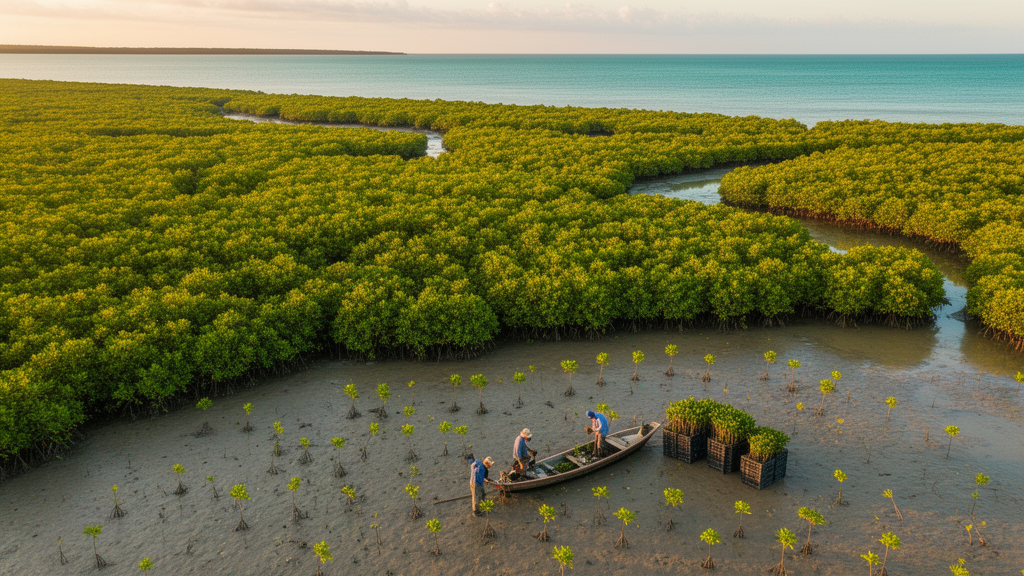
Mangrove forests cover only about 147,000 square kilometers worldwide, an area roughly the size of Bangladesh, yet they anchor coastal food webs, store vast quantities of carbon and shield millions of people from storms.
The three goals are deliberately blunt. By 2030, the alliance seeks to reduce mangrove losses driven by direct human actions to zero; to restore mangroves over at least half of all recently lost, restorable area; and to secure long-term protection for mangroves, doubling coverage where feasible, with a minimum of 30 percent in every country. Using global-scale datasets, the authors estimate that achieving these goals would avoid the loss of some 1,500 square kilometers of mangrove, restore roughly 4,000 square kilometers, and bring an additional 36,000 square kilometers under effective and equitable protection, raising the total protected share to about 97,000 square kilometers, or two-thirds of global mangrove cover.
The argument for urgency rests on the ecosystem’s outsized value. Mangroves straddle land, sea and freshwater, supporting high productivity and biodiversity, sequestering carbon in waterlogged soils, attenuating waves and storm surge, binding sediments, and nurserying commercially important fish and invertebrates. One study cited in the paper estimates that mangroves support the annual recruitment of nearly 735 billion individual commercially important young-of-year fish and invertebrates worldwide, and that an estimated 4.1 million small-scale fishers rely on mangrove-associated fisheries. Another estimate attributes flood risk reduction benefits to 15 million people and more than US$65 billion worth of property. Mangroves also supply timber, fuelwood, honey, medicines and a range of cultural values to local communities.
Halting loss is the first goal, and the data suggest it is within reach in principle. Annual gross mangrove loss averaged approximately 548 square kilometers between 2010 and 2020 according to the Global Mangrove Watch time series, with direct human actions, chiefly conversion to agriculture, aquaculture and urban development, accounting for an estimated 56 to 68 percent of losses in the 2010s. But the challenge is unevenly distributed: human-driven losses account for just 5 percent of gross losses in the Pacific Islands and 18 percent in Australia and New Zealand, yet exceed 80 percent in East and South-East Asia. Indonesia, Myanmar, Mexico and Malaysia together made up half of the global anthropogenic total over the decade, while countries including Saudi Arabia, Sri Lanka, China and Ghana each recorded average gross loss rates above 1 percent per year against a global average of 0.04 percent.
The authors stress that natural dynamics complicate any simple accounting. Mangroves are dynamic ecosystems, and substantial gains and losses arise from inundation, erosion and sedimentation, further influenced by sea-level rise, storms, groundwater extraction and altered river flows. These natural gains and losses are not factored into the goals, and apportioning anthropogenic responsibility for observed change remains difficult. The paper also notes that mangroves hold what researchers have called irrecoverable carbon, stocks that may not return even after effective restoration, making any avoided loss particularly valuable for emissions reductions.
The restoration goal is calibrated against a careful estimate of what is actually possible. Remote sensing shows total mangrove losses of more than 11,325 square kilometers since 1996, but not all of that area can be brought back: some former mangrove zones have become permanent open water through erosion, subsidence or dredging, and others now host roads, ports and buildings whose land value precludes restoration. After excluding such areas, an estimated 7,939 square kilometers of former mangrove remain biophysically restorable, and restoring half of that, roughly 4,000 square kilometers by 2030, is what the alliance proposes. Indonesia stands out with a restoration potential exceeding 1,000 square kilometers, three times more than any other country, while the Middle East target of 61.4 square kilometers, though modest in absolute terms, represents 16 percent of the region’s 2020 mangrove area.
The paper is candid about why restoration so often fails. Hastily conceived, poorly planned projects frequently have low success, and mass planting of one or two species in the wrong locations has been a recurring failure mode. The authors argue that headline spatial goals must be paired with site-scale information on topography, ecology and hydrological connectivity, together with cultural, legal and economic understanding, including land tenure, local livelihoods and the original drivers of loss. Restoration must be effective, stable over the long term, equitable and ecologically positive, and area metrics alone do not signify ecological quality.
On protection, the picture has improved markedly: some 40 percent of the 2020 mangrove extent lies within protected areas or other effective area-based conservation measures, up from 25 percent in 2010. Yet legal designation does not guarantee effectiveness, and mangrove losses continue inside protected boundaries, albeit at slower rates than outside. The proposed targets are tiered: countries below 15 percent protection should reach at least 30 percent; countries between 15 and 45 percent should double their coverage; and countries already above 45 percent should aim for 90 percent. Beyond formal protected areas, the authors point to other effective conservation measures, national restrictions on cutting or clearing mangroves present in 75 countries and territories covering over 80 percent of the world’s mangroves, and tools such as the Management Effectiveness Tracker Tool and the Site-level Assessment of Governance and Equity for measuring whether protection is genuinely effective and equitable.
The carbon arithmetic of success is substantial, though the authors are careful to distinguish secured from restored stocks. Avoiding the loss of 1,534 square kilometers by 2030 would secure over 27.4 megatonnes of carbon, within a range of 9.6 to 53.2 megatonnes, from soil and biomass that might otherwise be lost. Restoring 3,970 square kilometers would secure some 71.3 megatonnes of remaining carbon and, over time, lead to additional sequestration of 23.2 megatonnes, within 14.8 to 32.3 megatonnes, in biomass and soil, with estimates assuming restored forests do not reach full carbon equivalence with natural stands even after 40 years. Improved protection covering an additional 61,000 square kilometers would further secure an estimated 1,196.1 megatonnes of biomass and soil carbon, within a wide range of 354.2 to 2,370.0 megatonnes, a figure reflecting stocks secured rather than avoided losses, though avoided degradation under protection would reduce carbon losses.
The authors acknowledge significant uncertainties: the future trajectory of human-driven loss, the long-term effectiveness of restoration, limited data on mangrove condition and degradation, and the difficulty of tracking restoration success, which can take years to ascertain. They also flag emerging threats such as coastal squeeze, where barriers constrain wetland migration in response to sea-level rise. The Mangrove Breakthrough Financial Roadmap estimates that US$4 billion of investment is needed to reach the 2030 goals, requiring novel financing including green bonds, carbon markets, debt conversions and parametric insurance. Since the goals were set, the UNFCCC’s High-Level Climate Champions have adopted them as part of a Mangrove Breakthrough, and similar ecosystem-centric approaches are being considered for coral reefs, seagrass beds and saltmarshes. Success, the authors conclude, will depend on engagement by national governments and bottom-up support from civil society, with leadership from local communities paramount to achieving lasting outcomes.
Subject of Research: Global goals for mangrove conservation, restoration and protection by 2030
Article Title: Ambitious goals for global mangrove conservation and restoration
Article References: Spalding, M. D., Canty, S. W. J., Brown, C. J., Achete, F., Agblonon, G., Mohammed, K. H. A., Mohamed, S. A., Alzahlawi, N., Arifanti, V. B., Ashtamoorthy, S. K., Astra, A. S., Austin, W. E. N., Bandeira, S. O., Bayley, D. T. I., Beeston, M. A., Beguin Billecocq, I., Benbow, S. L. P., Beneby, J. N., Bera, N., … Worthington, T. A. (2026). Ambitious goals for global mangrove conservation and restoration. Ambio. https://doi.org/10.1007/s13280-026-02481-0
Image Credits: AI Generated
DOI: 10.1007/s13280-026-02481-0
Keywords: mangroves, Global Mangrove Alliance, restoration, conservation, carbon storage, biodiversity, coastal protection, fisheries, Kunming-Montreal Global Biodiversity Framework, Global Mangrove Watch, protected areas, climate change
Cite Scienmag News
Margaret Porter. (October 27, 2026). Global alliance sets 2030 goals to halt mangrove loss, restore 4,000 square kilometers. Scienmag. https://scienmag.com/global-alliance-sets-2030-goals-to-halt-mangrove-loss-restore-4000-square-kilometers/
Margaret Porter. "Global alliance sets 2030 goals to halt mangrove loss, restore 4,000 square kilometers." Scienmag, 27 October 2026, https://scienmag.com/global-alliance-sets-2030-goals-to-halt-mangrove-loss-restore-4000-square-kilometers/. Accessed 27 October 2026.
Margaret Porter. "Global alliance sets 2030 goals to halt mangrove loss, restore 4,000 square kilometers." Scienmag. October 27, 2026. https://scienmag.com/global-alliance-sets-2030-goals-to-halt-mangrove-loss-restore-4000-square-kilometers/


