


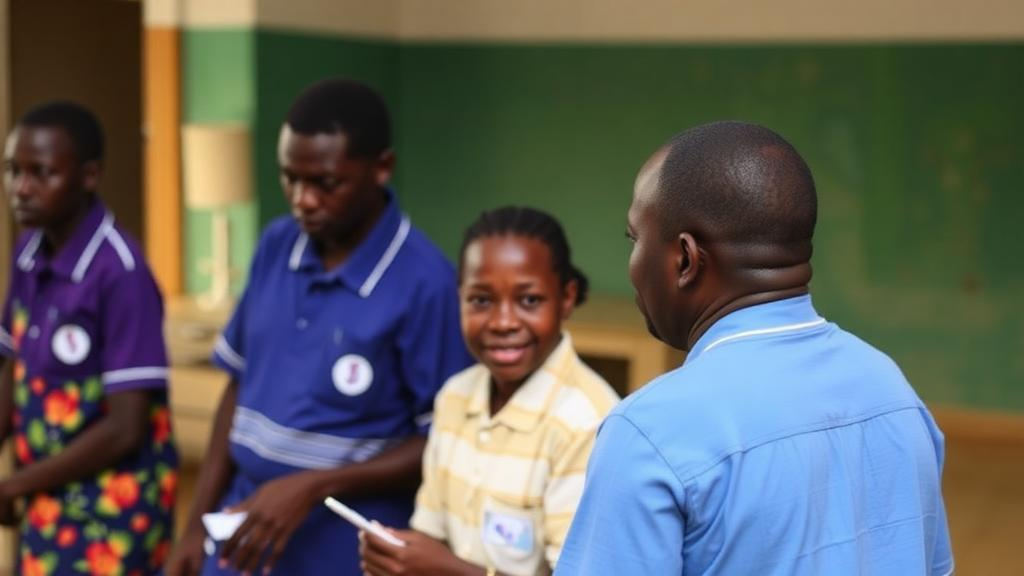
In the rural communities of northern Ghana, groups of health professions students have for years been sent out of the lecture hall and into villages, tasked with learning directly from the people they will one day serve. A new study from the University for Development Studies (UDS) suggests that these long-running community placements, designed primarily to teach students about community life and health determinants, may be sitting on an untapped potential: they could become a powerful platform for interprofessional education, the deliberate practice of learning with, from, and about other health professions. The research, published in BMC Medical Education, offers one of the first detailed accounts of how students and faculty in a sub-Saharan African context experience established community-based programmes through the lens of interprofessional learning.
Interprofessional education, commonly abbreviated as IPE, has become a global priority in health professions training. The logic is straightforward: most avoidable harm in healthcare systems traces back to failures of communication and coordination among professionals who were trained in silos and never learned to work as a team. When doctors, nurses, midwives, pharmacists, and nutritionists learn together during their formative years, the argument goes, they carry collaborative habits into clinical practice. Yet implementing IPE is notoriously difficult. Timetables across professional schools rarely align, faculty may lack training in facilitating interprofessional groups, and professional cultures steeped in hierarchy can undermine even well-designed shared learning activities. In many low- and middle-income countries, these structural obstacles are compounded by resource constraints, making creative use of existing educational infrastructure especially attractive.
The UDS study focused on two distinctive programmes. The Third Trimester Field Practical Programme (TTFPP) is an unusual curricular feature in which students across the university spend a trimester living in and studying assigned communities, conducting longitudinal fieldwork on social, economic, and health conditions. The Community-Based Education and Service (COBES) programme similarly immerses health professions students in community settings for structured learning and service. Both programmes have operated for years and are deeply embedded in the university’s identity. What the researchers wanted to know was whether these established structures, already bringing students into authentic community contexts, could be harnessed deliberately for interprofessional education, or whether the interprofessional contact they generate is too incidental to build on.
To answer that question, the team conducted a qualitative descriptive study grounded in an interpretivist paradigm, an approach that treats participants’ accounts not as objective measurements but as meaningful constructions of their lived experience. They recruited a purposive quota sample of 30 participants: 20 final-year health professions students and 10 faculty members, drawn from five professions, namely medicine, nursing, midwifery, nutrition, and pharmacy, all of whom had direct experience of either TTFPP or COBES. Data collection relied on in-depth, semi-structured interviews conducted by the first author, audio-recorded and transcribed verbatim. The researchers then applied team-based codebook thematic analysis, a rigorous method in which multiple analysts independently code the data against a shared framework, reconciling differences to strengthen reliability, with the support of NVivo qualitative analysis software. Reporting followed the COREQ guideline, an international standard for transparency in qualitative research, and the study received ethical clearance from the university’s Institutional Review Board.
The findings paint a picture of genuine promise undermined by a lack of intentionality. Participants across all five professions described interprofessional education in broadly consistent terms, associating it with teamwork, collaboration, and improved communication in healthcare delivery. They also regarded community-based education as a valuable forum in which such learning could plausibly occur, precisely because it places students from different professions in shared, authentic situations where a community’s problems do not respect professional boundaries. A village health challenge, in other words, naturally demands the complementary perspectives of a nurse, a nutritionist, and a physician in training. Participants believed that the community setting strips away some of the artificiality of classroom-based interprofessional exercises and replaces it with experiential learning that feels consequential.
Yet the study’s central and most striking finding is that the interprofessional contact occurring within these programmes is largely unplanned and informal rather than deliberately structured. Students from different professions may find themselves in the same community, sharing transport, accommodation, or informal conversations, and they may learn something about one another’s roles along the way. But no formal mechanism requires them to work together on shared tasks, reflect jointly on community findings, or negotiate professional roles in collaborative service delivery. The interprofessional learning that happens is, in effect, a by-product, serendipitous and uneven, dependent on chance rather than curriculum design. This distinction matters enormously for educational outcomes, because decades of IPE research indicate that informal exposure alone rarely dismantles stereotypes or builds the role-clarity that effective collaboration requires.
The thematic analysis surfaced five overarching themes from the interviews: participants’ understanding and valuation of IPE; their understanding and valuation of CBE; their belief that CBE could serve as a platform for IPE; the barriers that currently impede such use; and the strategies and opportunities for improvement. The barrier theme was particularly rich, encompassing communication difficulties among students and staff, organisational and resource constraints, inadequate supervision, professional hierarchy, and a fundamental lack of planning and scheduling for interprofessional activities. Each of these barriers is well recognised in the international IPE literature, but their convergence in the Ghanaian community setting illustrates how a promising platform can remain dormant when the surrounding institutional machinery is not aligned behind it.
Professional hierarchy deserves particular attention, because it is the barrier most resistant to logistical fixes. In many health systems, including Ghana’s, status differences between medicine and other professions are deeply culturally embedded, and students absorb these attitudes long before they qualify. When interprofessional activities lack explicit facilitation, hierarchical norms tend to reassert themselves, with medical students assuming leadership and other professions deferring regardless of the task at hand. The participants’ accounts suggest that without deliberate structuring, community placements may inadvertently reproduce the very siloed and stratified behaviours that interprofessional education is meant to dissolve. Conversely, a well-facilitated community task in which each profession’s contribution is indispensable could be a uniquely effective equaliser, since in a village setting no single professional toolkit is sufficient.
The improvement strategies identified by participants map closely onto what implementation science would predict. Realising the interprofessional potential of CBE, the study concludes, is likely to require intentional curricular integration, institutional support, structured supervision, and formalised interprofessional activities. In practical terms, that means designing shared community assignments that require genuine collaboration, training and deploying supervisors who can facilitate interprofessional groups, aligning the schedules and logistics of the five professional programmes, and securing institutional commitment so that interprofessional outcomes are assessed rather than left to chance. None of these requirements demands new physical infrastructure; they demand coordination, planning, and a willingness to treat the existing community programmes as educational platforms rather than standalone traditions.
The significance of the study extends well beyond one university in Tamale. Health professions schools across sub-Saharan Africa and other resource-constrained settings operate community-based programmes of various kinds, and many face the same dilemma: they cannot easily afford dedicated interprofessional education infrastructure, yet they already possess community placements that generate informal interprofessional contact. The UDS findings offer a template for interrogating those placements systematically, asking students and faculty what actually happens in the field and what would need to change for collaboration to become the rule rather than the accident. As health systems worldwide confront workforce shortages and the rising burden of chronic disease, the case for training collaborative practitioners has never been stronger, and this Ghanaian study suggests that the raw material for such training may already exist in the villages where students go to learn, waiting only to be organised with intention.
Subject of Research: Student and faculty perceptions of community-based education as a platform for interprofessional education in Ghana
Article Title: Student and faculty perspectives on community-based education as a potential platform for interprofessional education in Ghana
Article References: Assibi, M. A., Abugri, B. A., Gaa, P. K., Ziblim, S.-D., Amalba, A., & Mogre, V. (2026). Student and faculty perspectives on community-based education as a potential platform for interprofessional education in Ghana. BMC Medical Education. https://doi.org/10.1186/s12909-026-10495-1
Image Credits: AI Generated
DOI: 10.1186/s12909-026-10495-1
Keywords: interprofessional education, community-based education, health professions education, Ghana, qualitative research, collaborative learning, experiential learning, University for Development Studies, medical education, teamwork, professional hierarchy, curriculum design
Cite Scienmag News
Phoebe Ingram. (September 30, 2026). Ghana’s Community Health Training Grounds Could Become a Launchpad for Team-Based Care. Scienmag. https://scienmag.com/ghanas-community-health-training-grounds-could-become-a-launchpad-for-team-based-care/
Phoebe Ingram. "Ghana’s Community Health Training Grounds Could Become a Launchpad for Team-Based Care." Scienmag, 30 September 2026, https://scienmag.com/ghanas-community-health-training-grounds-could-become-a-launchpad-for-team-based-care/. Accessed 4 October 2026.
Phoebe Ingram. "Ghana’s Community Health Training Grounds Could Become a Launchpad for Team-Based Care." Scienmag. September 30, 2026. https://scienmag.com/ghanas-community-health-training-grounds-could-become-a-launchpad-for-team-based-care/


