


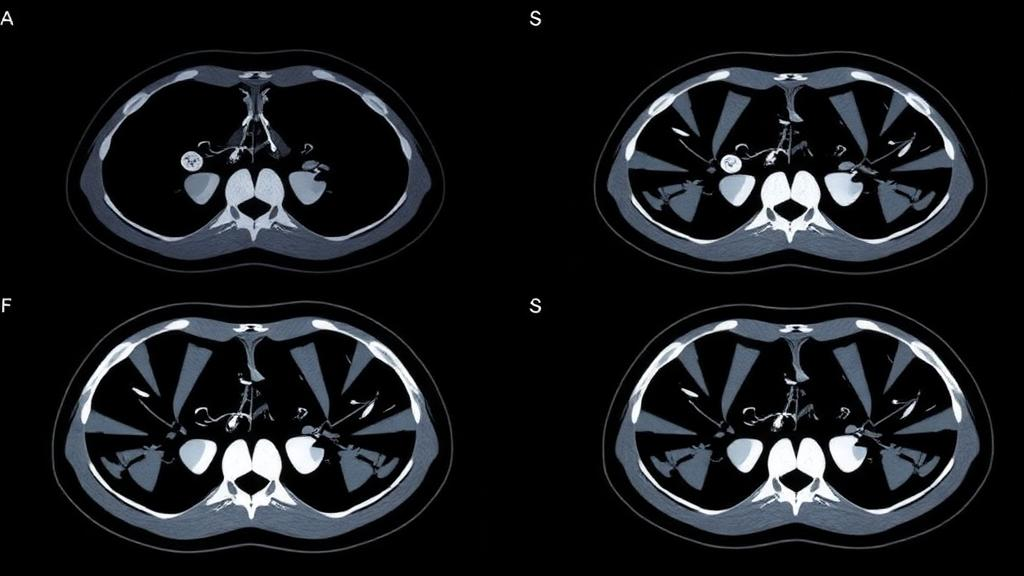
Computed tomography is one of medicine’s great computational triumphs: an X-ray machine circles the patient, detectors record thousands of shadow-like projections, and a reconstruction algorithm converts those raw measurements into cross-sectional images of the body. For decades, that conversion has relied on well-understood mathematics, from filtered back-projection to iterative model-based methods. Now a team of researchers in Lübeck, Germany, has demonstrated a strikingly different approach — a deep learning framework that learns to reconstruct CT images from measurement data alone, without ever being shown a single ground-truth image during training. The work, published in BMC Medical Imaging by Laura Hellwege, Johann Christopher Engster, Moritz Schaar, Thorsten M. Buzug and Maik Stille of the Fraunhofer Research Institution for Individualized Medical Technology and Engineering and the Institute of Medical Engineering at the University of Lübeck, could reshape how reconstruction software is built for imaging systems where reference images are scarce, expensive, or simply impossible to obtain.
The problem the researchers set out to solve belongs to a broad class known in mathematics as inverse problems. In a CT scan, the forward problem is straightforward to describe: X-rays pass through tissue, and each ray is attenuated according to the material it crosses, producing a set of line integrals through the body. The inverse problem — recovering the attenuation map from those integrals — is far harder, especially when measurements are noisy, incomplete, or acquired with a limited geometry. Classical methods solve it by exploiting a known physical model of the scanner. Supervised neural networks solve it differently: they learn the mapping from measurements to images by training on thousands of matched pairs of raw data and reference images. But in many real-world scenarios, from novel scanner prototypes to rare imaging geometries, those paired ground-truth images do not exist. The Lübeck team deliberately embraced this constraint, asking what a network could learn if nobody could tell it what the correct answer looks like.
Their answer builds on a conceptual bridge between three lines of research that have traditionally been treated separately. The first is iterative reconstruction, the classical approach in which an image estimate is repeatedly refined by comparing simulated projections of the current estimate against the actual measured data. The second is Deep Image Prior, or DIP, a technique showing that an untrained convolutional network, when optimized to reproduce a single noisy image, acts as an implicit regularizer that suppresses noise while preserving structure. The third is unrolled optimization, in which the iterations of a classical algorithm are mapped onto the layers of a neural network so the network can learn to perform the refinement steps. The new framework, which the authors describe as a training scheme for amortized reconstruction, fuses these ideas: the physics of the imaging system is embedded directly into the network’s architecture through projection layers, and the network is trained end-to-end using only the measurement data and that physics.
The key insight is that the forward model itself provides the supervision. During training, the network takes raw sinogram data — the collected X-ray projections — and produces an image estimate. That estimate is then pushed back through the known CT forward operator, generating simulated projections that can be compared with the real measurements. The difference between the two, a data-consistency loss, drives the network’s parameters toward configurations that produce images which, when re-projected, explain the measured data. No image-domain ground truth is required at any point. Because the network sees many training samples, it amortizes the cost of solving the inverse problem: after training, reconstructing an entirely new, unseen scan requires nothing more than a single forward pass through the network. The expensive search for a solution has been moved offline, into the training phase.
This is where the speed gains become dramatic. A per-image Deep Image Prior baseline, which optimizes a network separately for every single scan, produces reconstructions of comparable quality but demands thousands of gradient-descent steps for each new image. The Lübeck framework achieves similar reconstruction quality with a single network inference, a speed-up the authors quantify at roughly four orders of magnitude — a factor of about ten thousand. In practical terms, a reconstruction that would take hours under per-instance optimization becomes essentially instantaneous. That difference matters enormously for time-critical applications: interventional imaging, where physicians need images during a procedure; adaptive radiotherapy, where treatment plans must be updated on the fly; and high-throughput industrial or preclinical scanning, where reconstruction speed directly limits throughput.
The evaluation was carried out on the 2DeteCT dataset, a two-dimensional benchmark that allowed the team to construct a controlled, geometry-matched comparison against established methods. Within that benchmark, the unsupervised reconstructions proved competitive with, or better than, three reference approaches: filtered back-projection, the fast classical workhorse; maximum-likelihood reconstruction, an iterative statistical method; and a supervised network of identical architecture trained with full access to ground-truth images. The fact that the unsupervised network matched a supervised twin of the same size is perhaps the most consequential result, because it suggests that the physics-based data-consistency signal carries nearly all the information that paired training images would otherwise supply. For any imaging modality where ground truth is the bottleneck, that is a powerful proof of concept.
The technical machinery behind the result deserves attention. By embedding projection layers — differentiable implementations of the X-ray transform and its adjoint — into the network, the framework ensures that every reconstruction the network produces is evaluated against the actual physics of image formation. This physics-informed design distinguishes the approach from purely data-driven denoisers or post-processing networks, which can hallucinate plausible-looking structures that have no basis in the measurements. The data-consistency constraint anchors the network’s output to the measured projections, in the same way that iterative algorithms enforce fidelity to the data at every refinement step. The authors frame the method as a general recipe for inverse problems: any setting where a differentiable forward model exists and large volumes of measurement data are available, but ground-truth solutions are not, becomes a candidate for amortized unsupervised learning.
The team is candid about the limitations and the road ahead. Unsupervised methods trained purely on data consistency can be prone to over-smoothing, since a network that averages away fine detail may still explain the measurements well; the authors list counter-measures against over-smoothing as a priority for future work. They also plan to address multi-dataset adaptability, so that a network trained on one scanner geometry or patient population can transfer to another without full retraining, and to develop advanced uncertainty quantification, so that clinicians can see not just a reconstructed image but a calibrated measure of confidence in it. Extending the framework beyond two-dimensional benchmarks to fully three-dimensional cone-beam CT and to other medical-imaging inverse problems, including positron-emission tomography, is also on the agenda. The authors note that generative AI tools were used to improve the manuscript’s structure and readability, with the authors reviewing and taking full responsibility for the content.
The broader significance of the work lies in what it says about the future of medical image reconstruction. Supervised deep learning has produced impressive results in CT, but its appetite for paired training data has limited its reach, particularly for emerging modalities, low-dose protocols, and geometries where no reference images can ever be collected. By showing that the forward physics of the scanner can substitute for ground truth, the Lübeck team has opened a path to reconstruction networks that can be trained wherever raw measurement data exists — which is to say, everywhere a scanner operates. The four-orders-of-magnitude speed-up over per-image optimization turns an academic curiosity into a practical candidate for clinical deployment. The code is available as a minimal working example in the authors’ public repository, and all data analyzed in the study come from the openly available 2DeteCT dataset, inviting other groups to reproduce, refine, and extend the approach. If the promised advances in adaptability and uncertainty quantification materialize, the era of reconstruction algorithms that teach themselves — directly from the X-rays themselves — may be closer than anyone expected.
Subject of Research: Unsupervised deep learning for solving inverse problems in computed tomography image reconstruction
Article Title: Unsupervised deep learning for inverse problems in computed tomography
Article References: Hellwege, L., Engster, J. C., Schaar, M., Buzug, T. M., & Stille, M. (2026). Unsupervised deep learning for inverse problems in computed tomography. BMC Medical Imaging, 26(1), Article 482. https://doi.org/10.1186/s12880-026-02794-2
Image Credits: AI Generated
DOI: 10.1186/s12880-026-02794-2
Keywords: computed tomography, inverse problems, unsupervised deep learning, Deep Image Prior, image reconstruction, physics-informed neural networks, amortized optimization, medical imaging, filtered back-projection, 2DeteCT dataset, data consistency, X-ray tomography
Cite Scienmag News
Ophelia Keating. (September 30, 2026). AI Learns to Rebuild CT Scans Without Ever Seeing a Single Ground-Truth Image. Scienmag. https://scienmag.com/ai-learns-to-rebuild-ct-scans-without-ever-seeing-a-single-ground-truth-image/
Ophelia Keating. "AI Learns to Rebuild CT Scans Without Ever Seeing a Single Ground-Truth Image." Scienmag, 30 September 2026, https://scienmag.com/ai-learns-to-rebuild-ct-scans-without-ever-seeing-a-single-ground-truth-image/. Accessed 4 October 2026.
Ophelia Keating. "AI Learns to Rebuild CT Scans Without Ever Seeing a Single Ground-Truth Image." Scienmag. September 30, 2026. https://scienmag.com/ai-learns-to-rebuild-ct-scans-without-ever-seeing-a-single-ground-truth-image/


