


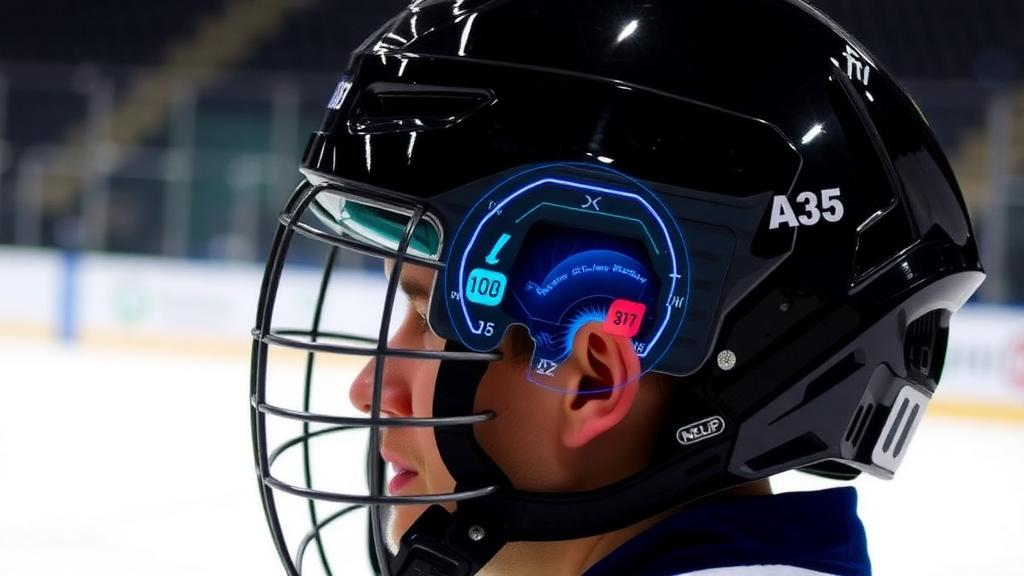
Concussions remain one of the most stubborn problems in contact sports, and ice hockey is no exception. Every season, players absorb hundreds of impacts to the head and body, some of which carry real risk of traumatic brain injury. Yet measuring what actually happens to the brain inside the skull during those impacts has always been extraordinarily difficult. A new study published in the Annals of Biomedical Engineering by Dario Sciacca and Anisoara Ionescu of the Swiss Federal Institute of Technology in Lausanne (EPFL) offers a fresh approach: a statistical modeling framework that can reconstruct both linear acceleration and rotational velocity of the head from a single inertial sensor mounted on the outside of a hockey helmet.
The core challenge the researchers set out to solve is known as helmet-head decoupling. When a player takes a hit, the helmet does not move in perfect lockstep with the skull. The shell and liner flex, compress, and shift relative to the head, which means a sensor bolted to the helmet records a distorted version of the true head motion. Previous work has quantified just how bad this distortion can be: helmet-mounted sensors have been shown to report linear accelerations up to five times greater than those at the head’s center of mass, while angular velocity estimates can deviate by as much as seventy percent depending on the impact conditions. Sensor placement and helmet fit only add to the variability. For researchers trying to build injury risk models from field data, this mismatch is a fundamental obstacle.
Sciacca and Ionescu’s solution builds on their earlier work with autoregressive models, but with an important twist. Instead of treating linear acceleration and angular velocity as separate signals to be corrected independently, their new framework uses a Vector AutoRegressive model, or VAR, that models the two quantities jointly. The physics behind this coupling is straightforward: when an impact strikes the head off-center, the same force that produces translational acceleration also generates a torque that sets the head spinning. Linear and rotational dynamics are therefore two faces of the same event, and a model that captures their interdependence should, in principle, reconstruct both more faithfully than two univariate models working in isolation.
To train and test the framework, the team conducted controlled laboratory experiments using a Hybrid III 50th percentile male headform, the standard crash-test dummy head used in automotive and sports safety research. The headform was fitted with reference-grade accelerometers and gyroscopes at its center of mass, sampling at ten kilohertz, providing the ground truth against which all estimates could be judged. Over the headform went a Bauer RE-AKT 150 ice hockey helmet instrumented with a single inertial measurement unit mounted on the back of the shell. A custom pendulum impactor then delivered blows to the helmeted head from four directions: front, front-oblique, side, and rear-oblique, at three pendulum angles corresponding to impact energies of roughly 33, 79, and 134 joules, velocities representative of both subconcussive and concussive events on the ice.
The modeling pipeline exploits a subtle but crucial observation: at the very beginning of an impact, the helmet signal and the true head signal track each other closely. It is only later in the impact, as the helmet and head begin to move relative to one another, that the helmet measurement diverges into noise and distortion. The researchers therefore feed the VAR model only the initial rising phase of the helmet signal, sometimes as little as ten percent of the peak, and let the model forecast the rest of the waveform. Trained on averaged reference waveforms from the headform, the model generates a dynamically consistent continuation that replaces the unreliable portion of the helmet recording. A grid search over model lags and input thresholds identified the optimal configuration, which turned out to be remarkably consistent: a single-sample lag and the shortest possible input segment worked best across nearly all impact conditions.
The results at the trained impact intensities were encouraging, particularly for rotational kinematics. Angular velocity reconstruction improved across most impact configurations, with peak magnitude percentage error falling by up to 20.9 percentage points, an 81.1 percent reduction, and root mean squared error dropping by up to 288.8 degrees per second, an 85.7 percent improvement, at the lowest impact intensity. Linear acceleration estimates also improved, though more unevenly, with peak error reductions of up to 171.8 percentage points and root mean squared error reductions of up to 10.9 g, again at the 30-degree condition. The reconstructed acceleration traces took on smoother, more Gaussian-like profiles that closely resembled the headform reference, a striking visual contrast to the jagged, variable raw helmet signals.
An interesting asymmetry emerged from the model’s internal coefficients. The cross-dependence term linking angular velocity to the prediction of linear acceleration remained close to zero, meaning rotational information contributed little to reconstructing translation. The reverse pathway, however, was strongly positive: linear acceleration substantially improved the prediction of angular velocity. The authors argue this is physically plausible. Linear acceleration responds directly and immediately to the contact-force impulse, while angular velocity reflects the accumulated rotational response over time, and the helmet-mounted accelerometer, sitting away from the head’s center of mass, inherently mixes rotational contributions into its readings, making it a rich proxy for the coupled response. The reverse pathway is harder to capture because the model includes angular velocity but not angular acceleration, and therefore cannot represent the nonlinear centripetal terms that would be needed.
The framework’s Achilles heel appeared when the researchers tested it on impacts at an intensity it had never seen. Using a two-point linear extrapolation of model coefficients from the 30-degree and 50-degree conditions, they estimated responses for the hardest 70-degree impacts, corresponding to roughly 134 joules. Angular velocity estimates still improved at most locations, with significant error reductions at the front and front-oblique directions reaching up to 341.1 degrees per second, a 52.2 percent improvement. Linear acceleration, however, degraded across the board, with peak error increasing by up to 68.6 percentage points, a more than sevenfold relative worsening. The likely culprit is progressive helmet-head decoupling at higher severities: as impacts grow harder, the relative motion between shell and skull becomes more pronounced, the helmet signal becomes noisier, and the learned relationships break down. The authors are careful to note that with only two training severities, the linearity of the coefficient-severity relationship cannot be verified, so the extrapolation procedure cannot be considered a true validation of generalization.
The study also carries important caveats about its laboratory foundations. The Hybrid III headform, while an industry standard, has a simplified neck and limited biofidelity for the coupled translational-rotational dynamics of a real human head-neck system, and its direction-dependent stiffness may partly explain why side impacts proved hardest to reconstruct. The experiments used a single helmet model and size, a single sensor placement, and a single attachment method, which means the learned kinematic relationships are likely helmet-specific and would require recalibration for other designs. Repeated impacts separated by only about twenty seconds may also have prevented full recovery of the helmet liner’s mechanical properties, introducing variability that the model had to absorb. And the dimensionality reduction step, which projects the three-dimensional signals onto a single dominant axis, discards potentially useful cross-axis information that a multivariate approach could otherwise exploit.
Despite these limitations, the work represents a meaningful step toward practical, helmet-based concussion monitoring. Rotational kinematics is widely regarded as a key predictor of brain injury, and the VAR framework delivered its most consistent and significant gains precisely there, for frontal and front-oblique impacts at low and moderate intensities. The authors suggest that future iterations could incorporate additional reference axes, more comprehensive characterization of helmet-head coupling, and nonlinear relationships between model coefficients and impact severity to push performance across the full range of real-world conditions. If those challenges can be met, the vision of a single unobtrusive sensor in every hockey helmet, quietly reconstructing the true motion of the head with each hit and flagging the impacts that matter most, moves considerably closer to reality.
Subject of Research: Estimation of head impact kinematics in ice hockey using helmet-mounted inertial sensors and vector autoregressive models
Article Title: Estimating Linear and Rotational Head Kinematics in Ice Hockey from a Single Helmet-Mounted IMU Using Vector Autoregressive Models
Article References: Sciacca, D., & Ionescu, A. (2026). Estimating Linear and Rotational Head Kinematics in Ice Hockey from a Single Helmet-Mounted IMU Using Vector Autoregressive Models. Annals of Biomedical Engineering. https://doi.org/10.1007/s10439-026-04395-0
Image Credits: AI Generated
DOI: 10.1007/s10439-026-04395-0
Keywords: head impact biomechanics, concussion, ice hockey, inertial measurement unit, vector autoregressive models, helmet-head decoupling, angular velocity, linear acceleration, sports technology, Hybrid III headform, wearable sensors, biomedical engineering
Cite Scienmag News
Cassandra Pierce. (September 30, 2026). Smart Helmet Algorithm Reconstructs Head Motion in Ice Hockey Impacts from a Single Sensor. Scienmag. https://scienmag.com/smart-helmet-algorithm-reconstructs-head-motion-in-ice-hockey-impacts-from-a-single-sensor/
Cassandra Pierce. "Smart Helmet Algorithm Reconstructs Head Motion in Ice Hockey Impacts from a Single Sensor." Scienmag, 30 September 2026, https://scienmag.com/smart-helmet-algorithm-reconstructs-head-motion-in-ice-hockey-impacts-from-a-single-sensor/. Accessed 4 October 2026.
Cassandra Pierce. "Smart Helmet Algorithm Reconstructs Head Motion in Ice Hockey Impacts from a Single Sensor." Scienmag. September 30, 2026. https://scienmag.com/smart-helmet-algorithm-reconstructs-head-motion-in-ice-hockey-impacts-from-a-single-sensor/


