


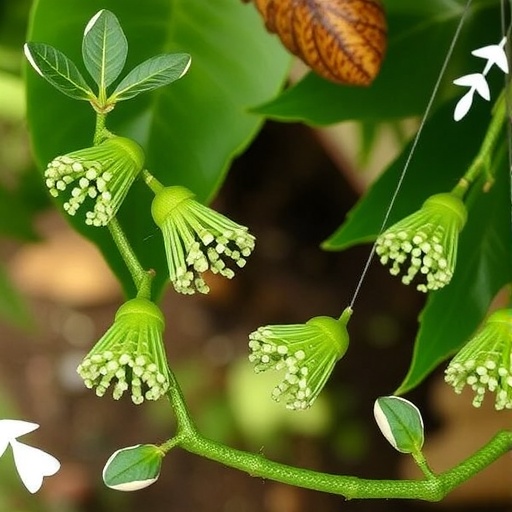
In the dense and biologically rich landscapes of Borneo, a remarkable tree species known as Shorea macrophylla, commonly referred to as tengkwang, stands out not only for its towering stature but also for its economic and ecological significance. This dipterocarp species is renowned for its large seeds, which harbor high-quality oil beneficial for diverse industrial applications. Alongside its value as a timber resource, Shorea macrophylla plays a critical role in regional afforestation efforts, aiming to restore degraded habitats and sustain local economies. Recent groundbreaking research conducted by scientists in Tsukuba, Japan, provides profound insights into the genetic architecture and conservation needs of this vital species.
This comprehensive study centers on the natural populations of Shorea macrophylla found in Kalimantan, the Indonesian portion of Borneo. Employing cutting-edge genomic tools, the research team leveraged two sophisticated types of DNA markers—single-nucleotide polymorphisms (SNPs) and simple sequence repeats (SSRs). These molecular markers offer a high-resolution perspective on the genetic variability and population structure of the species, facilitating an unprecedented understanding of its evolutionary lineage and adaptive potential. Together, these markers unraveled a complex and geographically distinct genetic landscape across the species’ range.
An outstanding revelation from the study is the clear genetic differentiation among the northeastern, central, and southwestern populations of Shorea macrophylla within Kalimantan. Each population demonstrates unique genetic signatures, underlining the influence of historical biogeographic events and localized environmental pressures on genetic divergence. Notably, the northeastern population harbors the greatest genetic diversity, positioning it as the putative ancestral group from which other populations have descended. This discovery not only reshapes our comprehension of the species’ evolutionary history but also guides conservation priorities.
Genetic diversity forms the bedrock of resilience against environmental changes and diseases. In the context of Shorea macrophylla, preserving this diversity is paramount to sustaining its ecological functions and economic benefits. The study advocates for a conservation strategy that treats the three populations as separate management units. Such an approach emphasizes the tailored preservation of each population’s unique genetic identity, ensuring that afforestation programs do not inadvertently hybridize or dilute localized adaptations. This fine-scale management is crucial for maintaining the species’ overall genetic health.
Beyond the present genetic insights, the researchers integrated future climate change projections into their analysis, offering a forward-looking dimension to their conservation vision. Model projections for the year 2070 forecast an expansion of suitable habitats for Shorea macrophylla under various climate scenarios. This anticipated range shift not only underscores the tree’s potential adaptability but also raises complex challenges for conservation management, particularly regarding the sourcing and planting of genetically appropriate seedlings.
The interaction between climate change and genetic structure accentuates the need to produce and plant seedlings within their respective management units. Such precision forestry will mitigate risks associated with outbreeding depression and loss of locally adapted gene complexes. Moreover, this strategy aligns with cutting-edge principles of assisted migration and gene conservation, aiming to buffer the species against the uncertainties of a rapidly changing climate while preserving its evolutionary potential.
The dual application of SNP and SSR markers in this study exemplifies the power of integrating high-throughput genomics with traditional genetic methods. While SNPs provide genome-wide coverage and fine discrimination among individual genotypes, SSRs, or microsatellites, offer robust insights into recent population dynamics and kinship structures. Together, these markers create a comprehensive genetic portrait that informs both scientific understanding and practical conservation action.
Additionally, this research advances the broader field of population genetics in tropical forest trees, which have historically been understudied due to their large genomes and complex reproductive strategies. The methodological framework and findings set an important precedent for assessing other dipterocarp species, many of which share similar ecological roles and face comparable threats from habitat loss and exploitation.
The socio-economic implications of conserving Shorea macrophylla are equally significant. The seed oil extracted from this species is valued for its quality, making sustainable cultivation and harvesting economically advantageous. However, without informed genetic management, afforestation and reforestation initiatives risk undermining the genetic integrity that supports both productivity and adaptation. Thus, this study bridges ecological science with applied forestry, advocating a balanced paradigm where economic interests and biodiversity conservation can coexist.
Moreover, the research benefits from strong institutional collaboration and international funding mechanisms, illustrating the global commitment to sustaining tropical biodiversity. Supported partly by Japan’s JSPS KAKENHI program and the Science and Technology Research Partnership for Sustainable Development (SATREPS), the project reflects a model of science-driven sustainable development, leveraging genetic data for real-world environmental challenges.
In light of these findings, researchers and forest managers are called to take decisive action. Maintaining distinct genetic management units for Shorea macrophylla is not merely a scientific recommendation—it is an imperative to secure the species’ future amid unprecedented environmental change. Through integrative genetic research and climate-informed conservation planning, the legacy of this majestic dipterocarp species can be preserved for generations to come.
News Publication Date: 9-Sep-2025
Web References: https://doi.org/10.1111/1440-1703.70010
References:
- The original scientific article published in Ecological Research
Cite Scienmag News
Juliet Wilcox. (October 10, 2025). Genetic Insights and Predicted Habitat Growth of Shorea macrophylla in Southeast Asia. Scienmag. https://scienmag.com/genetic-insights-and-predicted-habitat-growth-of-shorea-macrophylla-in-southeast-asia/
Juliet Wilcox. "Genetic Insights and Predicted Habitat Growth of Shorea macrophylla in Southeast Asia." Scienmag, 10 October 2025, https://scienmag.com/genetic-insights-and-predicted-habitat-growth-of-shorea-macrophylla-in-southeast-asia/. Accessed 5 September 2026.
Juliet Wilcox. "Genetic Insights and Predicted Habitat Growth of Shorea macrophylla in Southeast Asia." Scienmag. October 10, 2025. https://scienmag.com/genetic-insights-and-predicted-habitat-growth-of-shorea-macrophylla-in-southeast-asia/


