


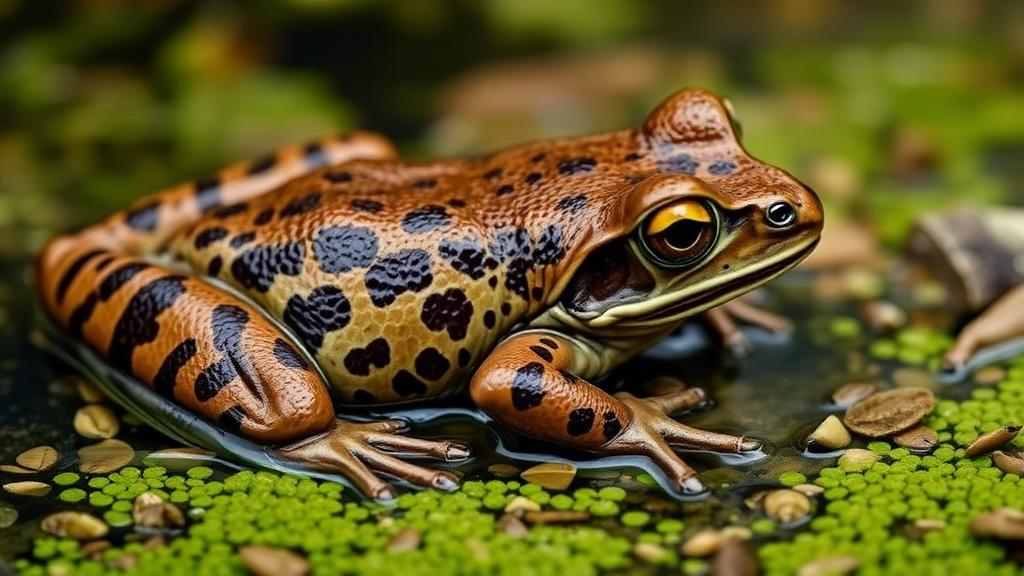
For much of the twentieth century, naturalists across the Western Palaearctic were content to recognize two kinds of water frogs: the small-bodied Rana lessonae of Western Europe and the large-bodied Rana ridibunda, the marsh frog, which ranged from Central and Eastern Europe through Central and Western Asia into Northern Africa. The hybrid between the two, Rana esculenta, was long treated as a separate species in its own right. That tidy picture, however, has been steadily dismantled over the past three decades, and a new study of frogs from Georgia suggests that the resulting taxonomy has become not merely complicated but formally incorrect.
The taxonomic upheaval began in earnest in the early 1990s. Molecular work revealed that the sprawling genus Rana was polyphyletic, meaning its members did not all share a single recent common ancestor, and the Palaearctic water frogs were reassigned to the genus Pelophylax. The marsh frog became Pelophylax ridibundus. Then the nominal species itself was split. Schneider and colleagues proposed in 1992 that frogs from West Asia deserved recognition as a distinct species, Pelophylax bedriagae. Later authors added further cryptic species from Anatolia and the Middle East, including P. caralitanus and P. cypriensis, although P. caralitanus has recently been synonymized with P. bedriagae. Other names, such as Rana saharica from North Africa, have been folded back into older species like P. perezi.
What remained genuinely unknown was the status of the water frogs inhabiting most of the Caucasus, a mountainous crossroads between Europe and Asia where the Black and Caspian Sea basins meet. To fill that gap, researchers collected toe phalanges of frogs from five Georgian locations representing different parts of the country, from both major sea basins and both the Greater and Lesser Caucasus Mountain systems. Tissue samples were stored in 95 percent alcohol for DNA extraction, purified with a commercial miniprep kit, and subjected to polymerase chain reaction targeting a partial sequence of the cytochrome oxidase subunit I gene, the standard mitochondrial barcode for animal identification.
The amplified fragments were sequenced in both directions and checked against the Barcode of Life Data System and the NCBI BLAST database. The team obtained six COI sequences from frogs across Georgia and compared them with 89 water frog sequences downloaded from GenBank, covering Turkey, Kazakhstan, the Balkan Peninsula, and Central and Western Europe, and belonging to the nominal species P. ridibundus, P. bedriagae, P. kurtmuelleri, P. caralitanus, P. perezi, P. lessonae, P. mongolius, and several unidentified Pelophylax. Extracted DNA was deposited in the scientific collections of Ilia State University in Tbilisi, with aliquots destined for the LIB Biobank at Museum Koenig in Bonn, Germany.
The genetic distances told a striking story. Between the 545-base-pair COI fragment of the Georgian frogs and samples from Kazakhstan, differences ranged from 0 to 4 percent, averaging 3.4 percent. Georgian frogs differed from Greek specimens by 1 to 5.5 percent, averaging 2.0 percent, and from P. caralitanus by just 1 to 1.5 percent. In contrast, the distance between Georgian frogs and Central European frogs, including nominal P. kurtmuelleri, was 5 to 6 percent, averaging 5.7 percent. Divergence between the nominal P. ridibundus and P. bedriagae groups on one side and P. lessonae on the other reached 14 to 15 percent, and 15 percent against P. perezi. Within the ridibundus-plus-bedriagae complex, sequence differences varied from 0 to 6 percent and rose in proportion to geographic distance between populations.
A maximum likelihood tree of the mitochondrial haplotypes placed the Georgian sequences in a clade shared with nominal P. ridibundus from Kazakhstan and nominal P. bedriagae from Greece. Differences among the Georgian haplotypes themselves were minor, yet they exceeded those between some individuals from Georgia and Kazakhstan or Georgia and Greece. Taken together, the mitochondrial evidence offered no support for treating the frogs of the entire Caucasus, the region west and north of the Caspian Sea basin, Anatolia, and the Balkan Peninsula as anything other than conspecific, members of a single species.
That conclusion collides head-on with the current nomenclature, and the problem lies in the type locality. Western Kazakhstan, specifically the Atyrau district described by Pallas in 1771, is the Terra Typica of P. ridibundus. By the rules of zoological nomenclature, frogs from that region must bear the name P. ridibundus. Yet recent researchers, including Ualiyeva and colleagues in 2022 and Dufresnes and colleagues in 2024, have routinely attributed the mitochondrial haplotypes of western Kazakh frogs to P. bedriagae, because those haplotypes cluster with sequences from Anatolia rather than with the Central European haplogroup. In other words, the frogs at the very spot where the name ridibundus was born are genetically closer to what has been called bedriagae than to the nominal ridibundus of Europe, rendering the formal usage of both names untenable.
The authors argue that the name P. bedriagae should be reserved for the frogs of the Levant and some southern Anatolian populations, the animals Schneider and colleagues described as a separate species in 1992. Several independent lines of evidence support this conservative move. Mating call analyses have shown that the vocalizations of frogs from western Kazakhstan, Armenia, and Central Europe are similar to one another and distinct from those of Middle Eastern frogs, including southern Anatolia. Nuclear gene data reveal no reciprocal monophyly between nominal P. ridibundus and P. bedriagae; in the type locality itself, two nuclear haplogroups occur, one closer to Anatolian and the other to Central European frogs, and both can be found admixed within the same western Kazakh population. A study of invasive marsh frogs in Belgium documented introgressive hybridization between nominal P. ridibundus and P. bedriagae, indicating the absence of reproductive barriers between them.
The presence of distinct mitochondrial haplogroups in the northwest and southeast of the range reflects a long period of isolation between European and West Asian or Balkan populations, but isolation of mitochondrial lineages alone is not sufficient to declare separate species under the framework of separately evolving metapopulation lineages articulated by De Queiroz in 2007. There is no evidence of restricted gene flow or of tension zones between the eastern and western geographic populations of marsh frogs, and the proportion of sequence divergence cannot by itself demonstrate that different evolutionary pathways have been taken. Marsh frogs from most of Anatolia, the Balkans, the Caucasus, and the Caspian area should therefore all be attributed to the species P. ridibundus, a verdict that restores a measure of order to one of Europe and Asia’s most tangled amphibian taxonomies.
Subject of Research: Which species of water frogs inhabit ponds of the Caucasus? Taxonomic mess with Pelophylax ridibundus species complex
Article Title: Which species of water frogs inhabit ponds of the Caucasus? Taxonomic mess with Pelophylax ridibundus species complex
Article References: Tarkhnishvili, D., Todua, M., & Iankoshvili, G. (2024). Which species of water frogs inhabit ponds of the Caucasus? Taxonomic mess with Pelophylax ridibundus species complex. Caucasiana, 3, 31-39. https://doi.org/10.3897/caucasiana.3.e117215
Image Credits: AI Generated
DOI: 10.3897/caucasiana.3.e117215
Keywords: genetics, taxonomy, amphibians, Caucasus, Georgia, marsh frog, DNA barcoding, Pelophylax, species, water, frogs, inhabit
Cite Scienmag News
Juliet Wilcox. (October 18, 2026). Genetic Barcodes Untangle the Marsh Frog Species Mess Across the Caucasus. Scienmag. https://scienmag.com/genetic-barcodes-untangle-the-marsh-frog-species-mess-across-the-caucasus/
Juliet Wilcox. "Genetic Barcodes Untangle the Marsh Frog Species Mess Across the Caucasus." Scienmag, 18 October 2026, https://scienmag.com/genetic-barcodes-untangle-the-marsh-frog-species-mess-across-the-caucasus/. Accessed 18 October 2026.
Juliet Wilcox. "Genetic Barcodes Untangle the Marsh Frog Species Mess Across the Caucasus." Scienmag. October 18, 2026. https://scienmag.com/genetic-barcodes-untangle-the-marsh-frog-species-mess-across-the-caucasus/


