


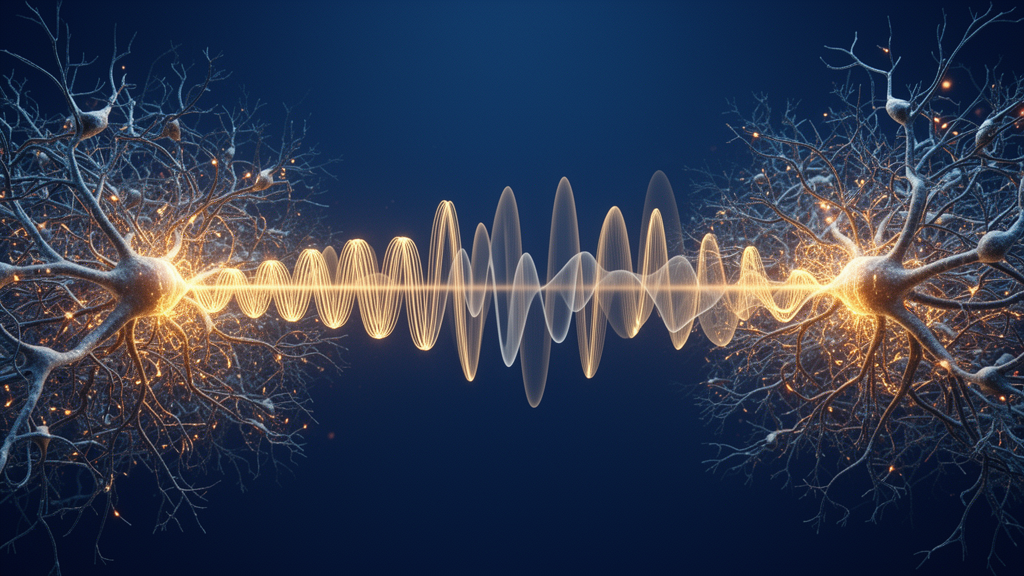
Audio is everywhere in modern life, from voice assistants and telemedicine calls to banking hotlines and social protection systems that record conversations with vulnerable citizens. Every one of those streams is a potential target for eavesdroppers, and researchers in Malaysia and India have now reported a mathematical framework that could make the scrambling of such audio both stronger and more predictable. Writing in Neural Computing and Applications, M. Manikandan of Finsoft Consulting Sdn Bhd, M. Kalpana of UCSI University and Asia Pacific University of Technology and Innovation, and P. Muthukumar of Gobi Arts and Science College describe how a special class of recurrent neural networks can be forced to lock step with one another within a guaranteed, finite window of time, and how that lock can be turned into an encryption key for voice and sound data.
The networks at the heart of the study are bidirectional associative memory fuzzy cellular neural networks, or BAM FCNNs. The bidirectional associative memory concept, introduced by Bart Kosko in 1988, describes two layers of neurons that feed signals back and forth between each other, so that a pattern presented to one layer evokes a response in the other and vice versa. Fuzzy cellular neural networks, first formalized by Tao Yang and colleagues in 1996, add fuzzy logic operators and local connections to the classical cellular architecture, allowing each neuron to weigh its inputs with linguistic rules rather than crisp arithmetic alone. Combining the two produces a dynamical system rich enough to generate complex, chaotic trajectories, which is precisely what cryptographers want from a pseudo-random source.
Chaos and cryptography have been intertwined for decades because chaotic systems amplify tiny differences in initial conditions into wildly different outputs. If a sender and a receiver each run a copy of the same chaotic system, and the sender forces the receiver’s copy to follow the sender’s copy exactly, the shared chaotic trajectory can act as a one-time pad that no outsider can reconstruct without the system parameters. The catch has always been synchronization: the two copies must converge to identical behavior, and classical results often guarantee only that the error decays asymptotically, meaning the lock could in principle take an unbounded amount of time. For real-time audio, where a delay of even a fraction of a second degrades the user experience, asymptotic promises are not enough.
This is where finite-time stability theory enters the picture. Unlike asymptotic stability, finite-time stability asks for the system error to fall below a prescribed threshold by a specific, computable deadline. Bhat and Bernstein laid the mathematical foundations for this notion in 2000, and subsequent work by Abdurahman, Jiang and Teng in 2016, Wang in 2018, and Zhang and Cao in 2021 extended it to fuzzy cellular and inertial neural networks with delays. The new paper builds on this lineage by deriving sufficient conditions under which a BAM FCNN with time delays will synchronize in finite time, using inequality techniques that bound the evolution of the error between the drive and response systems.
Time delays are not a nuisance in this setting; they are a structural feature. Signals in physical and electronic systems never propagate instantaneously, and recurrent neural networks that model them must account for the lag between a neuron receiving an input and producing its response. The authors consider discrete delays, in which past states at fixed earlier times influence present dynamics, and leakage delays, in which the network’s own decay terms carry a lag. Because the synchronization conditions must hold for all admissible delays, the resulting controller is robust: even if the communication channel introduces variable latency, the two neural copies still converge within the finite window that the theory guarantees.
Once the theoretical conditions were established, the team validated them with two numerical examples and corresponding simulations, demonstrating that the drive and response networks indeed synchronize within the predicted finite time. Those synchronized trajectories were then harnessed for practical audio encryption and decryption scenarios. In a typical scheme of this kind, the sender’s chaotic network output is used to confuse and diffuse the audio samples, permuting their order and masking their amplitudes, while the receiver’s network, once synchronized, reproduces the identical chaotic stream needed to invert the process. The authors also conducted a comprehensive security analysis in which the proposed approach was compared against existing encryption methods, examining statistical properties that attackers typically probe, such as the uniformity of the encrypted waveform’s distribution and the sensitivity of the ciphertext to tiny changes in the key.
The security analysis matters because chaotic encryption schemes have historically been vulnerable to chosen-plaintext and statistical attacks when the underlying chaotic generator is too simple or when the key space is too small. By anchoring the encryption in a BAM FCNN with fuzzy operators, bidirectional coupling and multiple delays, the scheme inherits a high-dimensional parameter space that is difficult to invert. The finite-time guarantee adds a further layer of practical value: the receiver knows not only that synchronization will eventually occur but that it will occur by a deadline, which is essential for streaming applications where decryption must keep pace with playback.
Beyond audio, the authors point to applications in social protection systems, where sensitive personal and financial information must be transmitted securely. Voice records of welfare consultations, biometric identifiers and financial disclosures all travel through channels that may be monitored, and a synchronization-based cipher whose convergence time is provably bounded could help ensure that such details remain protected even under real-time constraints. The framework’s emphasis on reliability and efficiency of computational models for real-time use suggests it is intended not as a laboratory curiosity but as a candidate for deployment in systems where both security and latency are non-negotiable.
The work also fits into a broader research program that the authors and collaborators have pursued for years. Kalpana, Ratnavelu and Balasubramaniam published an audio encryption scheme based on synchronization of robust BAM FCNNs with time delays in 2019, and a companion paper that same year described double-key security for sound record data using the drive-response structure of bidirectional associative memory neural networks. The new study strengthens that line by replacing asymptotic synchronization arguments with finite-time ones, closing the gap between theoretical guarantees and the timing requirements of live audio. Related efforts across the field, from DNA-coding schemes and Mobius-transform ciphers to hybrid-hyper chaotic systems with binary masking, show how crowded the audio encryption landscape has become, and comparative analyses like the one in this paper are what allow practitioners to judge which approaches hold up.
For readers wondering whether chaotic neural ciphers will ever sit alongside AES in everyday devices, the answer is likely to be nuanced. Classical block ciphers remain the standard for bulk data, but synchronization-based schemes offer properties that block ciphers lack, including a physical analogy to analog scrambling and the ability to bind the key to the dynamics of a nonlinear system rather than to a discrete algebraic structure. The finite-time synchronization results reported here provide the kind of rigorous timing guarantee that engineers need before trusting such a scheme in production. As voice interfaces multiply and regulations tighten around the handling of spoken personal data, the mathematics of making two neural networks agree, quickly and provably, may turn out to be one of the quieter but more consequential threads in the story of secure communication.
Subject of Research: Enhancing audio encryption security through finite-time synchronization of BAM FCNNs with time delays
Article Title: Enhancing audio encryption security through finite-time synchronization of BAM FCNNs with time delays
Article References: Manikandan, M., Kalpana, M., & Muthukumar, P. (2026). Enhancing audio encryption security through finite-time synchronization of BAM FCNNs with time delays. Neural Computing and Applications, 38(20), Article 820. https://doi.org/10.1007/s00521-026-12172-2
Image Credits: AI Generated
DOI: 10.1007/s00521-026-12172-2
Keywords: Enhancing, audio, encryption, security, finite-time, synchronization, FCNNs, time, delays, scientific research
Cite Scienmag News
Cassandra Pierce. (October 18, 2026). Chaotic neural networks lock onto each other in finite time to secure audio streams. Scienmag. https://scienmag.com/chaotic-neural-networks-lock-onto-each-other-in-finite-time-to-secure-audio-streams/
Cassandra Pierce. "Chaotic neural networks lock onto each other in finite time to secure audio streams." Scienmag, 18 October 2026, https://scienmag.com/chaotic-neural-networks-lock-onto-each-other-in-finite-time-to-secure-audio-streams/. Accessed 18 October 2026.
Cassandra Pierce. "Chaotic neural networks lock onto each other in finite time to secure audio streams." Scienmag. October 18, 2026. https://scienmag.com/chaotic-neural-networks-lock-onto-each-other-in-finite-time-to-secure-audio-streams/


