

Tuesday, August 25, 2026
Science
No Result
View All Result
  • Login
  • HOME
  • SCIENCE NEWS
  • CONTACT US
  • HOME
  • SCIENCE NEWS
  • CONTACT US
No Result
View All Result
Scienmag
No Result
View All Result
Home Science News Climate

Future climate impacts put whale diet at risk

May 23, 2024
in Climate
Reading Time: 2 mins read
0
Future climate impacts put whale diet at risk
66
SHARES
604
VIEWS
Share on FacebookShare on Twitter
ADVERTISEMENT

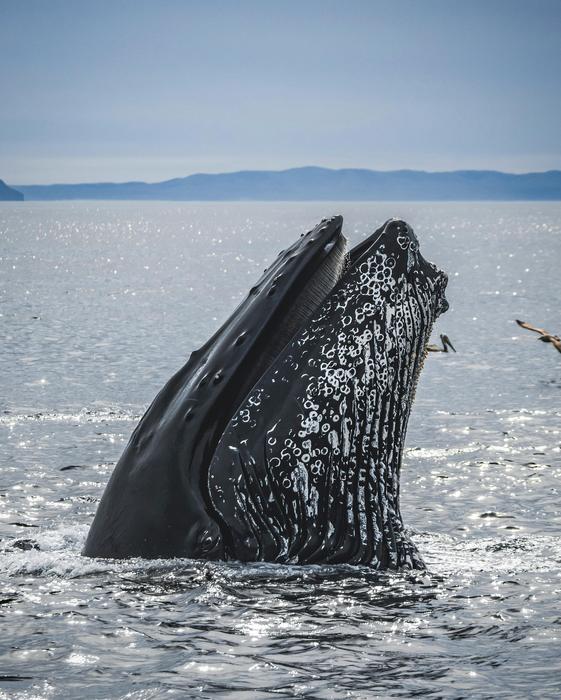
A new study led by Griffith University predicts that future climate change impacts could disrupt the krill-heavy diet that humpback whales in the southern hemisphere consume. 

Humpback diet

Credit: Adam Ernster

A new study led by Griffith University predicts that future climate change impacts could disrupt the krill-heavy diet that humpback whales in the southern hemisphere consume. 

Dr Jasmin Groß, who conducted the study as a PhD candidate at Griffith’s Centre for Planetary Health and Food Security analysed fatty acids and stable isotopes from blubber and skin samples of five different humpback whale populations around the southern hemisphere.  

These levels were then compared to those of their primary prey item, Antarctic krill. 

The team found that although there were distinct differences in the biochemical profiles, the diet of all tested humpback whale populations was Antarctic krill, which provides a high fat content diet ideal for the migratory lifestyle of these populations, Dr Groß said.  

“The migratory lifestyle of humpback whales requires predictable ecosystem productivity, and so, we can expect that populations feeding in areas that are subject to the strongest climate change impacts are more likely to show the first signs of a departure from their high-fidelity krill diet,” she said. 

“At present, there is no evidence of a divergence from a high-fidelity krill diet, but the characteristic isotopic signal we discovered of whales feeding in productive upwelling areas or in the marginal sea-ice zone, implies that future reductions in sea-ice extent and duration, and rising ocean temperatures could impact their feeding ecology.” 

Humpback whale blubber and skin biopsies were collected in August and September 2019 in or near their respective breeding grounds off Brazil, Western and Eastern Australia, New Caledonia and Colombia.  

Krill samples were collected from feeding grounds onboard three different vessels between January and March 2019.  

Dr Groß said the importance of this study in confirming that each population followed a high-fidelity Antarctic krill diet could be used as baseline knowledge to assess the extent of climate change impacts in the feeding grounds in future studies. 

Dr. Groß’s PhD research was conducted as part of the Humpback Whale Sentinel Programme, a key surveillance initiative of the Antarctic Monitoring and Assessment Programme (AnMAP).  

AnMAP is a joint initiative between the Scientific Committee for Antarctic Research (SCAR), the Arctic Monitoring and Assessment Programme (AMAP), United Nations Educational, Scientific and Cultural Organization (UNESCO), and Griffith University. 

The study ‘No distinct local cuisines among humpback whales: A population diet comparison in the Southern Hemisphere’ has been published in Science of the Total Environment. 


Journal

Science of The Total Environment

DOI

10.1016/j.scitotenv.2024.172939

Article Publication Date

4-May-2024

Share26Tweet17
Previous Post

Epidural linked to reduction in serious complications after childbirth

Next Post

Quantum photonic technologies set to be more reliable with new interferometer.

Related Posts

Traffic’s Contribution to Daily PM2.5 Exposure Linked to Cancer Mortality
Climate

Traffic’s Contribution to Daily PM2.5 Exposure Linked to Cancer Mortality

August 25, 2026
Eurasian Spring Heat Monopole–North Pacific Tripolar SST Link Weakens Since 1990s
Climate

Eurasian Spring Heat Monopole–North Pacific Tripolar SST Link Weakens Since 1990s

August 25, 2026
Water Conservation Shifts Across Northern Tianshan Under Land-Use Change and SSP2-4.5
Climate

Water Conservation Shifts Across Northern Tianshan Under Land-Use Change and SSP2-4.5

August 25, 2026
Future Flood Risks Concentrate Among U.S. Residents Living Near Small Rivers
Climate

Future Flood Risks Concentrate Among U.S. Residents Living Near Small Rivers

August 25, 2026
Over 150 Years Needed to Detect Nonstationarity in Mediterranean Precipitation Extremes
Climate

Over 150 Years Needed to Detect Nonstationarity in Mediterranean Precipitation Extremes

August 25, 2026
IPCC-AR6 Maps Climate-Driven Multi-Hazard Risks in Himachal Pradesh
Climate

IPCC-AR6 Maps Climate-Driven Multi-Hazard Risks in Himachal Pradesh

August 25, 2026
Next Post
Quantum photonic technologies set to be more reliable with new

Quantum photonic technologies set to be more reliable with new interferometer.

  • Mothers who receive childcare support from maternal grandparents show more

    Mothers who receive childcare support from maternal grandparents show more parental warmth, finds NTU Singapore study

    27656 shares
    Share 11059 Tweet 6912
  • University of Seville Breaks 120-Year-Old Mystery, Revises a Key Einstein Concept

    1061 shares
    Share 424 Tweet 265
  • Bee body mass, pathogens and local climate influence heat tolerance

    682 shares
    Share 273 Tweet 171
  • Researchers record first-ever images and data of a shark experiencing a boat strike

    546 shares
    Share 218 Tweet 137
  • Groundbreaking Clinical Trial Reveals Lubiprostone Enhances Kidney Function

    531 shares
    Share 212 Tweet 133
Science

Embark on a thrilling journey of discovery with Scienmag.com—your ultimate source for cutting-edge breakthroughs. Immerse yourself in a world where curiosity knows no limits and tomorrow’s possibilities become today’s reality!

RECENT NEWS

  • Study finds no climate-driven Neanderthal habitat fragmentation before extinction
  • Shanghai Study Links School Climate, Teacher Confidence, Teaching Practices, and Training Needs
  • Trace Elements Guide Exosome Modules and Self-Adapting Hydrogels for Diabetic Foot Regeneration
  • Novel clot-fibrinolysis waveform monitoring reveals anticoagulant effects during extracorporeal circulation

Categories

  • Agriculture
  • Anthropology
  • Archaeology
  • Athmospheric
  • Biology
  • Biotechnology
  • Blog
  • Bussines
  • Cancer
  • Chemistry
  • Climate
  • Earth Science
  • Editorial Policy
  • Marine
  • Mathematics
  • Medicine
  • Pediatry
  • Policy
  • Psychology & Psychiatry
  • Science Education
  • Social Science
  • Space
  • Technology and Engineering

Subscribe to Blog via Email

Enter your email address to subscribe to this blog and receive notifications of new posts by email.

Join 5,150 other subscribers

© 2025 Scienmag - Science Magazine

Welcome Back!

Login to your account below

Forgotten Password?

Retrieve your password

Please enter your username or email address to reset your password.

Log In
No Result
View All Result
  • HOME
  • SCIENCE NEWS
  • CONTACT US

© 2025 Scienmag - Science Magazine

Discover more from Science

Subscribe now to keep reading and get access to the full archive.

Continue reading
