


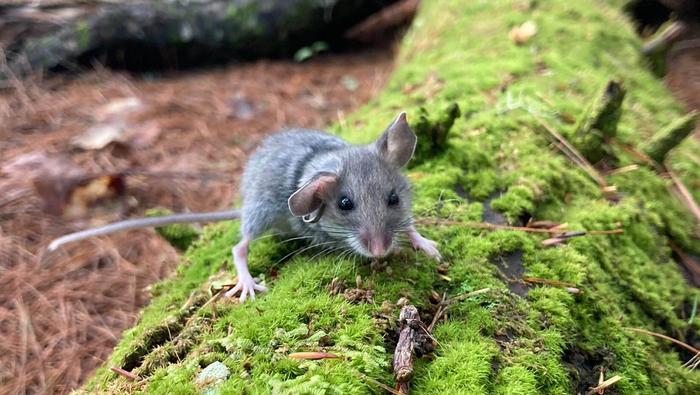
Scattered across the Penobscot Experimental Forest are veritable treasure troves for its denizens, each containing riches beyond comprehension. These caches do not contain gold or jewels — they’re filled with eastern white pine seeds and were placed by a team of researchers at the University of Maine for one purpose: to catch furry thieves red-handed.

Credit: Photo courtesy of Brigit Humphreys
Scattered across the Penobscot Experimental Forest are veritable treasure troves for its denizens, each containing riches beyond comprehension. These caches do not contain gold or jewels — they’re filled with eastern white pine seeds and were placed by a team of researchers at the University of Maine for one purpose: to catch furry thieves red-handed.
Brigit Humphreys, a UMaine graduate student studying ecology and environmental science, has been working in the forest, which sits about 10 miles north of Bangor, for the past two years in an effort to determine which animal personalities are predisposed to pilfering.
As part of a National Science Foundation-funded research project, Humphreys has been studying the behavior of small mammals in the wild. Her research adds to a growing body of knowledge showing that the unique personalities of individual small mammals play a critical role in forest regeneration by impacting seed dispersal. It also complements a larger project that has been eight years in the making and is nearing completion.
“The point of the project was to figure out how small mammal personality and animal personality in general influence different ecological processes,” Humphreys said. “We’re focused on small mammals because they’re a great study system. They’re abundant, we get a really good sample size and we can actually conduct experiments on them in the forest. Seed dispersal is a super important aspect to Maine’s economy, recreation and aesthetics. A lot of research focuses at the species or community level, but many of the individual aspects have been ignored in science. The idea is to bring more attention to the individual and how variation and personality at the individual level is actually really important for ecosystems, tree growth and forest regeneration.”
Humphreys has worked under the direction of professor Alessio Mortelliti of the Department of Wildlife, Fisheries, and Conservation Biology. From June-October 2022, Humphreys and a team of researchers set traps for small mammals, including squirrels, chipmunks, mice, voles and shrews. They worked in a six-grid system, slowly moving about 150 traps from one grid to another. Upon catching the animals, the team collected data about their personality traits and tagged each of them.
Once a grid was cleared of traps, Humphreys and her team planted artificial seed caches across the area, equipping each with a circular antenna buried around the cache. The caches contained eastern white pine seeds, which are an economically important species in Maine and a consistently preferred seed species among the small mammals involved in the study. Game cameras were also set up to observe pilferers in the act.
“The idea is when an individual that we have tagged crosses over the antenna, the antenna picks up on their unique tag, so we know what the personality of that individual was,” Humphreys said.
Her findings indicate that small mammal personality determines the effectiveness of pilferage in mice and voles, with some individuals being more successful at stealing seeds than others. The most accomplished thieves: deer mice.
“We found that more exploratory deer mice were more likely to find caches to pilfer, which makes a lot of sense because they’re likely moving around more and they don’t consider predation risk as much, so they’re able to find these caches and steal them. Those were our main personality results,” Humphreys said. “We found that individuals with a lower body condition, so skinnier animals, were more likely to pilfer because they were desperately hungry. We also found a sex effect. Female voles were more likely to pilfer, which aligns with past research on the same species of voles.”
Humphreys and her team observed many other curious and hungry species over the course of the study as well.
“We had over 10 different species come and pilfer the caches,” Humphreys said. “Some of them were unexpected, like raccoons came and took some of the seeds, which was interesting. The other common pilferers were American red squirrels, eastern chipmunks, Sorex shrews and jumping mice. For the jumping mice there were only a few individuals that we caught, but the ones that were present in our areas were very effective. They got like 10 caches in a night.”
Humphreys’ findings were recently published in the Journal of Animal Ecology as part of the special feature: “Intraspecific Variation in Ecology and Evolution.” She’s currently working on the last piece of the overall project, which focuses on comparing behavioral diversity in areas with varying styles of forest management.
“The take-home message of all the research we are doing is that individuals are important,” Humphreys said. “There’s a big push in the science community to conserve biodiversity, but beyond biodiversity, we have to be conserving behavioral diversity within a species if we truly want to have fully functional ecosystems.”
Journal
Journal of Animal Ecology
Article Title
Pilfering personalities: Effects of small mammal personality on cache pilferage
Article Publication Date
18-Mar-2024
Cite Scienmag News
Drew Townsend. (May 17, 2024). Furry thieves are running loose in a Maine forest, UMaine research shows. Scienmag. https://scienmag.com/furry-thieves-are-running-loose-in-a-maine-forest-umaine-research-shows/
Drew Townsend. "Furry thieves are running loose in a Maine forest, UMaine research shows." Scienmag, 17 May 2024, https://scienmag.com/furry-thieves-are-running-loose-in-a-maine-forest-umaine-research-shows/. Accessed 3 September 2026.
Drew Townsend. "Furry thieves are running loose in a Maine forest, UMaine research shows." Scienmag. May 17, 2024. https://scienmag.com/furry-thieves-are-running-loose-in-a-maine-forest-umaine-research-shows/

