


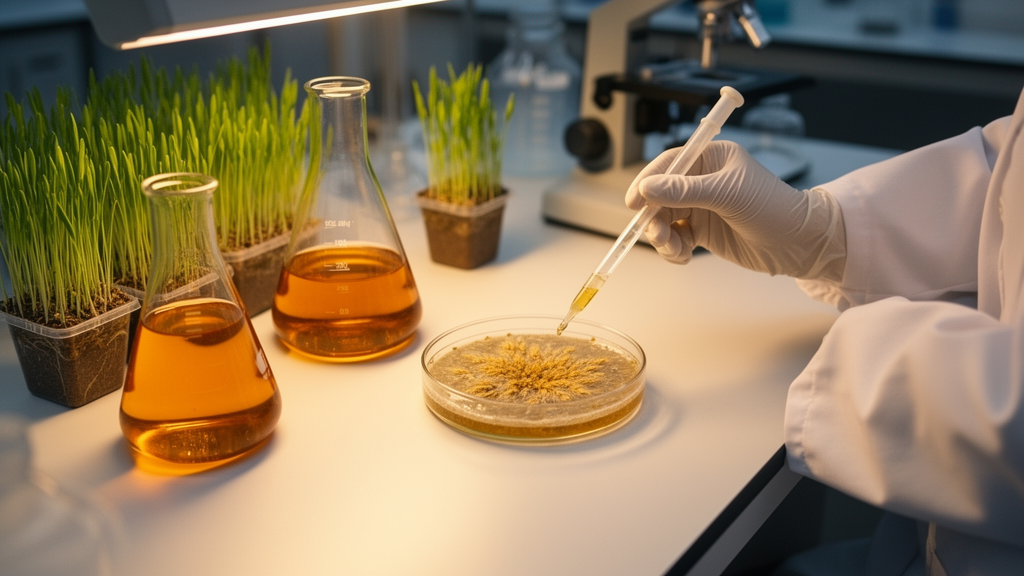
Fusarium head blight is one of the most damaging diseases of wheat worldwide, and growers routinely spray triazole fungicides such as prothioconazole and difenoconazole at flowering to keep the pathogen — and its dangerous mycotoxins deoxynivalenol and zearalenone — out of the grain. But wheat heads are rarely colonized by a single fungus. Alongside Fusarium, a second genus, Alternaria, quietly inhabits the same kernels, capable of producing its own suite of toxins including alternariol, alternariol monomethyl ether, tenuazonic acid and altertoxins. A new study from Italian researchers, published in Frontiers in Agronomy, has now tested how the very fungicides deployed against Fusarium head blight behave toward Alternaria alternata, the species most often behind wheat’s black point disease, and the results reveal a striking disconnect between killing a fungus and neutralizing its chemistry.
The team, led by scientists at the Institute of Sciences of Food Production of the Italian National Research Council in Bari together with colleagues at the University of Bari, the University of Turin and ADAMA Agricultural Solutions, combined laboratory assays with two years of field trials in northern Italy. In the lab, they exposed three strains of A. alternata, previously isolated from wheat kernels showing black point symptoms, to eight commercial fungicide formulations spanning several chemical classes: sterol biosynthesis inhibitors such as prothioconazole, difenoconazole, metconazole and tebuconazole; the respiratory uncoupler fluazinam; the multi-site contact fungicide folpet; and two mixtures pairing prothioconazole with difenoconazole or with the strobilurin azoxystrobin. Mycelial growth on treated agar plates, conidial germination under the microscope, and mycotoxin profiles measured by high-performance liquid chromatography together painted a detailed picture of how each molecule affects the pathogen.
The growth data were clear-cut. Difenoconazole was the most potent single active ingredient, halving colony growth at concentrations below 0.375 milligrams per liter, while the prothioconazole–difenoconazole mixture and the prothioconazole–azoxystrobin combination reached similar potency at very low doses, suggesting additive or synergistic inhibition of sterol biosynthesis at different steps of the same pathway. Fluazinam also performed strongly, with EC50 values between 0.1 and 0.5 milligrams per liter across strains. Folpet, by contrast, needed doses up to 50 milligrams per liter to suppress growth by more than 80 percent in the most sensitive strain, making it the least effective of the panel against mycelial expansion.
Conidial germination told a complementary story. At the lowest tested doses, most fungicides left spore germination untouched, but difenoconazole visibly stunted germ tube elongation even at 0.375 milligrams per liter and, at 0.75 milligrams per liter, blocked elongation entirely in roughly 30 percent of conidia. Folpet at 50 milligrams per liter was the standout, preventing germination in more than 80 percent of spores and arresting germ tube development completely within 72 hours. These microscopic effects matter because conidia are the propagules that land on wheat ears and initiate infection; a fungicide that stops germination or cripples germ tubes prevents colonization before it starts.
Yet when the researchers measured mycotoxin production at sub-lethal doses — concentrations that halve growth but do not kill the fungus — the picture inverted dramatically. Prothioconazole alone, at just 0.1 milligrams per liter, triggered massive increases in toxin output: alternariol monomethyl ether rose roughly tenfold in one strain and more than twelvefold in another, while alternariol, altenuene and tenuazonic acid all climbed significantly. Folpet produced even more spectacular inductions, with alternariol monomethyl ether jumping from 14 to nearly 235 micrograms per gram in one strain — an increase of almost 1,700 percent. Altertoxin I, a particularly concerning compound because of its mutagenic potency, was stimulated by prothioconazole, folpet, metconazole, tebuconazole and fluazinam at low doses. In stark contrast, difenoconazole at higher doses pushed several toxins below the detection limit, hinting that even closely related triazoles can diverge sharply in how they modulate fungal secondary metabolism.
The authors interpret this paradox through the lens of fungal hormesis and stress physiology. Sub-lethal chemical pressure can generate intracellular oxidative imbalance, and reactive oxygen species act as signals that reprogram secondary metabolism rather than simply damaging cells. Previous work on Fusarium graminearum showed that triazole exposure raises hydrogen peroxide inside the fungus and up-regulates the trichothecene biosynthetic pathway, boosting deoxynivalenol production. In Alternaria, recent molecular studies have identified regulatory networks — including the GATA transcription factor AaAreA, which links nitrogen status to alternariol biosynthesis genes, and the Slt2–Swi6 cell-wall integrity pathway, which controls production of alternariol, its methyl ether and tenuazonic acid — that plausibly mediate these fungicide-induced shifts. When growth is constrained, cellular resources may be redirected toward defense-related secondary metabolites, so a fungicide can simultaneously shrink a colony and inflate its toxin load.
To see whether these laboratory warnings translate to the field, the team ran split-plot trials over two growing seasons at the University of Turin’s experimental station in Carmagnola, comparing minimum tillage, which leaves maize residues on the soil surface, with conventional ploughing that buries them. They applied difenoconazole, prothioconazole or the two combined at wheat heading, and in half the plots artificially inoculated the ears with an A. alternata conidial suspension at flowering, 48 hours after spraying. The results confirmed prothioconazole’s reputation: it delivered the strongest reduction in Fusarium head blight incidence and severity, cut kernel colonization by Fusarium, and lowered deoxynivalenol by roughly 79 percent and zearalenone by about 77 percent on average. The mixture with difenoconazole performed comparably on mycotoxins and produced the highest grain yield gains, particularly under minimum tillage, where fungicide treatment lifted yield by 32 percent relative to the untreated control.
Conventional tillage itself proved to be a powerful lever against Fusarium. By incorporating maize residues into the soil rather than leaving them as inoculum reservoirs, ploughing reduced deoxynivalenol by 40 percent and zearalenone by 75 percent compared with minimum tillage, and improved grain yield by 16 percent and test weight as well. Notably, however, neither tillage system nor any fungicide treatment significantly altered Alternaria kernel colonization, which stayed below 20 percent in every plot, and no Alternaria toxins were detected in any field sample. Even the artificial inoculation at flowering failed to raise Alternaria contamination, leading the authors to hypothesize that anthesis is not the most susceptible window for Alternaria infection and that black point disease depends on environmental conditions and the competitive interplay among co-occurring fungal species rather than on a single well-defined infection event.
That disconnect between the petri dish and the paddock is the study’s central lesson. In vitro, sub-lethal prothioconazole and folpet clearly stimulated Alternaria toxin biosynthesis, yet under real field conditions — with strong Fusarium competition, variable weather, and an unknown natural timing of Alternaria inoculum — the fungus never reached the population densities or physiological state needed to translate that potential into measurable grain contamination. The authors caution that their field results are limited by the very low Alternaria incidence observed, and they call for follow-up experiments that inoculate at different wheat growth stages and under environmental conditions more favorable to Alternaria development, to pinpoint the phenological windows where the pathogen actually establishes and to determine the optimal fungicide timing for black point control.
The implications reach beyond agronomy into food safety policy. Alternaria toxins are not yet subject to binding maximum levels in wheat, but the European Commission’s 2022 recommendation urges systematic monitoring of alternariol, alternariol monomethyl ether and tenuazonic acid, and toxicological evidence linking these compounds to genotoxicity, cytotoxicity and endocrine disruption continues to accumulate. As climate change and evolving cropping practices reshape fungal communities on cereal ears, the study underscores that integrated disease management — combining residue management through tillage, judicious fungicide choice, and a deeper understanding of fungal ecology — remains the most reliable path to keeping both Fusarium and Alternaria risks in check, and that the compound-specific effects of fungicides on secondary metabolism deserve a permanent place in risk assessments for mycotoxin control.
Subject of Research: Effects of Fusarium head blight fungicides on Alternaria alternata growth and mycotoxin production in wheat
Article Title: In vitro and field response of Alternaria alternata to fungicides applied in soft wheat cropping systems for Fusarium Head Blight control
Article References: Abi Saad, C., Masiello, M., Haidukowski, M., Meloni, R., Somma, S., Maruccia, S., Sanzani, S. M., Ippolito, A., Pollmann, B., Moretti, A., & Blandino, M. (2026). In vitro and field response of Alternaria alternata to fungicides applied in soft wheat cropping systems for Fusarium Head Blight control. Frontiers in Agronomy, 8, Article 1906417. https://doi.org/10.3389/fagro.2026.1906417
Image Credits: AI Generated
DOI: 10.3389/fagro.2026.1906417
Keywords: Alternaria alternata, Fusarium head blight, wheat, mycotoxins, fungicides, prothioconazole, difenoconazole, black point disease, tillage, food safety, sterol biosynthesis inhibitors, hormesis
Cite Scienmag News
Alan Morgan. (October 15, 2026). Fungicides That Kill Wheat Fungi Can Backfire, Spiking Their Toxin Output in the Lab. Scienmag. https://scienmag.com/fungicides-that-kill-wheat-fungi-can-backfire-spiking-their-toxin-output-in-the-lab/
Alan Morgan. "Fungicides That Kill Wheat Fungi Can Backfire, Spiking Their Toxin Output in the Lab." Scienmag, 15 October 2026, https://scienmag.com/fungicides-that-kill-wheat-fungi-can-backfire-spiking-their-toxin-output-in-the-lab/. Accessed 15 October 2026.
Alan Morgan. "Fungicides That Kill Wheat Fungi Can Backfire, Spiking Their Toxin Output in the Lab." Scienmag. October 15, 2026. https://scienmag.com/fungicides-that-kill-wheat-fungi-can-backfire-spiking-their-toxin-output-in-the-lab/


