


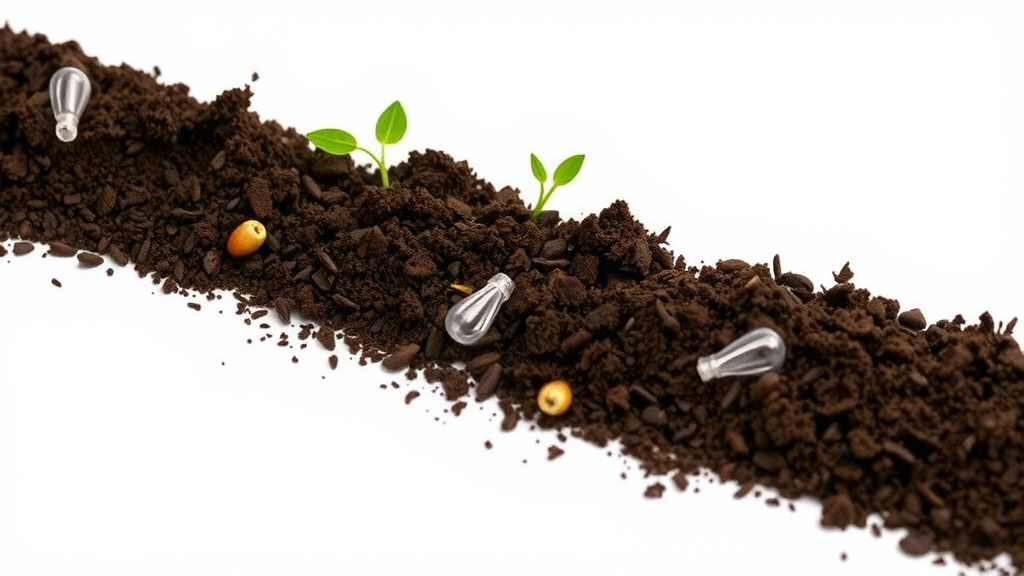
Plastic pollution has quietly become one of the defining contamination problems of the modern era, and its most troubling dimension may be the smallest. A new peer-reviewed review published in the journal Microplastics and Nanoplastics by Javad Karimi of Shiraz University in Iran and Sachin Seth and Reshma Sinha of Central University of Himachal Pradesh in India pulls together the scattered experimental literature on how microplastics and nanoplastics move from agricultural soils into plants, and from plants into the animals that eat them. The review, published open access on 25 September 2026, arrives at a moment when these particles have been detected in agricultural soils, water bodies, sediments, and even the atmosphere, raising urgent questions about whether the food on our plates carries an invisible cargo of degraded plastic.
The scale of the problem begins with the sheer ubiquity of the particles themselves. Microplastics, generally defined as plastic fragments smaller than five millimeters, and nanoplastics, which measure below one micrometer, are generated through the fragmentation and degradation of larger plastic materials as well as through direct release from industrial and consumer sources. Once in the environment, these particles do not travel alone. The review emphasizes that they can interact with co-contaminants, including heavy metals and persistent organic pollutants, effectively acting as tiny rafts that concentrate other toxins. They may also alter fundamental environmental properties and biological processes in the soils where food is grown, changing the very substrate on which agriculture depends.
Plants sit at the critical interface between this environmental contamination and the food web. As primary producers, they are the first biological gate through which soil-borne plastics must pass on their way to herbivores and, ultimately, to humans. The review’s synthesis of experimental evidence indicates that both microplastics and nanoplastics can be taken up by plants through their roots, and under certain conditions through aerial tissues such as leaves. But the two size classes behave very differently. Nanoscale particles, by virtue of their diminutive dimensions, generally show a far greater potential for internalization into plant tissues and for subsequent redistribution to above-ground parts, the very portions of the plant that most often end up as food.
The technical explanation for this size-dependent behavior lies in plant anatomy. Root cell walls, with their porous structure, act as a physical sieve that excludes particles above a certain diameter while permitting much smaller particles to pass. Once inside the root, particles must navigate the endodermis, a selective barrier that normally regulates the flow of water and solutes into the vascular system. Nanoplastics small enough to breach these defenses can be transported through the xylem, the plant’s water-conducting plumbing, and deposited in stems, leaves, and fruits. This translocation pathway is what transforms a soil contamination problem into a food safety problem, because it places plastic particles directly into edible plant biomass rather than leaving them on surfaces that might be washed away.
What happens when animals consume these contaminated plants is the second half of the story, and it is here that the review is most careful to draw distinctions. Following ingestion, experimental studies indicate that nanoplastics in particular can cross biological barriers in the gut and reach tissues beyond the gastrointestinal tract. In some model organisms, exposure to these particles has been associated with oxidative stress, inflammatory responses, cellular damage, and alterations in physiological or behavioral endpoints. These findings are striking, and they have fueled viral headlines about plastics invading the bodies of virtually every organism studied. Yet the review’s authors urge restraint in interpretation, noting that the relevance of such laboratory findings to environmentally realistic exposure levels, and to human health specifically, remains uncertain.
This distinction between exposure and harm is one of the review’s central contributions. The authors place particular emphasis on separating three concepts that are often conflated in public discussion: evidence of exposure, meaning that particles are present in an organism; demonstrated trophic transfer, meaning that particles move from one organism to another through feeding; and bioaccumulation and biomagnification, meaning that particle concentrations increase within an organism or up the food chain. While plant uptake is now well supported experimentally, the extent to which plant-associated plastics subsequently undergo trophic transfer to animals under environmentally realistic conditions remains less well established. Much of the strongest evidence comes from controlled laboratory settings where particle concentrations, sizes, and polymer types may not reflect what animals actually encounter in a field or pasture.
The uncertainty stems from several interacting factors that the review dissects in detail. Particle size matters enormously, as the nanoscale fraction behaves fundamentally differently from larger microplastics. Physicochemical properties such as polymer type, surface charge, and the presence of additives and adsorbed pollutants shape how particles interact with biological membranes and immune systems. Environmental conditions, including soil chemistry, moisture, and the presence of other contaminants, influence both plant uptake and particle fate. And analytical limitations compound everything: detecting and characterizing micro- and nanoplastics in complex biological matrices remains technically difficult, and the lack of standardized methods makes it hard to compare results across studies or to distinguish genuine contamination from laboratory background noise.
The detection challenge deserves particular attention because it underpins every other conclusion in the field. Identifying plastic particles in plant roots, leaves, or animal tissue requires methods capable of confirming both the chemical identity of the polymer and the size and morphology of the particle, all at very low concentrations in matrices full of natural organic material. The review surveys the analytical approaches currently available and highlights how methodological inconsistency has produced a fragmented evidence base. Without standardized protocols, a study reporting high particle counts in one food item may not be comparable to a study reporting low counts in another, leaving regulators and the public without a clear picture of actual exposure levels in the diet.
Against this backdrop of uncertainty, the review also considers what can be done. The authors argue that improving the characterization of transfer pathways through standardized methods, environmentally realistic field studies, and interdisciplinary research spanning plant science, animal physiology, and analytical chemistry is essential for strengthening environmental risk assessment. Better science, they contend, will inform proportionate strategies for reducing plastic inputs and exposure across agricultural and terrestrial food systems. That word, proportionate, is telling. The goal is not to dismiss concern but to ensure that mitigation efforts, from reducing plastic mulch and packaging in agriculture to improving waste management, are targeted at the pathways and particle types that genuinely matter for exposure.
The broader significance of the review lies in its sober framing of a topic prone to alarm. There is no doubt that plastic particles are present in agricultural environments and that plants can take them up, with nanoplastics posing the greater internalization risk. There is also no doubt that these particles can cause biological effects in laboratory organisms at sufficient doses. What remains to be demonstrated, with the rigor that food safety policy demands, is how efficiently these particles move through real food chains, whether they accumulate to meaningful concentrations in animal tissues, and what, if any, consequences follow for human consumers. By mapping the pathways, cataloging the uncertainties, and calling for standardized and realistic research, Karimi, Seth, and Sinha have provided both a warning and a roadmap, one that acknowledges the genuine threat of plastic pollution while insisting that the next generation of studies be designed to answer the questions that matter most.
Subject of Research: Trophic transfer of micro- and nanoplastics from plants to animals in terrestrial food chains
Article Title: Pathways of micro- and nanoplastics transfer from plants to animals in the food chain
Article References: Karimi, J., Seth, S., & Sinha, R. (2026). Pathways of micro- and nanoplastics transfer from plants to animals in the food chain. Microplastics and Nanoplastics. https://doi.org/10.1186/s43591-026-00232-2
Image Credits: AI Generated
DOI: 10.1186/s43591-026-00232-2
Keywords: microplastics, nanoplastics, plant uptake, trophic transfer, food chain, food safety, bioaccumulation, soil ecosystem, ecotoxicology, risk assessment, Pathways, micro-
Cite Scienmag News
Denise Maddox. (September 25, 2026). From Soil to Plate: How Tiny Plastics Climb the Food Chain. Scienmag. https://scienmag.com/from-soil-to-plate-how-tiny-plastics-climb-the-food-chain/
Denise Maddox. "From Soil to Plate: How Tiny Plastics Climb the Food Chain." Scienmag, 25 September 2026, https://scienmag.com/from-soil-to-plate-how-tiny-plastics-climb-the-food-chain/. Accessed 4 October 2026.
Denise Maddox. "From Soil to Plate: How Tiny Plastics Climb the Food Chain." Scienmag. September 25, 2026. https://scienmag.com/from-soil-to-plate-how-tiny-plastics-climb-the-food-chain/


