


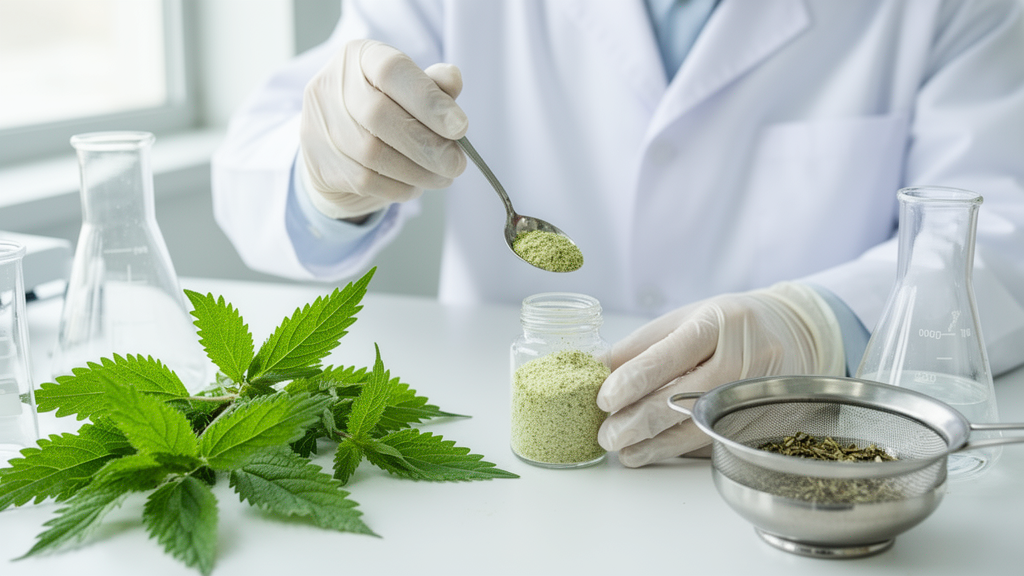
In a laboratory in Paulínia, Brazil, researchers have done something deceptively simple: they took a plant long brewed as a tea for upset stomachs and turned it into a rigorously engineered pharmaceutical granule. The plant is Monteverdia ilicifolia, known across Brazil as espinheira-santa, a shrub whose spiny, holly-like leaves have earned a place in the country’s primary healthcare system for their antidyspeptic, antacid, and gastric-protective properties. What makes the new study remarkable is not the plant itself, but the industrial discipline applied to it: a full Quality by Design, or QbD, campaign that traced every step from the field where the leaves were harvested to the granulated powder that could one day sit in a pharmacy jar.
Herbal medicines are notoriously difficult to manufacture consistently. Unlike a synthetic pill, whose active ingredient is a single, precisely defined molecule, a plant-derived extract is a shifting cocktail of polyphenols, tannins, and flavanols whose proportions depend on soil, weather, harvest timing, drying conditions, and dozens of processing choices. A tea made in one kitchen may differ dramatically from one made in another, and even a factory following a traditional recipe can produce batches that vary widely in potency. Most previous studies of espinheira-santa examined isolated steps in this chain; the team, led by Alberto Araujo de Caux of the State University of Campinas (UNICAMP), set out to map and control the entire journey at once.
The framework they used, Quality by Design, is a regulatory philosophy codified in the International Council for Harmonisation guideline Q8. Instead of testing finished products and rejecting bad batches, QbD demands that manufacturers understand their process so deeply that quality is built in from the start. The researchers began by defining a Quality Target Product Profile: a water-soluble dry extract of M. ilicifolia with industrially manageable powder properties that preserved the chemistry of the original aqueous extract. From that goal they derived fifteen Critical Quality Attributes, ranging from total polyphenol and tannin content to residual moisture, powder flowability, hygroscopicity, and even color.
Next came process mapping and risk assessment. Using Failure Mode and Effects Analysis, consistent with ISO 14971 standards, the team scored potential failures across seven stages: harvesting, drying, milling, extraction, concentration, spray drying, and granulation. Each hazard was rated for probability, detectability, and severity, producing Risk Priority Numbers that flagged which variables deserved experimental scrutiny. The mass balance of the full chain proved sobering: roughly 570 grams of dried leaves were needed to yield just 100 grams of finished granules, a cumulative yield of 17.6 percent, with extraction and spray drying accounting for the largest losses. Drying emerged as the operational bottleneck, demanding 72 hours of forced-air circulation while everything downstream together took barely a tenth of that time.
The extraction step, the chemical heart of the process, was attacked first with a Plackett-Burman screening design. This statistical tool allowed the researchers to test nine factors simultaneously in just twelve trials per method, for both decoction and infusion as prescribed by the Brazilian Pharmacopoeia. Two factors rose decisively above the noise: the drug-to-extract ratio, varied between 1 and 2 percent, and the degree of fragmentation of the dried leaves, comparing shredded material with finely powdered drug. Grinding the leaves increased the surface area available to the solvent, boosting the recovery of polyphenols, tannins, and the marker flavanols epicatechin and catechin. Surprisingly, factors that home herbalists obsess over, such as boiling time, extraction duration, and vessel material, had little consistent effect within the studied ranges.
The screening results carried a striking practical implication. Across the 24 laboratory trials, extracted polyphenol content ranged from about 40 milligrams to more than 145 milligrams per batch, a more than threefold difference in the dose a patient would receive from preparations all nominally following pharmacopoeial guidance. In other words, subtle variations in how an infusion or decoction is prepared could translate into substantially different therapeutic exposures, a finding that underscores why standardization matters for traditional remedies.
Scale-up introduced its own surprises. When the extraction was transferred to pilot-scale equipment thirty times larger, the team ran a Central Composite Design testing drug-to-extract ratios of 4 to 6 percent and agitation from 0 to 400 revolutions per minute. Agitation, negligible at bench scale, became a determining factor in the larger vessel, a classic illustration of why process behavior cannot simply be extrapolated. Higher stirring rates improved contact between solvent and plant matrix, while increasing the drug-to-extract ratio raised absolute yields of markers but diluted their relative concentration, hinting at solvent saturation. All pilot conditions produced extracts meeting Brazilian Pharmacopoeia specifications for total tannins, above 2 percent, and epicatechin, above 0.28 percent.
The final transformation, spray drying followed by granulation, was optimized with a 17-assay Central Composite Rotatable Design exploring maltodextrin concentration from 0 to 60 percent, feed rate from 3.9 to 8.1 milliliters per minute, and inlet air temperature from 120 to 200 degrees Celsius. Maltodextrin, a common carrier, dramatically reshaped the powder’s personality: more carrier produced lighter, better-flowing granules but diluted the active markers, raising the dose a patient must swallow. Temperature and feed rate modulated moisture, density, and the Carr index of compressibility. For granulation, the team chose hydroxypropyl methylcellulose as a binder rather than the more common polyvinylpyrrolidone, because PVP can form insoluble complexes with tannins and lock away the very compounds that give the medicine its activity. Residual moisture stayed below the critical 5 percent threshold in every run, confirming the spray dryer’s protective effect on a heat-sensitive botanical matrix.
Desirability analysis, which blends all quality goals into a single optimization score, revealed an honest limit: no single spray-drying condition could satisfy every attribute simultaneously, with global desirability falling below 0.7. The team therefore validated two candidate conditions in triplicate. The first, close to the modeled optimum, used no maltodextrin, a 20 percent feed rate, and 160 degree inlet air, delivering nearly 14 percent polyphenols and dense, fast-wetting granules. The second, with 45 percent maltodextrin, sacrificed chemical concentration for improved flow and reduced hygroscopicity. Process yield and marker retention proved statistically indistinguishable between the two, demonstrating that formulation choices could tune the product’s physical behavior without compromising chemical integrity, precisely the kind of flexible, evidence-based control that a Design Space is meant to provide.
The broader significance extends beyond one Brazilian shrub. Espinheira-santa has long been confounded with lookalike species such as Sorocea bonplandii and Zollernia ilicifolia, which share its popular name and can adulterate commercial supplies, making authenticated, chemically consistent manufacturing all the more urgent. By showing that a medicinal plant can be taken from a registered experimental field, through botanically verified harvesting, statistically optimized extraction, and validated drying and granulation, the UNICAMP team has offered a template for modernizing phytotherapy across the board. The authors note that future work should incorporate high-shear and fluidized-bed granulation for true industrial scale, assess raw material variability from different suppliers, and conduct long-term stability and biological activity studies. But the core message already stands: a plant that indigenous Mapuche communities prized centuries ago, and that Brazilian clinics prescribe today, can meet the same quantitative standards of reproducibility demanded of any synthetic drug, provided every leaf, liter, and degree along the way is treated as a measurable, controllable variable.
Subject of Research: Quality by Design development of a Monteverdia ilicifolia herbal medicine from plant harvesting to granulated extract
Article Title: Quality by design driven development of a Monteverdia ilicifolia herbal medicine: from plant to granules
Article References: de Caux, A. A., Klier Monteiro Filho, J. C., Barbosa da Silva e Medeiros, R., Villa Nova Rodrigues, M., Alves, M. N., Soares Forte, M. B., Rodrigues, M. I., & Ferreira Rodrigues, R. A. (2026). Quality by design driven development of a Monteverdia ilicifolia herbal medicine: from plant to granules. Frontiers in Natural Products, 5, Article 1887810. https://doi.org/10.3389/fntpr.2026.1887810
Image Credits: AI Generated
DOI: 10.3389/fntpr.2026.1887810
Keywords: Monteverdia ilicifolia, espinheira-santa, Quality by Design, design of experiments, herbal medicine, spray drying, granulation, process validation, polyphenols, tannins, risk assessment, pharmaceutical manufacturing
Cite Scienmag News
Denise Maddox. (October 15, 2026). From Field to Granules: Scientists Engineer a Stomach-Soothing Brazilian Herb Into a Modern Medicine. Scienmag. https://scienmag.com/from-field-to-granules-scientists-engineer-a-stomach-soothing-brazilian-herb-into-a-modern-medicine/
Denise Maddox. "From Field to Granules: Scientists Engineer a Stomach-Soothing Brazilian Herb Into a Modern Medicine." Scienmag, 15 October 2026, https://scienmag.com/from-field-to-granules-scientists-engineer-a-stomach-soothing-brazilian-herb-into-a-modern-medicine/. Accessed 15 October 2026.
Denise Maddox. "From Field to Granules: Scientists Engineer a Stomach-Soothing Brazilian Herb Into a Modern Medicine." Scienmag. October 15, 2026. https://scienmag.com/from-field-to-granules-scientists-engineer-a-stomach-soothing-brazilian-herb-into-a-modern-medicine/


