


In vitro fertilization has helped millions of couples conceive, yet even the most sophisticated clinics face a stubborn bottleneck: the embryo sometimes has nowhere hospitable to land. Controlled ovarian hyperstimulation, the hormonal step that coaxes ovaries to mature multiple eggs at once, is indispensable for harvesting oocytes, but mounting evidence shows it can leave the uterine lining, the endometrium, out of sync with the arriving embryo. Now a team of researchers in China reports that a therapy rooted in traditional medicine, electroacupuncture, can partially repair this damage in rats, and that its benefit appears to hinge on something surprising: the womb’s own circadian clock. The study, published in Frontiers in Physiology, tracked the rhythmic oscillations of clock genes across the implantation window and found that fertility drug treatment scrambles their timing, while electroacupuncture restores it, raising pregnancy rates in the process.
The researchers, led by Qian Zhu and colleagues at Nanjing University of Chinese Medicine and Qinghai University, focused on a clock gene called Per2, a core component of the molecular machinery that generates roughly 24-hour rhythms in cells throughout the body. In the canonical circadian loop, the CLOCK and BMAL1 proteins drive transcription of Period genes such as Per2, whose protein products then feed back to inhibit their own production, creating a self-sustaining oscillation. The endometrium is no passive bystander to this loop. Estrogen and progesterone, the hormones that orchestrate the menstrual cycle and early pregnancy, can reset clock gene expression in uterine tissue, and previous work has shown that progesterone can dose-dependently delay the peak of Per2 expression. That observation provided the seed for the new hypothesis: if fertility drugs flood the body with supraphysiological steroid hormones, they might throw the uterine oscillator off beat precisely when the embryo needs it most.
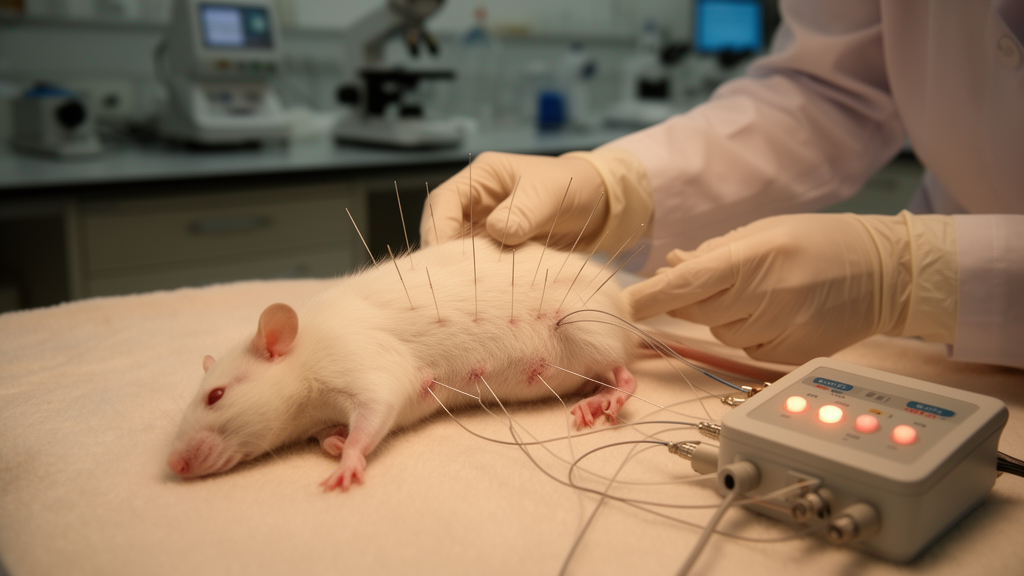
To test this, the team established a controlled ovarian hyperstimulation model in 126 female Sprague-Dawley rats, injecting pregnant mare serum gonadotropin followed by human chorionic gonadotropin to mimic the superovulation protocols used clinically. Three groups were compared: untreated controls, hormone-treated rats, and hormone-treated rats that also received electroacupuncture at two established acupuncture points, RN4 on the lower abdomen and SP6 on the lower leg. Stimulation was delivered daily for fifteen minutes at low frequency, 2/15 Hz, with alternating sides. The researchers then sampled pseudopregnant animals, mated with vasectomized males to isolate the maternal uterine environment from embryo-derived signals, every four hours across the implantation window on day 5.5 of gestation, capturing the full sweep of a circadian cycle in the uterine lining.
The results were striking. Hyperstimulated rats showed an abnormal surge in circulating progesterone with an unusually high amplitude and a delayed peak, and this hormonal distortion was temporally coupled to a delayed, amplified Per2 rhythm in the endometrium. Other clock genes responded differently: Clock and Per1 advanced in phase and lost amplitude, while Bmal1 and Per2 delayed and strengthened, indicating that the internal coupling of the clock network was disrupted rather than simply damped. Most tellingly, Per2 oscillated in near-perfect anti-phase with Vegf, the gene encoding vascular endothelial growth factor, a protein central to endometrial vascular remodeling. Because Per2 is known to promote degradation of HIF-1alpha, a transcription factor that drives Vegf production, the researchers reasoned that a hyperactive Per2 rhythm was suppressing the angiogenic support that the implanting embryo requires.
The downstream consequences followed logically. During the implantation window, hormone-treated rats showed downregulated expression of Vegf and integrin alphavbeta3, an adhesion molecule on the luminal epithelium that helps the embryo attach and invade. Under the scanning electron microscope, pinopodes, the mushroom-shaped protrusions of the uterine lining considered a morphological hallmark of receptivity, were collapsed and atrophied rather than mature and abundant. The uterus itself behaved oddly in time, showing premature dilation followed by rapid atrophy instead of the progressive expansion seen in controls. Most importantly, actual pregnancy rates collapsed: only one of six mated rats in the model group became pregnant, yielding a pregnancy rate of roughly 17 percent compared with 100 percent in controls.
Electroacupuncture reversed much of this cascade. Treated animals showed normalized progesterone amplitude without a phase change, corrected Per2 rhythm parameters, restored Vegf and integrin alphavbeta3 expression toward control levels, recovered healthier pinopode morphology, and maintained a more appropriately dilated uterine cavity late in the implantation window. Pregnancy rates climbed to 50 percent, and ultrasound on day 15 revealed no obvious embryonic abnormalities in any group, suggesting the intervention did not harm mid-term development. Interestingly, Vegf in the electroacupuncture group did not resume rhythmic oscillation; instead, it settled into a stable, elevated plateau. The authors suggest that the therapy works not by mechanically reinstating every molecular rhythm but by repairing the upstream timing defects so that downstream effectors can hold a state favorable for implantation.
To probe whether Per2 genuinely mediates the effect, the team turned to Per2 knockout mice, animals genetically engineered to lack the clock gene entirely. In wild-type mice subjected to the hyperstimulation model, electroacupuncture strongly upregulated Vegf and integrin alphavbeta3. In the knockouts, the upregulation was significantly weaker, and the therapy’s ability to lower progesterone disappeared altogether. The authors interpret this as preliminary evidence that Per2 participates in mediating electroacupuncture’s benefits, while cautioning that some residual effect persisted in the knockouts, implying parallel, Per2-independent pathways. They also note a possible bidirectional relationship: clock genes in the ovary help regulate rhythmic steroidogenic enzyme expression, so Per2 may not merely respond to progesterone but also influence its production by modulating ovarian function.
The study has important limitations that the authors acknowledge candidly. There was no sham acupuncture control group, such as needling at non-acupoint locations, so the contribution of acupoint-specific stimulation versus the general physiological effects of needling and restraint cannot be disentangled. The knockout mouse cohort was small, and because Per2 is deleted systemically rather than only in the uterus, the experiments cannot rule out indirect effects through the ovaries or other tissues. Protein-level confirmation by Western blot was performed at a single time point, leaving the full rhythmic dynamics of Per2 and Vegf proteins unexplored, and the proposed direct regulatory link between Per2 and Vegf in endometrial cells awaits confirmation through chromatin immunoprecipitation or reporter assays in vitro. Clinical translation, moreover, requires demonstrating that the same clock-based mechanism operates in the human endometrium under IVF protocols.
Still, the conceptual payoff is considerable. Most prior research on how fertility drugs impair endometrial receptivity has examined static molecular snapshots, such as altered receptor expression or pathway activation. By shifting the lens to chronobiology, this work reframes implantation failure as a problem of timing, not merely of quantity, in which the temporal architecture of the uterine clock gene network matters as much as the molecules themselves. It also offers a mechanistic account for why acupuncture, whose reproductive benefits have been suggested by systematic reviews and meta-analyses of clinical trials, might work, connecting a traditional intervention to the modern language of peripheral circadian oscillators and hormone-coupled gene rhythms. If future studies with sham controls, conditional knockouts, and human tissue replicate these findings, timing-based interventions aimed at the endometrial clock could become an intriguing adjuvant strategy in assisted reproduction, complementing the growing practice of frozen embryo transfer, which already circumvents the hormonal storm of stimulation by giving the endometrium a quieter cycle in which to receive the embryo.
Subject of Research: Electroacupuncture restoration of endometrial Per2 circadian rhythm in controlled ovarian hyperstimulation
Article Title: Electroacupuncture improves endometrial receptivity and pregnancy outcomes in controlled ovarian hyperstimulation rats by restoring Per2 circadian rhythm
Article References: Zhu, Q., Li, Q., Zan, Y., Ma, T., Fang, Y., Sa, Y., Xu, T., Xia, L., & Xia, Y. (2026). Electroacupuncture improves endometrial receptivity and pregnancy outcomes in controlled ovarian hyperstimulation rats by restoring Per2 circadian rhythm. Frontiers in Physiology, 17, Article 1812562. https://doi.org/10.3389/fphys.2026.1812562
Image Credits: AI Generated
DOI: 10.3389/fphys.2026.1812562
Keywords: electroacupuncture, endometrial receptivity, circadian rhythm, Per2, controlled ovarian hyperstimulation, IVF-ET, implantation window, progesterone, Vegf, integrin alphavbeta3, pinopodes, reproductive physiology
Cite Scienmag News
Juliet Wilcox. (October 15, 2026). Electroacupuncture Rewires the Uterine Clock to Boost Implantation in IVF Rats. Scienmag. https://scienmag.com/electroacupuncture-rewires-the-uterine-clock-to-boost-implantation-in-ivf-rats/
Juliet Wilcox. "Electroacupuncture Rewires the Uterine Clock to Boost Implantation in IVF Rats." Scienmag, 15 October 2026, https://scienmag.com/electroacupuncture-rewires-the-uterine-clock-to-boost-implantation-in-ivf-rats/. Accessed 15 October 2026.
Juliet Wilcox. "Electroacupuncture Rewires the Uterine Clock to Boost Implantation in IVF Rats." Scienmag. October 15, 2026. https://scienmag.com/electroacupuncture-rewires-the-uterine-clock-to-boost-implantation-in-ivf-rats/


