


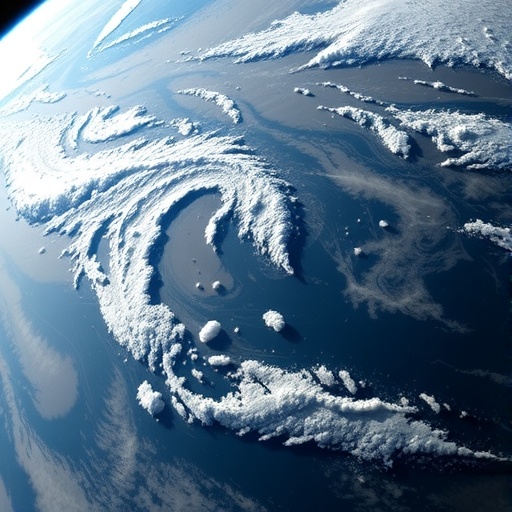
In early February 2022, a moderate geomagnetic storm dramatically illustrated the vulnerability of modern technology to space weather. Shortly after launch, SpaceX lost 38 out of 49 Starlink satellites, underscoring that even modest solar activity can wreak havoc on intricate human systems. This event highlights the critical necessity to better predict and forecast space weather to mitigate its impact on satellites, power grids, transportation networks, and even biological systems on Earth.
Solar storms originate from intense bursts of energy on the Sun’s surface, such as solar flares and coronal mass ejections, propelling charged particles and electromagnetic radiation into space. When these energetic events reach Earth, they interact with the magnetosphere and ionosphere, inducing electric currents that can disrupt technological infrastructure. The magnetosphere-ionosphere system acts as a complex interface where solar wind energy is transferred and converted, leading to perturbations that are often intertwined with signals from terrestrial natural hazards, complicating detection and response strategies.
At the forefront of tackling this challenge is the Swarm-AWARE initiative, launched by the European Space Agency and elaborated upon at the 2026 European Geosciences Union General Assembly. Led by Georgios Balasis from the National Observatory of Athens, Swarm-AWARE aims to disentangle the electromagnetic signatures of space weather from those triggered by natural terrestrial hazards. This distinction is crucial for safeguarding critical infrastructure, enhancing communication systems, and improving early warning mechanisms for both space weather and geological events.
The ESA’s Swarm mission comprises a constellation of satellites measuring Earth’s magnetic field with unparalleled precision, alongside plasma densities, temperatures, and electric fields. By integrating these comprehensive datasets with observations from ground stations and Copernicus Sentinel-5P, researchers are forming a holistic picture of the ionospheric environment. This integration is vital to parse out the subtle electromagnetic variations that distinguish solar storm effects from natural phenomena such as volcanic eruptions or earthquakes.
A striking example used by the Swarm-AWARE team is the 2022 eruption of Hunga Tonga-Hunga Ha’apai. This colossal volcanic event injected massive amounts of water vapor into the stratosphere and generated atmospheric waves that propagated into the ionosphere. These waves induced dramatic perturbations in ionospheric densities and spawned electric fields traveling along magnetic field lines, producing near-instantaneous electromagnetic responses measurable across the Pacific. The Swarm satellites detected these perturbations, revealing the intricate coupling between terrestrial events and space weather-related ionospheric changes.
Applying cutting-edge machine learning techniques and sophisticated time series analyses, the Swarm-AWARE project seeks to unravel the complexity of these overlapping signals. By training algorithms on a wealth of satellite and ground-based data, the team aims to develop predictive models that can forecast the impact of space weather with greater reliability. Such advancements would empower operators of technological infrastructures to anticipate disturbances, reducing downtime and preventing widespread failures.
Intrinsic to this research is understanding how space weather-induced electric fields replicate or mask signals from natural hazards. Distinguishing between these is not only a scientific curiosity but a practical necessity to avoid false alarms in hazard detection or missed warnings that could culminate in catastrophic consequences. For example, geomagnetic storms can induce currents in power grids resembling those caused by seismic activities, challenging conventional monitoring systems.
The Swarm satellites’ measurement capabilities push the boundaries of space weather science. Their magnetometers achieve exquisite sensitivity, capturing rapid and localized fluctuations in Earth’s magnetic environment. These details reveal how solar-induced electric fields modulate the ionosphere and couple with Earth’s magnetic geometry. Ultimately, a deeper understanding of these interactions will facilitate more nuanced forecasts and response strategies.
Moreover, data from the Copernicus Sentinel-5P satellite complements Swarm observations by providing atmospheric composition information, such as trace gases and aerosols. This allows for a multifaceted approach in which atmospheric constituents and electromagnetic data converge to provide a more complete understanding of geospace dynamics during solar storms and natural hazards.
The repercussions of this work extend beyond scientific knowledge to tangible societal benefits. Enhanced space weather forecasting will improve the safety and reliability of satellite operations, GPS navigation, aviation, and electrical power distribution. Additionally, understanding ionospheric dynamics aids radio communications and supports military and emergency services that rely heavily on uninterrupted signal integrity.
Looking forward, the Swarm-AWARE project intends to continuously refine its predictive models by assimilating ever-growing datasets and employing advancements in artificial intelligence. Their vision is a near-real-time monitoring and prediction system that can anticipate space weather impacts before they materialize, enabling preemptive protective actions across multiple sectors.
In summary, the intersection of space weather and natural hazards represents a complex frontier with significant implications for Earth’s technological and ecological systems. Through integrating innovative satellite observations with sophisticated analytical tools, the Swarm-AWARE mission stands as a beacon of progress, safeguarding our increasingly interconnected world from the whims of solar and terrestrial forces.
News Publication Date: May 6, 2026
Cite Scienmag News
Russell Cooper. (May 6, 2026). From Earth’s Surface to the Skies: How New Satellite Data Pinpoints and Characterizes Destructive Events. Scienmag. https://scienmag.com/from-earths-surface-to-the-skies-how-new-satellite-data-pinpoints-and-characterizes-destructive-events/
Russell Cooper. "From Earth’s Surface to the Skies: How New Satellite Data Pinpoints and Characterizes Destructive Events." Scienmag, 6 May 2026, https://scienmag.com/from-earths-surface-to-the-skies-how-new-satellite-data-pinpoints-and-characterizes-destructive-events/. Accessed 4 September 2026.
Russell Cooper. "From Earth’s Surface to the Skies: How New Satellite Data Pinpoints and Characterizes Destructive Events." Scienmag. May 6, 2026. https://scienmag.com/from-earths-surface-to-the-skies-how-new-satellite-data-pinpoints-and-characterizes-destructive-events/


