


Uncovering the genetic saga of Castanea trees, a pivotal study maps their evolutionary journey and local climate adaptations. This research pierces through the veil of time to reveal the genetic markers and molecular mechanisms that have allowed these nut fruit trees to adapt and flourish across East Asia, offering precious insights for their future in the face of environmental challenges.
Chestnuts, a vital nut fruit tree, have played a significant role in ecosystems and human cultivation for thousands of years. However, understanding their genetic relationships and how they’ve adapted to different climates remains a challenge. The study of these species’ evolutionary history is complicated by the lack of comprehensive genomic data, leading to varying hypotheses about their origins and adaptations. Due to these challenges, there is a pressing need to conduct in-depth research on the genomic basis of chestnut adaptation to diverse environmental conditions.
In a study (DOI: 10.1093/hr/uhae147) published on May 28, 2024, in Horticulture Research, a team from the Beijing University of Agriculture and Liaoning Economic Forest Research Institute explored the evolutionary history and local adaptation of chestnut species in East Asia. The research used genomic data from 394 chestnut samples to uncover how these species diverged and adapted to different climates over millions of years. The study provides new insights into the genetic mechanisms underlying these adaptations, with potential applications in improving the resilience of chestnut species to climate change.
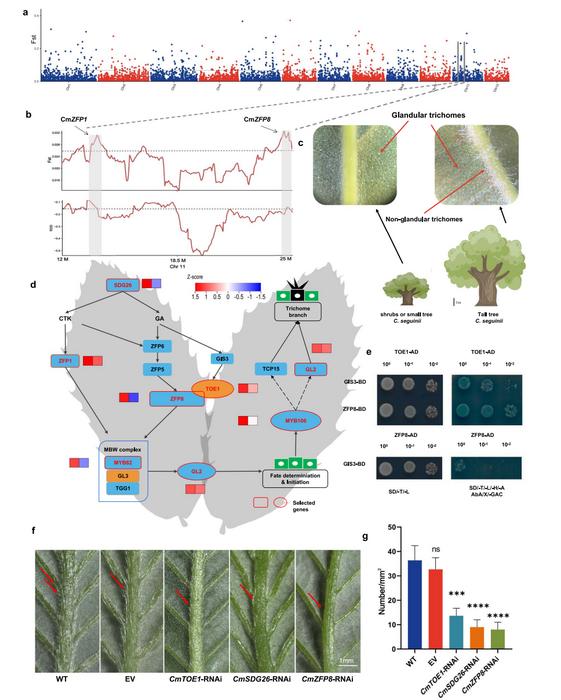
The study analyzed the genomes of 394 chestnut samples across four East Asian species, revealing significant genetic diversity and adaptation mechanisms. The researchers found that Castanea henryi is the oldest species in the genus, diverging around 31.56 million years ago, followed by Castanea mollissima. The study identified 22 candidate genes associated with temperature and precipitation adaptations, highlighting the molecular mechanisms that enable these species to thrive in diverse environments. One of the key findings was the interaction between CmTOE1, CmZFP8, and CmGIS3 genes, which promotes the formation of non-glandular trichomes—a crucial adaptation for surviving in cold and high-altitude environments. Additionally, the study revealed a significant expansion of the CER1 gene family in Chinese chestnuts, which plays a vital role in drought resistance by regulating leaf wax thickness. These discoveries provide a deeper understanding of the genetic basis for the environmental adaptability of chestnut species and offer valuable genetic resources for breeding programs aimed at enhancing resilience to climate change.
Professor Ling Qin from Beijing University of Agriculture stated, “Our study uncovers key genetic adaptations in East Asian chestnuts, paving the way for future research to enhance their resilience to environmental challenges and support breeding programs for improved climate adaptability.”
The study’s findings offer critical insights for breeding chestnut varieties with enhanced resilience to climate change. Identified genes can improve drought tolerance, cold resistance, and adaptability, supporting sustainable cultivation and conservation. This research also paves the way for exploring the evolution and adaptation of other nut species.

Credit: Horticulture Research
Uncovering the genetic saga of Castanea trees, a pivotal study maps their evolutionary journey and local climate adaptations. This research pierces through the veil of time to reveal the genetic markers and molecular mechanisms that have allowed these nut fruit trees to adapt and flourish across East Asia, offering precious insights for their future in the face of environmental challenges.
Chestnuts, a vital nut fruit tree, have played a significant role in ecosystems and human cultivation for thousands of years. However, understanding their genetic relationships and how they’ve adapted to different climates remains a challenge. The study of these species’ evolutionary history is complicated by the lack of comprehensive genomic data, leading to varying hypotheses about their origins and adaptations. Due to these challenges, there is a pressing need to conduct in-depth research on the genomic basis of chestnut adaptation to diverse environmental conditions.
In a study (DOI: 10.1093/hr/uhae147) published on May 28, 2024, in Horticulture Research, a team from the Beijing University of Agriculture and Liaoning Economic Forest Research Institute explored the evolutionary history and local adaptation of chestnut species in East Asia. The research used genomic data from 394 chestnut samples to uncover how these species diverged and adapted to different climates over millions of years. The study provides new insights into the genetic mechanisms underlying these adaptations, with potential applications in improving the resilience of chestnut species to climate change.
The study analyzed the genomes of 394 chestnut samples across four East Asian species, revealing significant genetic diversity and adaptation mechanisms. The researchers found that Castanea henryi is the oldest species in the genus, diverging around 31.56 million years ago, followed by Castanea mollissima. The study identified 22 candidate genes associated with temperature and precipitation adaptations, highlighting the molecular mechanisms that enable these species to thrive in diverse environments. One of the key findings was the interaction between CmTOE1, CmZFP8, and CmGIS3 genes, which promotes the formation of non-glandular trichomes—a crucial adaptation for surviving in cold and high-altitude environments. Additionally, the study revealed a significant expansion of the CER1 gene family in Chinese chestnuts, which plays a vital role in drought resistance by regulating leaf wax thickness. These discoveries provide a deeper understanding of the genetic basis for the environmental adaptability of chestnut species and offer valuable genetic resources for breeding programs aimed at enhancing resilience to climate change.
Professor Ling Qin from Beijing University of Agriculture stated, “Our study uncovers key genetic adaptations in East Asian chestnuts, paving the way for future research to enhance their resilience to environmental challenges and support breeding programs for improved climate adaptability.”
The study’s findings offer critical insights for breeding chestnut varieties with enhanced resilience to climate change. Identified genes can improve drought tolerance, cold resistance, and adaptability, supporting sustainable cultivation and conservation. This research also paves the way for exploring the evolution and adaptation of other nut species.
###
References
Original Source URL
Funding information
This work was supported by grants from the National Natural Science Foundation of China (32271929) and the National Key Research & Development Program of China (2018YFD1000605).
About Horticulture Research
Horticulture Research is an open access journal of Nanjing Agricultural University and ranked number two in the Horticulture category of the Journal Citation Reports ™ from Clarivate, 2023. The journal is committed to publishing original research articles, reviews, perspectives, comments, correspondence articles and letters to the editor related to all major horticultural plants and disciplines, including biotechnology, breeding, cellular and molecular biology, evolution, genetics, inter-species interactions, physiology, and the origination and domestication of crops.
Journal
Horticulture Research
Subject of Research
Not applicable
Article Title
New insights into the evolution and local adaptation of the genus Castanea in east Asia
Article Publication Date
28-May-2024
COI Statement
The authors declare that they have no competing interests.
Cite Scienmag News
Juliet Wilcox. (August 26, 2024). From antiquity to adaptation: Tracing the genetic journey of east Asian chestnut varieties. Scienmag. https://scienmag.com/from-antiquity-to-adaptation-tracing-the-genetic-journey-of-east-asian-chestnut-varieties/
Juliet Wilcox. "From antiquity to adaptation: Tracing the genetic journey of east Asian chestnut varieties." Scienmag, 26 August 2024, https://scienmag.com/from-antiquity-to-adaptation-tracing-the-genetic-journey-of-east-asian-chestnut-varieties/. Accessed 5 September 2026.
Juliet Wilcox. "From antiquity to adaptation: Tracing the genetic journey of east Asian chestnut varieties." Scienmag. August 26, 2024. https://scienmag.com/from-antiquity-to-adaptation-tracing-the-genetic-journey-of-east-asian-chestnut-varieties/

