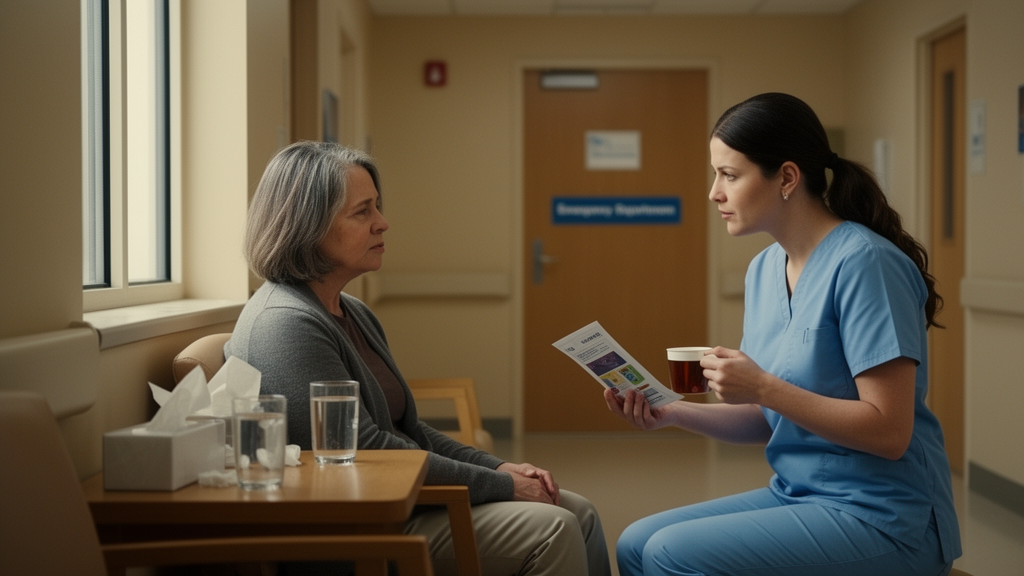
Emergency departments in France see a small but steady stream of deaths: roughly 0.2 percent of visits end with the patient dying, which works out to a median of two deaths per week in a single department. For the relatives at the bedside, the suddenness of an emergency death can leave lasting psychological scars. A new study protocol published in BMC Palliative Care describes MYRIADE, a cluster randomized controlled trial designed to test whether a structured, low-resource support strategy delivered in the emergency department can reduce the risk of prolonged grief disorder among bereaved family members.
The trial, led by researchers including Mélanie Roussel and Yonathan Freund, will enroll relatives of patients who die either in the emergency department or in its observation unit, where the anticipated life expectancy is under 72 hours and a treatment-limitation decision has been made. Bereaved relatives face an elevated risk of prolonged grief disorder and post-traumatic stress disorder, conditions that can persist for months and impair daily functioning. The study team notes that no randomized trial has yet tested a comprehensive multifaceted intervention for this population in the emergency setting.
The rationale draws partly on intensive care research. In the ICU, interventions that combine proactive communication strategies, informational support, and family involvement in patient care have been shown to improve psychological outcomes for relatives. But the emergency department differs in important ways: exposure to the dying process is much shorter, and emergency professionals are generally less accustomed to providing end-of-life care. Whether an adapted version of the ICU approach can work under these constraints is precisely what MYRIADE aims to determine.
The intervention unfolds in three steps. At arrival, staff provide proactive communication with relatives and hand out an information booklet accompanied by short videos. During the patient’s course, relatives are given the opportunity to take part in nursing care. After the death, the team holds a dedicated discussion with the family and provides bereavement materials. Notably, the strategy requires no additional staff, which the investigators say could make it widely implementable if proven effective.
MYRIADE is a prospective, multicentre, parallel cluster randomized controlled trial involving 31 French emergency departments. Centres are randomized 1:1 to the intervention or to usual care, with stratification by academic status and by size, defined as small versus large according to each department’s inclusion potential. Clustering the randomization by centre helps avoid contamination, since individual randomization within a single department would risk mixing intervention and control practices among staff caring for the same patients.
The primary outcome is prolonged grief disorder, measured with the Prolonged Grief 13-item revised scale six months after the death. Secondary outcomes include post-traumatic stress disorder assessed with the PCL-5, and anxiety and depression measured with the HADS, all at three months. A total of 924 relatives, 462 per group, gives the trial 80 percent power to detect a reduction in the proportion experiencing prolonged grief from 25 percent to 15 percent, with the calculation accounting for the cluster design.
Analysis will follow the intention-to-treat principle, using generalized linear mixed models with centre included as a random effect. This statistical approach respects the original group assignment regardless of how much of the intervention relatives actually received, and the random effect for centre adjusts for the correlation between participants recruited at the same site. The trial is registered at ClinicalTrials.gov under NCT06733974, registered on 13 December 2024, and funded by the French Ministry of Health through the PHRC-N 2023 program.
Because this is a published study protocol, the article reports the planned design rather than results. No findings on the effectiveness of the intervention exist yet; those will depend on trial completion and follow-up. The investigators frame the work as the first randomized trial to assess a multifaceted intervention for relatives of patients dying in the emergency department, and they emphasize that a positive result would support broad adoption of a strategy that adds no staffing burden. The open-access protocol was published on 23 October 2026.
Subject of Research: A cluster randomized controlled trial protocol testing a multifaceted support intervention for relatives of patients dying in French emergency departments to reduce prolonged grief disorder.
Article Title: A multifaceted intervention strategy for relatives of patients dying in the emergency department to reduce prolonged grief: study protocol for a cluster randomized controlled trial (MYRIADE)
Article References: Roussel, M., Gay, M., Gautier, M., Le Borgne, P., Beauvais, A., Javaud, N., Berard, L., Rousseau, A., Simon, T., & Freund, Y. (2026). A multifaceted intervention strategy for relatives of patients dying in the emergency department to reduce prolonged grief: study protocol for a cluster randomized controlled trial (MYRIADE). BMC Palliative Care. https://doi.org/10.1186/s12904-026-02381-w
Image Credits: AI Generated
DOI: 10.1186/s12904-026-02381-w
Keywords: emergency department, prolonged grief disorder, bereavement, cluster randomized trial, palliative care, post-traumatic stress disorder, family support, end-of-life care, study protocol, France, multifaceted, intervention
Cite Scienmag News
Ophelia Keating. (October 28, 2026). French trial to test support program for relatives after emergency department deaths. Scienmag. https://scienmag.com/french-trial-to-test-support-program-for-relatives-after-emergency-department-deaths/
Ophelia Keating. "French trial to test support program for relatives after emergency department deaths." Scienmag, 28 October 2026, https://scienmag.com/french-trial-to-test-support-program-for-relatives-after-emergency-department-deaths/. Accessed 28 October 2026.
Ophelia Keating. "French trial to test support program for relatives after emergency department deaths." Scienmag. October 28, 2026. https://scienmag.com/french-trial-to-test-support-program-for-relatives-after-emergency-department-deaths/