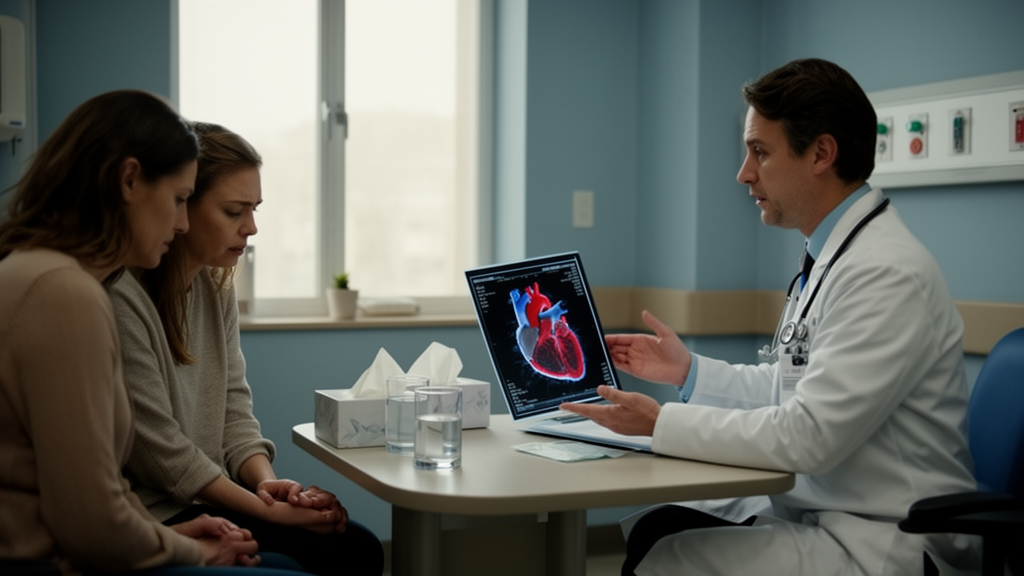
When someone dies suddenly from a cardiac cause, the autopsy that follows can do more than establish why the heart stopped. It may uncover a hereditary heart disorder, a finding that turns a single death into a warning for surviving relatives, who may need detailed cardiological evaluation, genetic counseling and cascade screening of family members. Yet the conversation in which those findings reach the family is often left to chance. A team of forensic specialists writing in BMC Medical Ethics describes the problem bluntly: despite advances in post-mortem diagnostics, communication remains inconsistent, and bereaved families frequently report unmet informational and emotional needs.
The group, drawn from seven Departments of Forensic Medicine across the Balkan region, set out to change that. In a paper led by Tijana Petrović and colleagues, they present what they describe as the first expert consensus-based, network-derived communication framework for the Balkan region, one that integrates ethical principles with forensic, genetic and cardiological perspectives to support structured, family-centered post-mortem care. The work grew out of the Balkan network for quality improvement in forensic medicine, a collaboration spanning institutions in the region.
The methods behind the framework were deliberately practical. The authors first examined the current evidence on the ethical and practical challenges of communicating autopsy findings after sudden cardiac death. They then carried out a structured, network-based development process within the seven participating departments, with the explicit aim of improving the quality and consistency of communication with bereaved families. The result is not a clinical guideline validated in practice but a proposed pathway, built from expert consensus and intended as a foundation for future work.
That pathway follows the family through the entire investigation rather than delivering a single, terminal conversation. It emphasizes early family engagement and continuous communication from the start of the forensic process. When autopsy findings are ready, the framework calls for structured communication of results, so that what is disclosed, by whom, and in what setting follows a deliberate plan. In cases where a heritable cardiac disease is suspected, the pathway extends further: family counseling, referral for cardiological evaluation and genetic counseling when appropriate, cascade screening of at-risk relatives, and long-term follow-up. The authors position it both as a practical communication framework and as a model of good practice in forensic medicine for pathologists.
The ethical stakes are central to the argument. Beyond the informative value of autopsy results, the authors write, communicating those findings raises issues of transparency, disclosure of hereditary risk, professional responsibility and family-centered care. Sudden cardiac death is described as a devastating event not only for determining the cause of death but also for the health of surviving relatives. A post-mortem diagnosis of an inherited cardiac condition can set in motion a chain of preventive care for people who may not know they are at risk, which makes the manner of disclosure consequential in ways that ordinary death notifications are not.
The authors are careful about the limits of their evidence. In their conclusion they state that current evidence is limited, but that it consistently supports structured communication with the bereaved family, respect for family autonomy, and facilitation of appropriate assessment of relatives where a hereditary disease is suspected. They frame communication of autopsy findings as an important part of postmortem care following sudden cardiac death, not just the transmission of diagnostic information, and they argue that beyond the conversation itself there is an ethical responsibility to bereaved families and next of kin.
The framework is explicitly presented as a starting point rather than a finished standard. The authors write that it may improve communication skills in forensic practice, strengthen multidisciplinary collaboration, and provide a basis for future validation studies and the development of evidence-based guidelines. In other words, the pathway has been built and agreed by experts, but its effect on family outcomes, on screening uptake or on the consistency of practice across departments has yet to be tested. Validation studies would be the natural next step before the framework could harden into formal guidance.
The regional context matters. The Balkan network brought together departments from seven countries or jurisdictions, including contributors from Serbia, Croatia, North Macedonia, Bosnia and Herzegovina, Greece and Slovenia, alongside a cardiac pathology specialist based in the United Kingdom and an Italian co-author. Harmonizing practice across systems with different resources and traditions is part of the stated purpose, and the authors describe the framework as network-derived, meaning it emerged from the collaboration itself rather than from a single institution or a top-down directive.
What the paper offers, in the end, is a template for a conversation that forensic medicine has long handled unevenly. It asks pathologists to treat the disclosure of autopsy findings as a process with a beginning, a middle and a follow-through: engage the family early, keep them informed throughout the investigation, deliver findings in a structured way, and, when the heart itself points to an inherited disorder, connect relatives to the cardiological and genetic services that can act on the result. The authors acknowledge that the evidence base is thin, but they argue that what evidence exists points the same way, toward structure, transparency and respect for the family’s autonomy. Whether the pathway improves outcomes for bereaved families in practice remains a question for the validation studies the authors hope their framework will inspire.
Subject of Research: An expert consensus framework for communicating autopsy findings to families after sudden cardiac death, developed by a Balkan forensic medicine network.
Article Title: Communicating autopsy findings to families after sudden cardiac death: an expert-informed framework from the Balkan network for quality improvement in forensic medicine
Article References: Petrović, T., Gojković, T., Alempijević, Đ., Mihić, A. G., Srpanova, V. B., Dervisevic, E., Alibegović, A., Spiliopoulou, C., Sheppard, M. N., & D’Errico, S. (2026). Communicating autopsy findings to families after sudden cardiac death: an expert-informed framework from the Balkan network for quality improvement in forensic medicine. BMC Medical Ethics. https://doi.org/10.1186/s12910-026-01644-8
Image Credits: AI Generated
DOI: 10.1186/s12910-026-01644-8
Keywords: sudden cardiac death, autopsy, forensic medicine, genetic counseling, cascade screening, bereaved families, medical ethics, Balkan network, communication framework, hereditary heart disease, Communicating, findings
Cite Scienmag News
Courtney Benton. (October 28, 2026). Experts Build a Framework for Telling Families What Autopsies Reveal After Sudden Cardiac Death. Scienmag. https://scienmag.com/experts-build-a-framework-for-telling-families-what-autopsies-reveal-after-sudden-cardiac-death/
Courtney Benton. "Experts Build a Framework for Telling Families What Autopsies Reveal After Sudden Cardiac Death." Scienmag, 28 October 2026, https://scienmag.com/experts-build-a-framework-for-telling-families-what-autopsies-reveal-after-sudden-cardiac-death/. Accessed 28 October 2026.
Courtney Benton. "Experts Build a Framework for Telling Families What Autopsies Reveal After Sudden Cardiac Death." Scienmag. October 28, 2026. https://scienmag.com/experts-build-a-framework-for-telling-families-what-autopsies-reveal-after-sudden-cardiac-death/