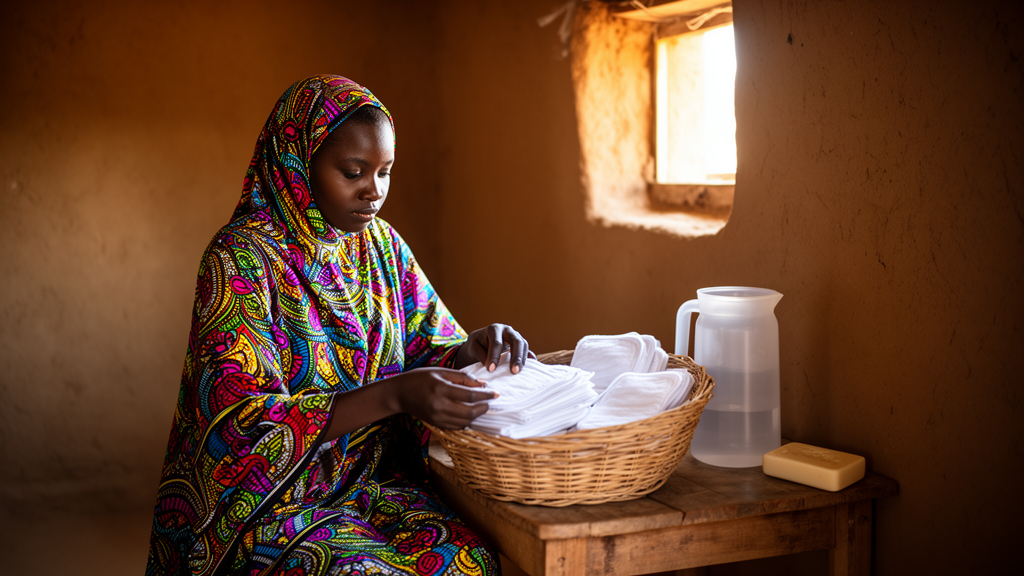
A survey of 333 women of reproductive age in three rural villages of White Nile State, Sudan, has found that while many respondents reported relatively safe hygiene practices, only 36 percent demonstrated good knowledge of menstrual hygiene management, and nearly half cited affordability as a barrier to obtaining disposable sanitary pads. The findings come from a descriptive cross-sectional study published in BMC Women’s Health, based on data collected during a three-day medical convoy in the Guli and Alsalam localities.
The study recruited women aged 15 to 45 years who attended a mobile clinic, using convenience sampling. Data were gathered with a pretested, interviewer-administered questionnaire covering sociodemographic variables, knowledge of menstruation and hygiene, attitudes toward menstrual and reproductive health, and hygiene practices, and were analyzed with SPSS version 28. The mean age at menarche was 13.9 years, and 95.8 percent of participants reported having undergone female genital mutilation, a strikingly high prevalence that the authors highlight alongside knowledge gaps and cultural restrictions as factors continuing to affect menstrual health in the region.
Knowledge of menstruation before it began was reported by 53.2 percent of participants, but overall understanding of menstrual hygiene management was uneven: 36 percent demonstrated good knowledge, while 32.1 percent had moderate knowledge and 31.8 percent had poor knowledge. Mothers were the main source of information for 48.9 percent of respondents, followed by teachers at 42 percent, underscoring the role of family and school channels in transmitting information about menstruation in these communities.
Attitudes toward reproductive health were mixed. A large majority, 78.7 percent, indicated that they would seek treatment for symptoms resembling a reproductive tract infection, but 21.3 percent reported barriers to doing so, including stigma and financial constraints. Self-reported symptoms consistent with reproductive tract infections were common in the sample, with burning urination reported by 55.9 percent of participants and abnormal vaginal discharge by 49.5 percent, making these the two most frequently reported symptoms.
Practices were comparatively positive. Disposable sanitary pads were used by 74.8 percent of respondents, most participants reported changing absorbents two to three times per day, and 62.2 percent said they washed the genital area more than once per day using water and soap. Access to disposable pads, however, was constrained: 45.5 percent of participants cited affordability and 27.6 percent cited availability as limitations, indicating that even where preferred products were used, securing them consistently posed a challenge.
The authors conclude that the study highlights both progress and persistent gaps in menstrual hygiene management among rural Sudanese women. While many practiced safe hygiene and expressed willingness to seek care, knowledge gaps, cultural restrictions, the high prevalence of female genital mutilation, and limited access to sanitary products continue to affect menstrual health. They call for targeted interventions that integrate health education, improved product accessibility, and reproductive health services.
Several limitations should be kept in mind when interpreting these results. The study was cross-sectional and relied on self-reported data, so reported symptoms and practices cannot be independently verified, and no causal relationships can be established. Recruitment took place at a mobile clinic during a three-day medical convoy using convenience sampling in three villages within two localities, which means the participants may not represent all women of reproductive age in White Nile State or in rural Sudan more broadly. The findings describe this specific surveyed population at a single point in time rather than trends over time.
Within those limits, the survey offers a detailed snapshot of menstrual health in a rural, low-resource setting where published evidence from Sudan has been limited. The combination of high reported FGM prevalence, uneven knowledge levels, reliance on mothers and teachers for information, and cost- and supply-related barriers to sanitary products suggests that improving menstrual health in such communities would require action on education, product access, and reproductive health services together, rather than any single measure in isolation.
Subject of Research: Knowledge, attitudes and practices of menstrual hygiene management among women of reproductive age in rural White Nile State, Sudan
Article Title: Menstrual hygiene management among women of reproductive age in White Nile State, Sudan: a descriptive cross-sectional study
Article References: Osman, A., Abdullah, R., Ali, A., Esam, F., Mohamed, M., Ali, E., & Abdelseid, H. (2026). Menstrual hygiene management among women of reproductive age in White Nile State, Sudan: a descriptive cross-sectional study. BMC Women's Health. https://doi.org/10.1186/s12905-026-04985-z
Image Credits: AI Generated
DOI: 10.1186/s12905-026-04985-z
Keywords: menstrual hygiene management, Sudan, White Nile State, cross-sectional study, women's health, female genital mutilation, reproductive tract infection, sanitary pads, rural health, health education, low-resource settings, Menstrual
Cite Scienmag News
Ophelia Keating. (October 28, 2026). Knowledge gaps and product barriers shape menstrual hygiene in rural Sudan, survey finds. Scienmag. https://scienmag.com/knowledge-gaps-and-product-barriers-shape-menstrual-hygiene-in-rural-sudan-survey-finds/
Ophelia Keating. "Knowledge gaps and product barriers shape menstrual hygiene in rural Sudan, survey finds." Scienmag, 28 October 2026, https://scienmag.com/knowledge-gaps-and-product-barriers-shape-menstrual-hygiene-in-rural-sudan-survey-finds/. Accessed 28 October 2026.
Ophelia Keating. "Knowledge gaps and product barriers shape menstrual hygiene in rural Sudan, survey finds." Scienmag. October 28, 2026. https://scienmag.com/knowledge-gaps-and-product-barriers-shape-menstrual-hygiene-in-rural-sudan-survey-finds/