In the study, published in the Beni-Suef University Journal of Basic and Applied Sciences, treatment with the unrefined Origanum oil cut fecal cyst counts by 91.3 percent, while nitazoxanide, the reference drug, achieved an 85.6 percent reduction. Both effects were measured against infected untreated controls and reached statistical significance at p<0.001.
Blastocystis species are anaerobic intestinal protozoa found in humans and animals worldwide. Long considered harmless commensals, certain subtypes have been increasingly associated with gastrointestinal complaints including abdominal pain, diarrhea, flatulence, and irritable bowel syndrome–like symptoms. The parasite’s pathogenesis has been linked to disruption of the intestinal epithelial barrier, increased mucosal permeability, and the induction of oxidative and inflammatory damage. Conventional therapies, particularly metronidazole, show variable efficacy, and treatment failures have prompted investigators to search for alternatives drawn from medicinal plants.
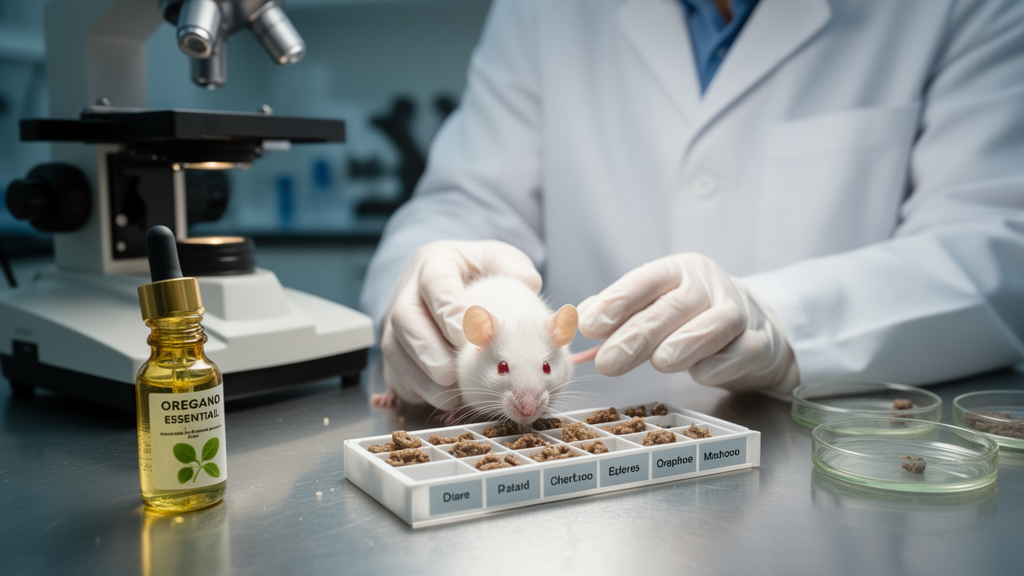
The research team, led by Ekhlas H. Abdel-Hafeez and colleagues, used forty male Swiss albino mice weighing 20 to 25 grams, divided into four groups of ten. Group I served as a non-infected, untreated negative control. Group II received only the parasite inoculum. Group III was infected and treated orally with nitazoxanide at 100 milligrams per kilogram per day. Group IV was infected and treated orally with crude Origanum essential oil at 0.5 milliliters per kilogram per day. Every mouse in the three infected groups was orally inoculated with 1×10⁵ viable Blastocystis cysts suspended in 0.2 milliliters of phosphate-buffered saline. Infection was confirmed by microscopic examination of fecal samples on day seven post-inoculation, and only then did the seven-day treatment courses begin.
The parasite isolate was not a laboratory strain but a clinical sample originally obtained from naturally infected patients and maintained in Locke–Egg medium under anaerobic conditions at 37 degrees Celsius. Prior characterization by PCR–restriction fragment length polymorphism had assigned it to group B, comprising a mixed infection with subtypes ST3, ST4, and ST8. Before inoculation, cultured cysts were washed three times in sterile phosphate-buffered saline, and viability was confirmed by microscopic examination and Trypan Blue exclusion. Inoculum purity was verified microscopically to exclude visible contaminants.
To produce the oil, fresh aerial parts of Origanum species—leaves and flowering tops—were washed, shade-dried for seven to ten days, and ground into a coarse powder. Approximately 250 grams of the dried material underwent hydro-distillation for three hours in a Clevenger-type apparatus. The extracted oil was dried over anhydrous sodium sulfate and stored in amber vials at 4 degrees Celsius until use, with yield expressed as milliliters per 100 grams of dry weight. Critically, the researchers performed no gas chromatography–mass spectrometry or high-performance liquid chromatography analysis on the batch. The oil was tested strictly in its crude form, meaning the observed biological activity reflects the combined effect of the whole extract rather than any isolated compound.
Assessment relied on three complementary approaches. Fresh fecal samples were collected daily and examined by direct wet mount microscopy using normal saline and Lugol’s iodine. Quantitative cyst counts were performed with a Neubauer hemocytometer under light microscopy at 400× magnification, with each sample counted in duplicate and expressed as cysts per gram of stool. Parasitological efficacy was evaluated on day 14 post-infection by comparing mean cyst counts between treated groups and the infected untreated group. Intestinal tissues were homogenized for biochemical analysis: nitric oxide was measured as total nitrite/nitrate using the Griess reaction after nitrate reduction, expressed in micromoles per gram of tissue, while lipid peroxidation was assessed through malondialdehyde levels using the thiobarbituric acid reactive substances assay, expressed in nanomoles per gram of tissue. For histopathology, small intestinal tissues were fixed in 10 percent buffered formalin, stained with hematoxylin and eosin, and examined at 200–400× magnification for villous atrophy, epithelial damage, inflammation, and parasite presence. Cyst counts and histopathological readings were performed by investigators blinded to treatment groups, although the authors note that formal a priori sample-size calculations, systematic randomization, and double-blinded outcome assessments were not implemented.
The parasitological results were striking. The infected untreated group reached a mean cyst burden of 6.2×10⁵ ± 0.4×10⁵ cysts per gram of stool on day 14 post-infection. Nitazoxanide treatment reduced cyst shedding by 85.6 percent relative to that burden, while crude Origanum oil achieved a 91.3 percent reduction, both statistically significant at p<0.001. No Blastocystis forms were detected in the non-infected control group. Clinically, all infected mice developed mild to moderate signs during the first week—reduced activity, ruffled fur, and soft stools—most pronounced in the untreated group. Mice in both treatment groups showed improvement in general condition and appetite within five to seven days of starting treatment, and no mortality occurred in any group throughout the experiment.
Biochemical measurements revealed that infection drove significant oxidative stress in the gut. Intestinal nitric oxide and malondialdehyde levels were significantly higher in infected untreated mice than in non-infected controls, at 52.8 ± 4.6 micromoles per gram of tissue and 15.2 ± 1.4 nanomoles per gram of tissue, respectively. Both treatments significantly lowered these markers compared with infected untreated animals. In the Origanum-treated group, nitric oxide fell to 28.6 ± 2.8 micromoles per gram of tissue and malondialdehyde to 6.9 ± 0.8 nanomoles per gram of tissue, values approaching those of the non-infected control group. The authors interpret the reduction in oxidative markers as likely reflecting a combined effect of reduced parasite burden and the overall antioxidant properties of the crude oil mixture, while emphasizing that the specific compounds mediating these effects remain unknown due to the lack of chemical profiling.
Histopathology told a parallel story. Infected untreated mice showed severe villous atrophy, epithelial desquamation, brush-border loss, and dense inflammatory cell infiltration—lymphocytes, plasma cells, and eosinophils—within the lamina propria. Multiple vacuolated Blastocystis cysts were observed within the mucosa and crypts, accompanied by ulceration and necrosis. Nitazoxanide treatment produced partial improvement of these lesions. In contrast, the crude Origanum oil-treated group displayed restoration of mucosal architecture with intact villi, a preserved epithelial lining, and minimal inflammatory cell infiltration, and no Blastocystis cysts were observed in the examined sections. Lesion scores were significantly lower in both treated groups than in infected untreated mice, with the lowest mean score recorded in the oil-treated group. The non-infected control group showed normal intestinal architecture with intact villi and no inflammatory changes.
The authors are explicit about the limits of these findings. Because the essential oil was never chemically profiled, the relative proportions of major monoterpenes such as carvacrol and thymol—compounds frequently described in the literature as key active constituents of Lamiaceae oils—remain unknown, preventing attribution of the observed effects to specific chemicals or guaranteeing batch-to-batch reproducibility. Efficacy was tested at only a single dose and a fixed seven-day duration, precluding any dose-response analysis. The infection model used a single mixed clinical isolate rather than the full diversity of Blastocystis subtypes, and the study was conducted in a single animal model—male Swiss albino mice—without an independently deposited herbarium voucher specimen for the plant material. The authors conclude that further studies using botanically authenticated, chemically profiled essential oils across varied doses, treatment durations, and diverse Blastocystis subtypes are required to clarify mechanisms, evaluate safety, and determine whether these preliminary murine findings hold any clinical relevance for human infection.
Subject of Research: Therapeutic efficacy of crude Origanum essential oil against Blastocystis infection in experimentally infected mice
Article Title: The efficacy of the crude Origanum genus (Lamiaceae) essential oils on experimentally infected mice with Blastocystis spp.
Article References: Abdel-Hafeez, E. H., Abdel-Fatah, M. M., Sanadeki, M. M., Nasr, M. M. S. A., Hafez, S. M., & Abd Rabou, R. A. M. (2026). The efficacy of the crude Origanum genus (Lamiaceae) essential oils on experimentally infected mice with Blastocystis spp.. Beni-Suef University Journal of Basic and Applied Sciences, 15(1), Article 110. https://doi.org/10.1186/s43088-026-00838-8
Image Credits: AI Generated
DOI: 10.1186/s43088-026-00838-8
Keywords: Blastocystis, Origanum vulgare, essential oil, nitazoxanide, mice, intestinal oxidative stress, nitric oxide, malondialdehyde, histopathology, parasitology, nitazoxanide comparison, experimental infection
Cite Scienmag News
Rebecca Stewart. (October 28, 2026). Crude Oregano Essential Oil Cuts Blastocystis Cyst Shedding in Infected Mice. Scienmag. https://scienmag.com/crude-oregano-essential-oil-cuts-blastocystis-cyst-shedding-in-infected-mice/
Rebecca Stewart. "Crude Oregano Essential Oil Cuts Blastocystis Cyst Shedding in Infected Mice." Scienmag, 28 October 2026, https://scienmag.com/crude-oregano-essential-oil-cuts-blastocystis-cyst-shedding-in-infected-mice/. Accessed 28 October 2026.
Rebecca Stewart. "Crude Oregano Essential Oil Cuts Blastocystis Cyst Shedding in Infected Mice." Scienmag. October 28, 2026. https://scienmag.com/crude-oregano-essential-oil-cuts-blastocystis-cyst-shedding-in-infected-mice/