


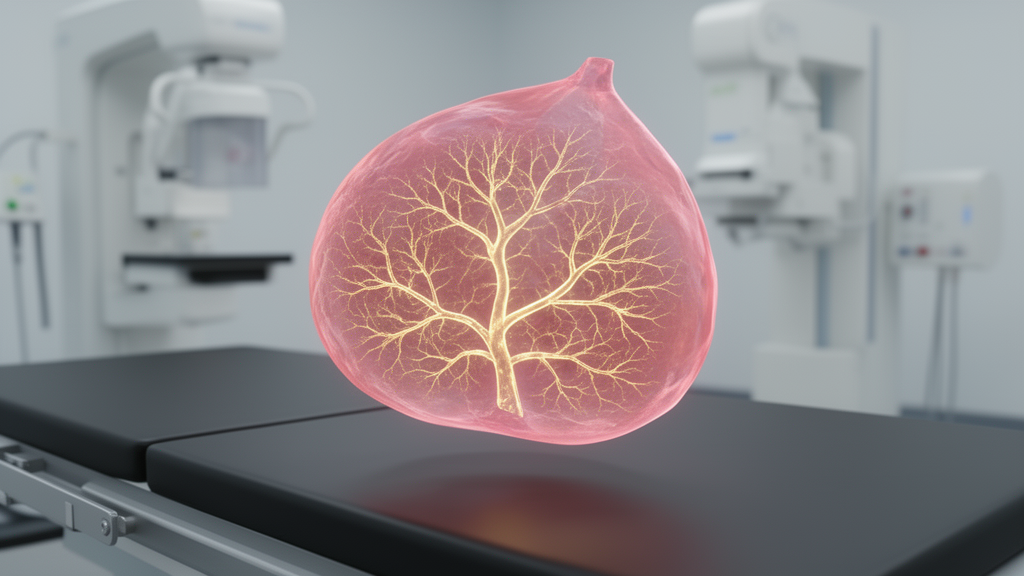
Artificial intelligence systems that diagnose breast cancer have grown enormously powerful in recent years, but they have also grown enormously expensive. Deep learning architectures built on convolutional neural networks and transformers can sift through mammograms with impressive skill, yet they demand GPU clusters, millions of parameters, and vast annotated datasets. A new study published in Discover Artificial Intelligence by Krishnakumar Subramaniam of Amrita Vishwa Vidyapeetham in Chennai takes the opposite approach, and the results are striking. By pairing a nature-inspired optimization algorithm called stochastic fractal search with the humble k-nearest neighbor classifier, the framework achieved 97.3 percent accuracy on the CBIS-DDSM dataset and 98.7 percent on the INbreast dataset, all while cutting the feature space by more than half.
The core insight behind the work is that more computation does not always mean better diagnosis. Existing deep learning and optimization-assisted mammographic classification frameworks often suffer from high-dimensional feature redundancy, increased computational complexity, and limited interpretability. When a model relies on thousands of learned features, many of them turn out to be irrelevant noise that inflates memory requirements, slows training, and increases the risk of overfitting. Subramaniam’s framework, designated SFS-FS-BC, instead begins with just 30 handcrafted radiomic descriptors extracted from lesion regions and lets an optimization algorithm decide which of them actually matter for distinguishing benign from malignant tissue.
The choice of optimization engine is what gives the study its distinctive flavor. Stochastic fractal search is a population-based metaheuristic inspired by the growth and diffusion patterns of natural fractals, the branching structures seen in everything from river deltas to lung tissue. In the algorithm, each candidate solution, called a particle, represents a possible subset of features encoded as continuous values between zero and one. During the diffusion phase, particles perform Gaussian random walks through the search space using two complementary strategies: one directed toward the best solution found so far, which accelerates exploitation of promising regions, and one centered on each particle’s current position, which preserves the diversity needed for global exploration.
After diffusion, a ranking-based update mechanism refines the population. Particles are sorted by fitness, measured as the classification accuracy achieved by their feature subset under cross-validation, and weaker solutions are improved through stochastic interactions with stronger ones. Once the optimization converges, the continuous particle vectors are converted into binary feature masks using a fixed threshold of 0.5: values at or above the threshold select a feature, values below discard it. The result is a compact, optimized feature subset that feeds directly into the k-nearest neighbor classifier, which labels a test sample by majority vote among its five closest neighbors measured with Euclidean distance.
The experimental design reflects careful attention to a problem that plagues many machine learning studies in medicine: data leakage. The framework employed a patient-wise stratified 5-fold cross-validation protocol in which all images from the same patient were kept within a single fold, preventing the model from learning one patient’s imaging signature and then being tested on it again. Normalization parameters were computed exclusively from training subsets, and the feature selection optimization itself was run independently within each training fold. All reported metrics represent means and standard deviations across 30 independent experimental runs, and pairwise Wilcoxon signed-rank tests confirmed that the improvements over baseline methods were statistically significant at p < 0.01.
The numbers tell a compelling story. On CBIS-DDSM, a curated subset of the Digital Database for Screening Mammography containing 891 benign and 675 malignant lesions, the framework achieved 97.3 percent accuracy, 97.1 percent precision, 97.5 percent recall, an F1-score of 97.3 percent, and an area under the ROC curve of 0.991. On INbreast, a high-quality full-field digital mammography dataset with 220 benign and 190 malignant cases, performance climbed to 98.7 percent accuracy and 0.995 AUC. Perhaps most telling is the comparison with the baseline: a k-nearest neighbor classifier using all 30 features without selection managed only 87.6 percent accuracy on CBIS-DDSM, meaning the fractal optimization alone accounted for nearly a ten-point gain.
Feature reduction proved equally important. The stochastic fractal search compressed the original 30-dimensional feature space to an average of 12.67 optimized features, and an analysis of selection frequencies across 30 runs revealed which descriptors the algorithm consistently favored. Texture-based measures such as contrast, entropy, homogeneity, and correlation appeared again and again, confirming that tissue heterogeneity patterns are among the strongest signals of malignancy. Morphological descriptors like circularity and eccentricity were also repeatedly selected, underscoring the clinical observation that malignant lesions tend to have irregular, poorly defined shapes compared with benign masses.
Convergence behavior further distinguished the approach from its competitors. The optimization typically stabilized within roughly 35 to 40 iterations, despite a maximum limit of 100, thanks to a convergence-based early stopping mechanism that halts the search when the best fitness fails to improve beyond a tolerance of 10 to the minus 6 for ten consecutive iterations. In head-to-head comparisons, particle swarm optimization required nearly 65 iterations and genetic algorithms about 80 to approach comparable fitness values. An ablation study confirmed that every component contributes: removing fractal diffusion, ranking-based updates, or Z-score normalization each degraded performance, while the full pipeline reached 98.47 percent accuracy on the combined datasets.
The study is candid about its limits. The framework depends on expert-provided lesion annotations and segmentation masks rather than performing fully automated lesion localization, and it was evaluated only on public datasets without an independent external test set, so the results cannot yet be read as proof of clinical generalizability. Runtime comparisons with deep learning methods were conducted on CPU hardware and should be interpreted cautiously, since many competing architectures were originally implemented on GPU-accelerated systems. The work also addresses only binary benign-malignant classification, not the full clinical workflow of detection, segmentation, and risk assessment.
Even with those caveats, the implications are significant. Because the selected features correspond to interpretable morphological, intensity, and texture characteristics that radiologists already assess, the framework offers a transparency that black-box deep learning models often lack. Its low computational footprint makes it a plausible candidate for resource-constrained clinical environments where GPU infrastructure is unavailable, potentially supporting screening workflows and second-opinion analysis. The author points toward multi-institutional validation, automated segmentation integration, and hybrid radiomics-deep learning architectures as the next steps. For now, the study stands as an elegant demonstration that sometimes the smartest way forward in medical AI is not a bigger model, but a better-chosen handful of features, found with a little help from the mathematics of fractals.
Subject of Research: Fractal optimization-driven feature selection and k-nearest neighbor classification of benign and malignant breast lesions in mammographic images
Article Title: Breast cancer classification in mammographic images using fractal diffusion feature selection and k nearest neighbor
Article References: Subramaniam, K. (2026). Breast cancer classification in mammographic images using fractal diffusion feature selection and k nearest neighbor. Discover Artificial Intelligence, 6(1), Article 1236. https://doi.org/10.1007/s44163-026-02284-y
Image Credits: AI Generated
DOI: 10.1007/s44163-026-02284-y
Keywords: breast cancer, mammography, stochastic fractal search, feature selection, k-nearest neighbor, computer-aided diagnosis, radiomics, machine learning, CBIS-DDSM, INbreast, metaheuristic optimization, medical imaging
Cite Scienmag News
Nathaniel Bowman. (October 18, 2026). Fractal Math Meets Mammography: Simple AI Hits 98.7% Accuracy in Breast Cancer Detection. Scienmag. https://scienmag.com/fractal-math-meets-mammography-simple-ai-hits-98-7-accuracy-in-breast-cancer-detection/
Nathaniel Bowman. "Fractal Math Meets Mammography: Simple AI Hits 98.7% Accuracy in Breast Cancer Detection." Scienmag, 18 October 2026, https://scienmag.com/fractal-math-meets-mammography-simple-ai-hits-98-7-accuracy-in-breast-cancer-detection/. Accessed 18 October 2026.
Nathaniel Bowman. "Fractal Math Meets Mammography: Simple AI Hits 98.7% Accuracy in Breast Cancer Detection." Scienmag. October 18, 2026. https://scienmag.com/fractal-math-meets-mammography-simple-ai-hits-98-7-accuracy-in-breast-cancer-detection/


