


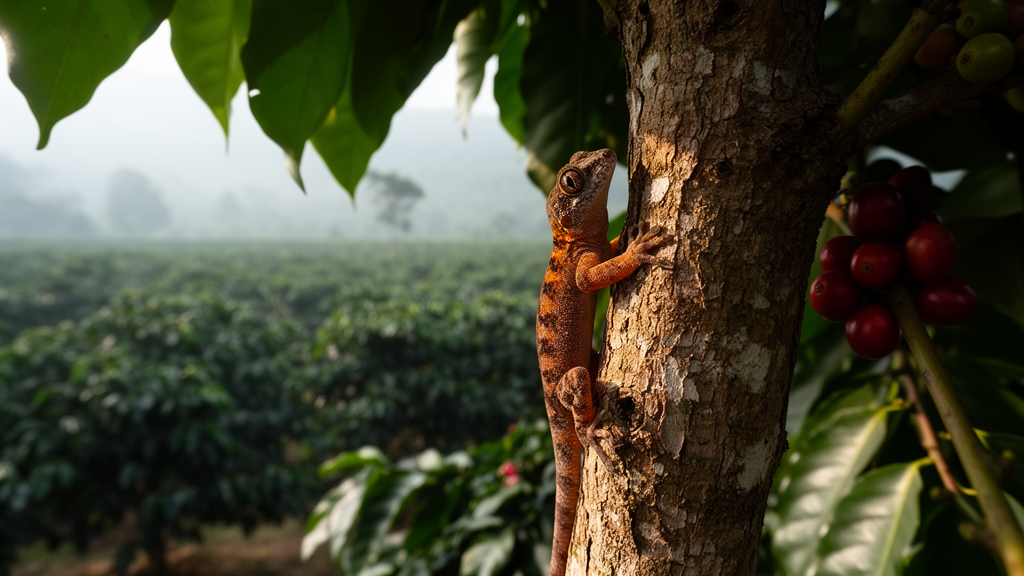
Deep in Vietnam’s Central Highlands, one of the world’s most imperiled reptiles is quietly running out of time. The Gia Lai Bent-toed Gecko, Cyrtodactylus gialaiensis, a species known to science only since 2017, survives today in numbers so small that researchers describe its extinction in the wild as a realistic near-term scenario. A new study published in the journal Nature Conservation has expanded the search for this elusive lizard across Gia Lai Province, and the results are both a glimmer of hope and a stark warning. The gecko has been found in more places than previously known, yet every confirmed population is tiny, fragmented, and entirely outside Vietnam’s protected area network.
The species was first discovered on a coffee farm in Chu Se District, an unremarkable setting for a remarkable animal. Bent-toed geckos of the genus Cyrtodactylus are notoriously difficult to tell apart by appearance alone, and C. gialaiensis was described from a landscape already transformed by decades of agricultural expansion. Its estimated range covered less than ten square kilometers, and because that range sat wholly outside any protected area, the International Union for Conservation of Nature classified the species as Critically Endangered almost immediately after its formal description in 2018. Earlier surveys had looked only around the type locality, leaving open the question of whether other populations might persist in suitable habitat elsewhere in the province.
To answer that question, a research team conducted extensive field surveys across four districts of Gia Lai Province between March 2022 and April 2025, visiting sites in Chu Se, Duc Co, Chu Prong, and Chu Pah. The team established 28 transects spanning coffee, rubber, durian, padauk, passion fruit, and coconut palm plantations, along with the soil cliffs and remnant vegetation patches that thread through these farmlands. Because the gecko is nocturnal, each transect was visited three times after sunset, between 19:00 and 00:30, when the animals are most active and detection probability is highest. Surveys covered both adobe and basalt soil types, reflecting the region’s diverse volcanic geology.
Identifying the animals required more than fieldwork. The researchers collected tail tissue samples from 18 geckos and sequenced a fragment of the mitochondrial ND2 gene, a standard molecular marker for distinguishing closely related Cyrtodactylus species. Eleven samples, drawn from Chu Se, Duc Co, and Chu Pah, showed 98.62 to 99.22 percent sequence similarity to the reference sequence of C. gialaiensis, confirming the species’ presence in all three districts. The remaining seven samples, all from Chu Pah, belonged to a different species altogether, underscoring how easily these lookalike geckos can be misidentified without genetic verification. Morphological measurements of captured animals, including snout-vent length, head dimensions, and limb proportions, fell within the ranges reported for the original type specimens.
The confirmed distribution is the study’s most encouraging finding. C. gialaiensis is now known to occur in at least three districts of Gia Lai Province, with the nearest subpopulations separated by 22 kilometers between Chu Se and Duc Co, 41 kilometers between Duc Co and Chu Pah, and 56 kilometers between Chu Pah and Chu Se. These distances suggest the species once ranged more widely across the province before habitat destruction carved its population into isolated fragments. Yet the species went undetected on 16 of the 28 surveyed transects, and its rarity elsewhere indicates that much of the suitable habitat has already been lost, leaving the gecko to persist only in remnant patches of natural vegetation or to survive, apparently by accident, within monoculture plantations.
The population numbers are sobering. Using a capture-mark-recapture approach, in which each gecko was hand-caught, marked with correction fluid dots or numbers, and released at its point of capture, the team applied the Schnabel index to estimate abundance. In Chu Se District, the total population was estimated at approximately 96 individuals, with a 95 percent confidence interval of 40 to 314, of which only 47 were adults. Populations in Duc Co and Chu Pah are even smaller. These figures fall far below established thresholds for long-term viability: classical recommendations and recent simulations suggest an effective population size of roughly 500 individuals for species with moderate reproductive rates, while some analyses argue that at least 7,000 are needed to secure the long-term survival of any vertebrate. With so few animals, C. gialaiensis is acutely vulnerable to environmental and demographic randomness, and the low proportion of juveniles recorded, just under 17 percent, offers little sign of robust recruitment.
The gecko’s ecological preferences help explain its predicament. Individuals were most active between 20:00 and 22:00 and were found on hole cliffs, soil cliffs, tree trunks, shrubs, and coffee stumps at elevations of 557 to 650 meters above sea level. The microhabitats they occupy are cool and humid, with mean air temperatures around 23 degrees Celsius, mean relative humidity above 81 percent, and substrate temperatures averaging about 21.6 degrees. Canopy cover at occupied sites averaged only around 35 to 40 percent, reflecting the open, managed character of the plantations the species now inhabits. These narrow requirements mean that even modest changes in land management, such as the shift from bamboo to coconut palm documented at one site in October 2022, can render habitat unsuitable, while intensified chemical use on converted land adds further pressure.
Threats are everywhere the gecko lives. Habitat loss driven by land-use change was identified as the most critical risk facing every population, compounded by garbage, including plastics and chemical products, littering the habitat in Chu Se. A telling indicator of predation pressure came from tail condition: between roughly 38 and 60 percent of individuals encountered across the four Chu Se transects had regenerated tails, a sign of past attacks, likely by domesticated animals. None of the studied populations lies within a protected area, leaving landowners free to convert plantations at will. Provincial strategies for 2023 to 2025, with a vision toward 2030, recommend replacing traditional crops such as rubber, pepper, coffee, and sugarcane with passion fruit, potato, pineapple, banana, chili, watermelon, and soybean, a transition the study’s authors identify as a major short- and medium-term threat to wildlife survival across the region.
The broader conservation picture is complicated by conflicting assessments. While the IUCN Red List lists the species as Critically Endangered, Vietnam’s national Red Data Book downgraded it to Endangered, citing a larger estimated extent of occurrence. The new study recalculated both metrics using all recorded localities and the GeoCAT tool, arriving at an extent of occurrence of approximately 2,124 square kilometers and an area of occupancy of 56 square kilometers. But because every subpopulation is estimated to contain fewer than 50 mature individuals and is severely fragmented, with continued decline expected, the authors conclude the species meets the criteria for Critically Endangered category C2a(i). The long distances between subpopulations and the absence of habitat corridors make migration essentially impossible, raising the specter of genetic drift and inbreeding depression eroding what little diversity remains.
There is still a narrow path forward, and the study outlines it. At the type locality, a payment for ecosystem services scheme has already been implemented, under which the landowner agreed to forgo chemical products, crop conversion, and other activities harmful to the species. The researchers recommend expanding field surveys to identify sites with better vegetation cover that could be designated as protected areas or species conservation areas, and they call for a captive-breeding program to reinforce the small, fragmented wild populations. Whether these measures arrive in time will determine if the Gia Lai Bent-toed Gecko becomes a cautionary tale of coffee-farm biodiversity lost, or a rare example of a Critically Endangered reptile pulled back from the brink in one of Southeast Asia’s most transformed landscapes.
Subject of Research: Population status, distribution, and conservation of the Critically Endangered Gia Lai Bent-toed Gecko in Vietnam
Article Title: Decades of habitat destruction – is there any chance left for the endemic and Critically Endangered Cyrtodactylus gialaiensis in Vietnam?
Article References: Ngo, H. T., Quang Phan, T., Do, Q. H., Ngo, H. N., Nguyen, H. Q., Luu, V. Q., Pham, C. T., Ngoc Ho, A. T., Nguyen, T. Q., Nguyen, T. H., Ziegler, T., & Le, M. D. (2026). Decades of habitat destruction – is there any chance left for the endemic and Critically Endangered Cyrtodactylus gialaiensis in Vietnam?. Nature Conservation, 61, 113-131. https://doi.org/10.3897/natureconservation.61.169011
Image Credits: AI Generated
DOI: 10.3897/natureconservation.61.169011
Keywords: Cyrtodactylus gialaiensis, Gia Lai Bent-toed Gecko, Vietnam, habitat loss, Critically Endangered, reptile conservation, population estimate, coffee plantations, habitat fragmentation, IUCN Red List, Central Highlands, captive breeding
Cite Scienmag News
Margaret Porter. (October 18, 2026). Vietnam’s Rarest Gecko Clings to Survival on Coffee Farms as Habitat Vanishes. Scienmag. https://scienmag.com/vietnams-rarest-gecko-clings-to-survival-on-coffee-farms-as-habitat-vanishes/
Margaret Porter. "Vietnam’s Rarest Gecko Clings to Survival on Coffee Farms as Habitat Vanishes." Scienmag, 18 October 2026, https://scienmag.com/vietnams-rarest-gecko-clings-to-survival-on-coffee-farms-as-habitat-vanishes/. Accessed 18 October 2026.
Margaret Porter. "Vietnam’s Rarest Gecko Clings to Survival on Coffee Farms as Habitat Vanishes." Scienmag. October 18, 2026. https://scienmag.com/vietnams-rarest-gecko-clings-to-survival-on-coffee-farms-as-habitat-vanishes/


