


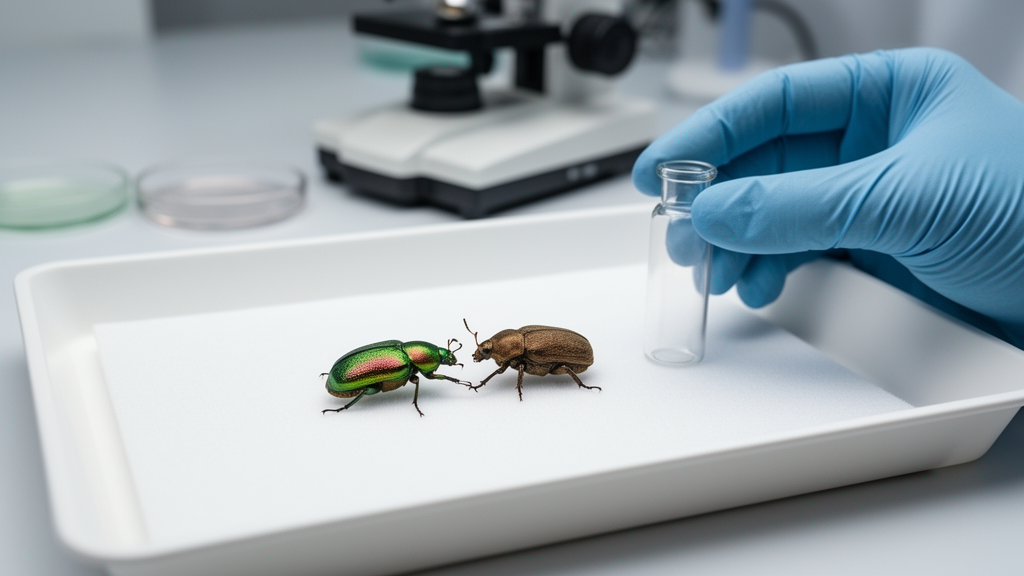
Deep in the mountains of southern Georgia, a team of researchers armed with aspirators, ethanol vials and a portable sense of curiosity has quietly rewritten the country’s beetle map. During an October 2021 expedition to the Samtskhe-Javakheti region, scientists from the Caucasus Barcode of Life project, or CaBOL, collected a handful of unassuming insects that turned out to include two species never before documented in Georgia: the sap beetle Pocadius adustus and the pill beetle Byrrhus pustulatus. The discovery, published in the journal Caucasiana, combines classic morphological identification with modern DNA barcoding, and it offers a vivid illustration of how much biodiversity still hides in plain sight at the crossroads of Europe and Asia.
The Caucasus is one of the world’s 36 recognized biodiversity hotspots, a region packed with endemic species found nowhere else on Earth. Yet the countries straddling this mountainous isthmus between Europe and Asia suffer from surprisingly large gaps in biological knowledge. Beetles, the most species-rich order of animals on the planet, exemplify the problem. Georgia, despite a long history of natural history research stretching back to imperial-era expeditions, still lacks a complete inventory of its beetle fauna, and new species and new country records continue to surface with every modest field campaign.
The CaBOL team from the Institute of Ecology at Ilia State University conducted its Samtskhe-Javakhti expedition between October 8 and 11, 2021, sweeping beetles from under rocks, from vegetation, from beneath wood bark and from mushrooms. Specimens were preserved in 96 percent ethanol and stored at minus 22 degrees Celsius in the university’s scientific collections. Back in the laboratory, the researchers photographed their catches with macro photography rigs, stacking dozens of images to produce razor-sharp portraits of insects often barely a few millimeters long.
But the real technological muscle came from the genetics bench. The team extracted genomic DNA from tissue samples and amplified partial sequences of the cytochrome oxidase subunit I gene, the workhorse barcode region used by molecular ecologists worldwide. The polymerase chain reaction protocol used a two-stage thermal profile, first with an annealing temperature that stepped down one degree per cycle, then a second set of 25 cycles at a lower annealing temperature, a strategy designed to coax clean amplicons out of difficult templates. Sequencing was conducted in both directions at the Beijing Genomics Institute in Hong Kong, and the resulting barcodes were uploaded to the BOLD Systems database for identification and comparison.
The first new country record, Pocadius adustus, is a small sap beetle in the family Nitidulidae, a group famous for their associations with fungi and fermenting plant matter. Species of the genus Pocadius are specialists on epigeous gasteromycetes, puffballs and their relatives that release spores from the ground. The Georgian specimens were found, fittingly, inside the cavity of a puffball in the Nedzvi Managed Reserve. DNA barcoding showed 98.95 percent similarity to reference sequences of P. adustus from Germany, and the morphology matched the classical identification keys perfectly. The species has a wide Palaearctic distribution, with the nearest known findings in Turkey and the Western Caucasus of Russia, so its presence in Georgia fills an expected but previously unconfirmed gap in the map.
The second newcomer, Byrrhus pustulatus, belongs to the pill beetles, family Byrrhidae, so named for their habit of tucking into tight balls when disturbed. Both larvae and adults of this genus feed on moss, algae and liverworts. The single specimen was collected southwest of the village of Ijareti at about 1,500 meters above sea level. Its barcode showed 99.08 percent similarity to German reference material, and its morphology corresponded exactly to the descriptions in Soviet-era keys. With the nearest records in Armenia and Azerbaijan, the species was long expected to occur in Georgia, but until now nobody had documented it.
The study also updated the known distributions of three other poorly studied species. The water-scavenger beetle Coelostoma orbiculare, an aquatic insect that grazes on wet and submerged surfaces including wet rocks and even artificial concrete, was confirmed at multiple sites across Georgia, from the Black Sea coast near Poti to high mountain lakes at over 2,200 meters. Four barcodes from Georgian specimens were nearly identical to each other, with the nearest neighbor in BOLD being C. orbiculare from Finland. Remarkably, the species had been reported from Tbilisi and Gomareti as far back as 1953, but that information was overlooked by subsequent authors, and no study of Georgia’s Hydrophilidae has been performed since.
The other two updates involve beetles with macabre or fungal lifestyles. Lycoperdina succincta, a handsome endomychid beetle whose larvae develop inside puffballs and related Agaricaceae mushrooms, was collected at Saghamo Lake, only the third finding for the country and a significant eastward extension of its known range. Necrobia violacea, a cosmopolitan checkered beetle in the family Cleridae, is technically a predator but shows necrobiontic behavior, often congregating on animal carcasses. The Georgian specimen was collected from a cow skull at the mouth of the Paravani River at Saghamo Lake, a detail that reads like a scene from a gothic novel. Its barcode showed 99.85 percent identity to German reference material. The species had been reported from Georgia in 1915, but like several other checkered beetles, it was subsequently dropped from the literature, with authors citing only the vague label Caucasus.
These forgotten records highlight a recurring theme in Caucasus biodiversity research: old, local and hard-to-reach sources, often in Russian or Georgian, are routinely overlooked by modern authors, producing an incomplete picture not only of Georgia’s fauna but of the entire region’s. The researchers argue that this data inaccessibility makes it difficult to correctly understand beetle diversity and distribution, and to plan conservation strategies accordingly. They call on coleopterologists and citizen scientists alike to intensify field research across Georgia, noting that each modest expedition continues to yield new species and new records. In a hotspot critically prone to biodiversity loss, every barcode sequence and every puffball checked for hidden beetles is a small act of rescue for knowledge that might otherwise vanish before the species themselves do.
Subject of Research: DNA-assisted discovery of two beetle species new to Georgia's fauna and distribution updates for three little-studied beetle taxa
Article Title: New and well-forgotten: DNA-assisted records of two beetle ( Insecta , Coleoptera ) species new for the fauna of Georgia with an update on the distribution of some other little studied taxa
Article References: Japarashvili, S., Bulbulashvili, N., Seropian, A., Chkhartishvili, T., Iankoshvili, G., Chitadze, B., Balkhamishvili, S., Arsenashvili, E., Todua, M., & Memishishi, A. (2023). New and well-forgotten: DNA-assisted records of two beetle (Insecta, Coleoptera) species new for the fauna of Georgia with an update on the distribution of some other little studied taxa. Caucasiana, 2, 63-70. https://doi.org/10.3897/caucasiana.2.e98998
Image Credits: AI Generated
DOI: 10.3897/caucasiana.2.e98998
Keywords: beetles, Coleoptera, DNA barcoding, Georgia, Caucasus biodiversity, CaBOL, new species records, entomology, well-forgotten, DNA-assisted, records, beetle
Cite Scienmag News
Margaret Porter. (October 18, 2026). DNA Barcodes Reveal Two Beetle Species Never Before Recorded in Georgia. Scienmag. https://scienmag.com/dna-barcodes-reveal-two-beetle-species-never-before-recorded-in-georgia/
Margaret Porter. "DNA Barcodes Reveal Two Beetle Species Never Before Recorded in Georgia." Scienmag, 18 October 2026, https://scienmag.com/dna-barcodes-reveal-two-beetle-species-never-before-recorded-in-georgia/. Accessed 18 October 2026.
Margaret Porter. "DNA Barcodes Reveal Two Beetle Species Never Before Recorded in Georgia." Scienmag. October 18, 2026. https://scienmag.com/dna-barcodes-reveal-two-beetle-species-never-before-recorded-in-georgia/


