


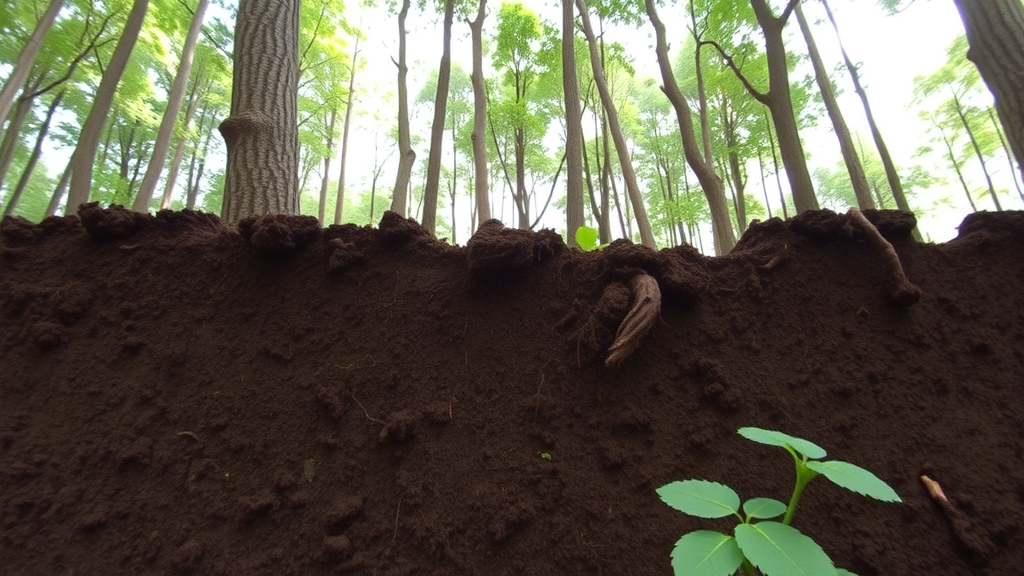
Deep in the mid-hills of Nepal, where community-managed forests blanket steep slopes above the Pokhara Valley, scientists have uncovered a deceptively simple truth about how forests lock away carbon: what matters most above ground is the architecture of the trees themselves, while what matters below ground is the texture of the soil. A new study published in Discover Forests provides one of the most integrated assessments to date of the biotic and abiotic forces governing carbon storage in community forests, and its findings carry immediate consequences for climate policy in the Himalayan region and beyond.
The research, led by Binayak Poudel of the Institute of Forestry at Tribhuvan University, together with colleagues in Canada and Nepal, quantified both vegetation carbon and soil organic carbon across three dominant forest types: Shorea robusta (sal), Pinus roxburghii (chir pine), and mixed broadleaved forests. Working in two community forests in Kaski District—the 162-hectare Sityum Kasyari and Simsar Patleswara Jukepani Community Forest and the 14-hectare Banpale Community Forest—the team established nineteen nested circular plots of 500 square meters each, measuring every tree with a diameter at breast height of at least five centimeters. Soil samples were collected from four depth intervals reaching down to 80 centimeters, with five subsamples composited at each depth to smooth out local heterogeneity.
The results were striking. Shorea robusta forests emerged as the undisputed carbon champions, storing 113.5 plus or minus 7.1 megagrams of carbon per hectare in vegetation and 102.0 plus or minus 2.3 megagrams per hectare in soil—substantially more than chir pine forests, which held 96.5 and 85.5 megagrams respectively, and far ahead of mixed broadleaved forests at just 64.2 and 84.9 megagrams. Together, the sal forests banked roughly 215 megagrams of carbon per hectare across vegetation and soil combined, placing them at the upper end of the range reported for South Asian subtropical forests.
But the real analytical payoff came from teasing apart why these differences exist. The researchers evaluated fourteen predictors spanning stand structure, anthropogenic disturbance, soil properties, topography, and climate, using Pearson correlation analysis and principal component analysis to identify the dominant drivers. For tree carbon, two structural variables towered above the rest: basal area, with a correlation coefficient of 0.641, and canopy cover, at 0.635, both highly significant. Tree height and stem density, by contrast, showed only weak, non-significant positive relationships—a reminder that a forest crowded with small stems stores far less carbon than one anchored by a few massive trunks.
Equally important was what the analysis revealed about human pressure. The team constructed an Anthropogenic Disturbance Index combining stem cutting, leaf litter collection, lopping intensity, and fire influence, each weighted equally. This index correlated negatively with tree carbon at r equals minus 0.60, a statistically significant signal that where people extract biomass, carbon stocks suffer. Mixed broadleaved forests, which local communities depend on most heavily for fuelwood and cattle fodder, showed the highest disturbance levels and the lowest carbon stocks. Chir pine forests, whose needles are unsuitable for composting or fodder, experienced the least disturbance.
Soil organic carbon told a different story entirely. Here, the strongest correlate was not a property of the trees but a property of the ground itself: soil texture. Silt content correlated positively with SOC at r equals 0.587, while sand content showed a significant negative correlation at r equals minus 0.581. This pattern reflects a well-established mechanism in soil science—fine mineral particles form stable organo-mineral complexes that physically shield organic matter from microbial decomposition, whereas sandy soils, with poor aggregate structure and low water retention, accelerate mineralization. Canopy cover was the only structural variable significantly associated with soil carbon, at r equals 0.560, suggesting that dense canopies moderate soil temperature and moisture in ways that favor organic matter accumulation.
Principal component analysis confirmed this division of labor. For tree carbon, the first two principal components explained 53.2 percent of total variance, with carbon clustering alongside basal area, canopy cover, and stem density. For soil carbon, the first two components accounted for 52.8 percent of variation, dominated by textural and site variables. Permutational multivariate analysis of variance showed that forest type explained 45 to 46 percent of the variation in both pools—statistically significant for each. Intriguingly, elevation correlated negatively with soil carbon while aspect correlated positively with tree carbon, and mean annual temperature showed a positive relationship with SOC that the authors attribute to the co-distribution of warmer, more productive lower-elevation sal forests rather than a direct climatic effect.
The comparison with earlier Nepalese and Himalayan studies adds valuable context. Previous work in Makawanpur district reported sal forest biomass as high as 313.69 megagrams per hectare in well-managed community forests, while degraded stands in Dang district stored barely 99 megagrams. Protected-area studies in Shuklaphanta National Park found core-zone carbon stocks of 258.56 megagrams per hectare versus 193.3 in buffer zones—a protected-area effect that mirrors the disturbance gradient documented in the new study. The authors also note that Nepal’s total forest topsoil SOC has been estimated at 494 million tons, a figure that local-scale studies like this one help refine for national inventories.
The study is candid about its limitations. Nineteen plots distributed unevenly across three forest types constrain statistical power, and the geographic scope of two community forests in a single district limits extrapolation. The analysis relies on correlation and PCA, which identify associations without establishing causality, and the disturbance index applies equal weights to pressures that likely differ in carbon impact. Climate data at 1-kilometer resolution from WorldClim varied too little across plots to serve as strong predictors, and the fieldwork captured only a single post-monsoon season. The authors recommend denser plot networks, structural equation modeling, soil carbon fractionation, and longer observation windows in future work.
Yet the management implications are clear and actionable. Because basal area, canopy cover, and disturbance intensity are readily measurable in routine forest inventories, they can be embedded directly into community forest operational plans and carbon monitoring frameworks. Protecting large-diameter trees, maintaining canopy closure, and strictly regulating cutting, lopping, litter removal, and fire emerge as the highest-leverage interventions for maximizing ecosystem carbon. For Nepal’s REDD+ program and national carbon accounting, the message is that structural integrity—rather than forest type alone—should anchor carbon-oriented planning in the country’s community forests, which cover nearly 45 percent of the national land area and represent one of the developing world’s most celebrated conservation success stories.
Subject of Research: Carbon storage drivers in Nepalese mid-hill community forests
Article Title: Stand structure drives vegetation carbon storage while soil texture regulates soil organic carbon in Nepalese mid-hill community forests
Article References: Poudel, B., Bhattarai, S., Koirala, S., Chapagain, J., & Timilsina, S. (2026). Stand structure drives vegetation carbon storage while soil texture regulates soil organic carbon in Nepalese mid-hill community forests. Discover Forests, 2(1), Article 69. https://doi.org/10.1007/s44415-026-00130-8
Image Credits: AI Generated
DOI: 10.1007/s44415-026-00130-8
Keywords: forest carbon, soil organic carbon, stand structure, basal area, canopy cover, Shorea robusta, anthropogenic disturbance, soil texture, community forestry, Nepal, REDD+, carbon stocks
Cite Scienmag News
Violet Maxwell. (September 22, 2026). Forest Structure and Soil Texture Steer Carbon Storage in Nepal’s Community Forests. Scienmag. https://scienmag.com/forest-structure-and-soil-texture-steer-carbon-storage-in-nepals-community-forests/
Violet Maxwell. "Forest Structure and Soil Texture Steer Carbon Storage in Nepal’s Community Forests." Scienmag, 22 September 2026, https://scienmag.com/forest-structure-and-soil-texture-steer-carbon-storage-in-nepals-community-forests/. Accessed 5 October 2026.
Violet Maxwell. "Forest Structure and Soil Texture Steer Carbon Storage in Nepal’s Community Forests." Scienmag. September 22, 2026. https://scienmag.com/forest-structure-and-soil-texture-steer-carbon-storage-in-nepals-community-forests/


