


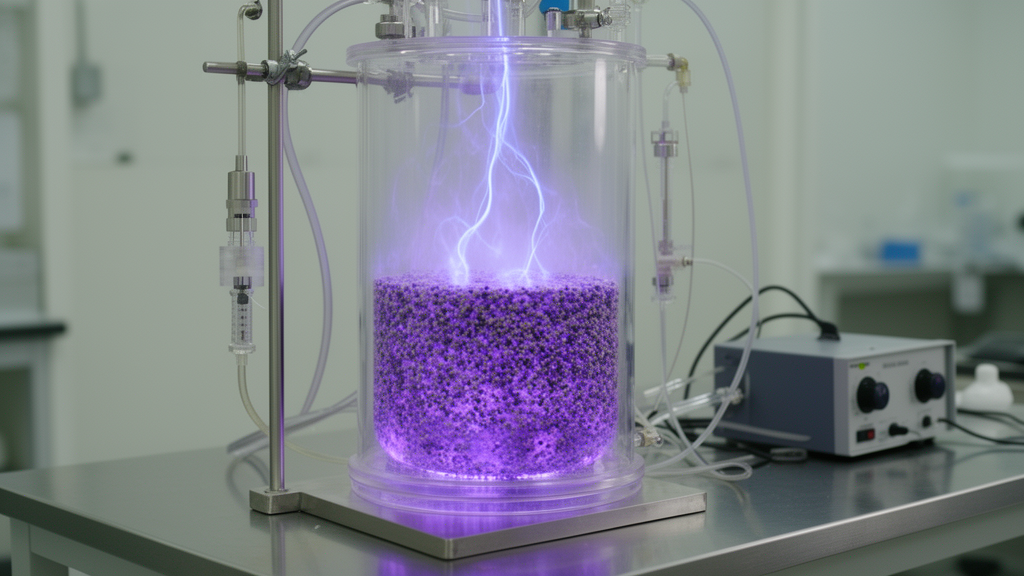
A 2026 mini review finds that fluidized-bed plasma reactors can improve gas conversion, ammonia synthesis, carbon production and contaminated-soil treatment by keeping particles in motion and repeatedly renewing contact between solids and plasma-generated reactive species. The same particle motion can also reshape the electrical discharge, suppress power deposition or reduce effective gas residence time. Rather than acting as a universal upgrade, fluidization therefore creates a coupled operating regime in which heat and mass transfer, surface renewal, hydrodynamics, plasma generation and electrical power must be balanced against one another.
Nonthermal plasma can activate stable molecules such as carbon dioxide, methane and nitrogen while maintaining comparatively low bulk-gas temperatures, creating opportunities to couple chemical conversion with renewable electricity. In a packed-bed dielectric barrier discharge, or DBD, the solid catalyst remains stationary, providing direct plasma–catalyst contact but potentially limiting heat and mass transfer, increasing pressure drop and producing uneven plasma exposure. Fluidizing the particles introduces motion and void formation, which can improve solids circulation and repeatedly expose catalyst surfaces. Yet particles also affect charge distribution, electrical fields and discharge pathways, so improved contact does not automatically guarantee a stronger or more efficient plasma.
A controlled comparison of fluidized-bed and packed-bed DBD reactors for dry reforming of methane provides evidence that particle motion can influence the reaction independently of residence time alone. The two systems had similar specific energy inputs of 1.52 and 1.37 eV per molecule and weight-hourly space velocities of 4,500 and 5,455 cm³ gcat⁻¹ h⁻¹, although pressure, gas flow, catalyst loading, discharge power and residence time differed. At 500 °C, nominal residence time was 93.3 milliseconds in the fluidized reactor and 6.84 milliseconds in the packed reactor, yet thermal conversion increased only marginally. Lissajous analysis at 12 and 100 kHz also showed broadly comparable macroscopic discharge behavior. The stronger fluidized-bed response was therefore consistent with enhanced coupling between excited species and the larger plasma-accessible external surface of moving powder catalysts, together with improved transport supporting the strongly endothermic reaction.
Fluidization does not always produce the highest conversion. In a catalyst-spouted-bed DBD reactor for dry reforming, a fixed bed delivered more conversion, but its electrode temperature exceeded 700 °C within 11 minutes and continuous operation became difficult. Spouting stabilized the temperature at approximately 370 °C and reduced carbon accumulation, so its principal demonstrated advantage was thermal stability and carbon control rather than peak reaction output. The same distinction appeared in carbon dioxide conversion with biochar: an atmospheric plasmatron reached up to 27.1% conversion and 36.9% energy efficiency while producing nearly oxygen-free carbon monoxide, but the fixed bed performed better. The authors attributed that result to closer plasma–biochar contact and faster local oxygen scavenging in the fixed configuration, which reduced carbon monoxide reoxidation. Fluidization was not advantageous when rapid local scavenging outweighed the benefit of particle renewal.
Particle loading can determine whether a discharge is strengthened or suppressed. In an FB-DBD reactor, adding 2.5 grams of activated carbon raised discharge power to 1.4 times and carbon dioxide conversion to 2.7 times the particle-free values; increasing the loading to 60 grams reduced discharge power from 0.32 to 0.22 kW. Other work found that catalyst particles in a gliding-arc fluidized bed promoted carbon dioxide conversion while reducing discharge power and gas-processing capacity, although magnetic acceleration improved both conversion and energy efficiency by approximately 32%. A low-pressure glow-discharge fluidized bed containing 4 grams of alumina reached up to 35% carbon dioxide conversion, with diagnostics attributing the enhancement to particle-induced plasma confinement, changed electron kinetics and oxygen removal. These observations indicate that added solids are not merely extra reactive surface: their loading, distribution and electrical properties can reorganize plasma generation itself.
Ammonia synthesis highlights both the potential of fluidization and the difficulty of identifying its cause. An electrohydrodynamic fluidized-bed DBD reactor produced 5.9 g-NH₃ kWh⁻¹, compared with 2.6 g-NH₃ kWh⁻¹ in a packed-bed configuration, at atmospheric pressure and 300 °C. The result was strongly particle-size dependent: particles no larger than 1 μm were readily mobilized, whereas 200 μm particles remained essentially stationary. A separate fixed-versus-fluidized comparison using Ru–Co/Al₂O₃ found that fluidization increased ammonia formation by as much as 38.2% and coincided with more frequent microdischarges and stronger electrical excitation. An electrohydrodynamic reactor also demonstrated an ammonia formation rate of 12.07 μmol g⁻¹ h⁻¹ with an H₂-free nitrogen-and-steam feed over Co–Ni/MgO. Because fluidization simultaneously changes heat transfer, surface renewal and discharge behavior, these higher formation rates cannot yet be attributed uniquely to thermal management, electrical intensification or surface renewal.
Moving solids also enable reactions in which particles are consumed, created or chemically transformed. A rotating gliding arc coupled to an alumina fluidized bed increased methane conversion from 11.8% to 16.6% and hydrogen selectivity from 85.1% to 97.2% in a feed containing 8 vol% methane, while lowering the reported hydrogen energy cost to 10.6 kJ L⁻¹. The system operated for only about 25 minutes, however, because carbon deposited on the electrodes extinguished the arc. By contrast, an FB-DBD configuration sustained carbon production from carbon monoxide at 577 °C for more than 11 hours without gas dilution, reaching more than 228.9 gC gFe⁻¹ and 30.2 gC gFe⁻¹ h⁻¹. Particle collisions detached carbon nanofiber aggregates, maintained gas gaps for plasma generation, and enabled downstream separation using differences in terminal velocity. This contrast demonstrates that sustained operation must be assessed through reaction performance, bed evolution and discharge stability together.
Further systems show how particle circulation can couple chemistry with solids handling. In biomass reforming with a rotating-gliding-arc spouted bed, carbon dioxide conversion rose from 6.8% with plasma alone to 10.3% with sodium-loaded biomass, while energy efficiency increased from 10% to 33%. Char consumed atomic oxygen and molecular oxygen and suppressed carbon monoxide reoxidation, whereas sodium accelerated heterogeneous char–carbon dioxide conversion. A pulsed-discharge spouted bed reduced tin dioxide: the discharge raised the average apparent bed-surface temperature from about 560 to 730 °C, and the product contained approximately 37 mass% metallic tin after 30 minutes, whereas flame-only operation produced no reduction. Because the electrical contribution also increased bed temperature, direct electron-induced defect formation and discharge-induced heating were not experimentally separated.
Multiphase treatment and materials processing reveal additional benefits of circulating particles. A triphase DBD reactor with fluidized Ir/GaN upgraded biomass-derived pyrolysis oil at approximately 100 °C, producing an 86.8% liquid yield and increasing the C5–C11 fraction from 54.3% to 80.4%, with relatively stable yield and composition over 24 hours. A fluidized-bed DBD system removed 91.2% of atrazine from contaminated soil in six minutes, improving removal and energy efficiency by 35.5% and 38.9% relative to a fixed bed, consistent with more uniform exposure of soil particles to reactive species. Plasma-assisted fluidization also distributed palladium deposition over porous powders, partially regenerated ground tire rubber by cleaving sulfur crosslinks, and enabled continuous production of 10–20 nm nitrogen-doped silicon carbide and nanocarbon composites. Across these applications, fluidization affects exposure, circulation and material handling as well as reaction kinetics, often making the separate contribution of each effect difficult to isolate.
The review argues that the next advance will come from treating the reactor as a coupled electrical, thermal and hydrodynamic system. Particle size, density, morphology, conductivity and dielectric properties govern circulation, polarization, charge relaxation, plasma coverage and bed structure; electrical charging can then feed back into particle motion. Operating conditions optimized at startup may deteriorate as particles grow, shrink, become coated, agglomerate or are consumed. A well-fluidized bed is not necessarily the best plasma generator, and similar specific energy inputs do not guarantee comparable reaction environments. Meaningful experiments should compare plasma-off and plasma-on states in both static and fluidized beds, measure absorbed power directly, and synchronize particle, temperature, residence-time and discharge measurements. Scale-up must preserve the fluidization regime, solids circulation, normalized residence-time distribution, volumetric absorbed-power density and spatial discharge uniformity rather than relying on geometric similarity alone. The practical question is therefore not whether particles should move, but whether their movement removes the dominant reactor bottleneck without sacrificing effective plasma exposure and stable solids handling.
Subject of Research: A mini review of fluidized-bed plasma catalysis, plasma–particle coupling, reaction performance and scale-up requirements.
Article Title: Fluidized-bed plasma catalysis: recent advances and emerging applications
Article References: Chen, X., & Nozaki, T. (2026). Fluidized-bed plasma catalysis: recent advances and emerging applications. Frontiers in Chemical Engineering, 8, Article 1980223. https://doi.org/10.3389/fceng.2026.1980223
Image Credits: AI Generated
DOI: 10.3389/fceng.2026.1980223
Keywords: fluidized beds, plasma catalysis, plasma-particle coupling, process electrification, ammonia synthesis, carbon dioxide conversion, dry reforming, dielectric barrier discharge, chemical engineering, scale-up, Fluidized-bed, plasma
Cite Scienmag News
Bethany Barker. (October 20, 2026). Fluidized-bed plasma catalysis: recent advances and emerging applications. Scienmag. https://scienmag.com/fluidized-bed-plasma-catalysis-recent-advances-and-emerging-applications/
Bethany Barker. "Fluidized-bed plasma catalysis: recent advances and emerging applications." Scienmag, 20 October 2026, https://scienmag.com/fluidized-bed-plasma-catalysis-recent-advances-and-emerging-applications/. Accessed 20 October 2026.
Bethany Barker. "Fluidized-bed plasma catalysis: recent advances and emerging applications." Scienmag. October 20, 2026. https://scienmag.com/fluidized-bed-plasma-catalysis-recent-advances-and-emerging-applications/


