

Tuesday, October 20, 2026
Science
No Result
View All Result
  • Login
  • HOME
  • SCIENCE NEWS
  • CONTACT US
  • HOME
  • SCIENCE NEWS
  • CONTACT US
No Result
View All Result
Scienmag
No Result
View All Result
Home Science News Biology

Cephalopod suckers may evolve through repurposed development genes

October 20, 2026
in Biology
Juliet Wilcox
By Juliet Wilcox Scienmag Editorial Profile - Human Genetics
Reading Time: 2 mins read
0
Cephalopod suckers may evolve through repurposed development genes

Cephalopod suckers may evolve through repurposed development genes

65
SHARES
587
VIEWS
Share on FacebookShare on Twitter
ADVERTISEMENT

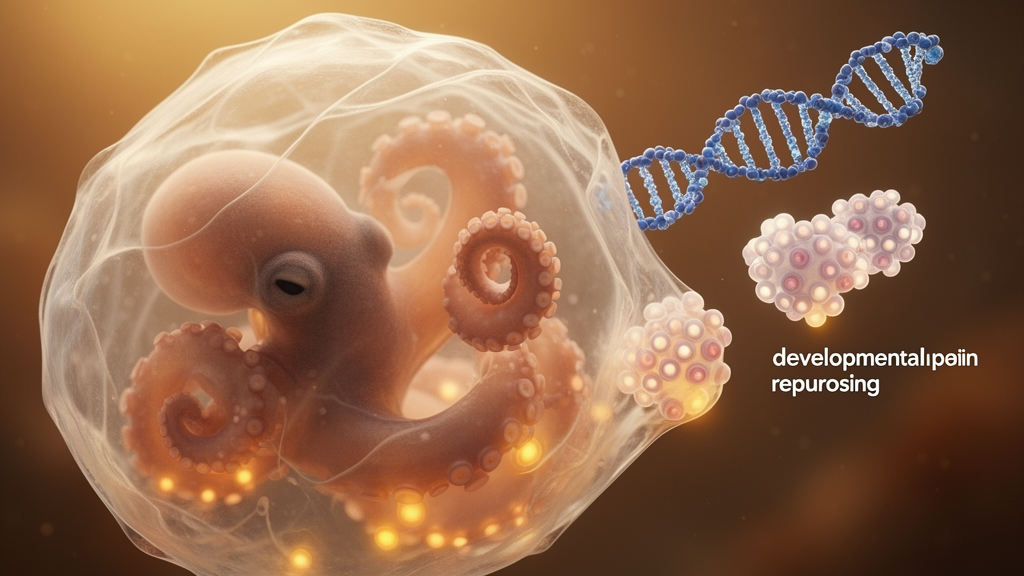
Developing suckers on the arms of cuttlefish and octopus activate the gene Ets1 in a pattern distinct from the appendage-patterning activity observed along the arms themselves, according to a comparative developmental study led by researchers at the University of Tokyo. The results suggest that cephalopod suckers may have evolved through the reuse of genes already involved in early molluscan development. The researchers compared gene activity during embryonic development in cuttlefish, octopus and snail body parts, identifying Ets1 expression in the regions where suckers form. Because the study primarily mapped gene activity, it does not establish that Ets1 directly causes sucker formation or that the gene alone is sufficient to produce the structure.

Arms and suckers appeared to share fewer developmental signals than the researchers initially expected. Several genes associated with appendage patterning were active along developing cephalopod arms, consistent with the observation that arm development involves conserved patterning genes also used in appendage development in insects and mammals. No comparable pattern was detected in developing suckers. Sucker tissue instead expressed Ets1, a gene normally involved in early developmental processes in mollusks. The pattern points to a possible evolutionary route in which an existing molecular program was redirected to build a specialized anatomical structure. Postdoctoral fellow Ryosuke Kimbara said the researchers changed direction after encountering difficulty identifying genes expressed in suckers and expanded their screening to a more comprehensive approach. The distinctive Ets1 signal emerged from that broader search rather than from the original expectation that appendage-patterning genes would explain both arms and suckers.

As suckers developed, researchers also observed changes in cell shape and cell movement, alongside cell proliferation involved in forming the adhesive structures. These cellular activities resembled the epithelial–mesenchymal transition observed during early embryonic development. The resemblance supports the hypothesis that mechanisms used early in molluscan embryogenesis may have been recruited later in sucker production, but the study did not directly demonstrate that epithelial–mesenchymal transition occurs in forming suckers. The precise role of Ets1 and the extent to which the transition-like process contributes to sucker formation therefore remain experimentally unresolved. Tests that switch individual genes on or off will be needed to determine whether Ets1 drives any of the observed cellular changes.

The researchers also report that early developmental patterns and gene expression in suckers are broadly similar among cephalopods such as squid, cuttlefish and octopus, despite differences in the morphology and adhesive mechanisms of their developed suckers. This difference leaves open the possibility that the underlying molecular mechanisms may have evolved independently as each lineage acquired its specialized structures. More broadly, the findings illustrate how evolution can produce a new structure without requiring an entirely new set of genes: a gene already serving another role in the developing organism can be repurposed for a novel function. The researchers suggest that similar mechanisms may eventually help explain other unusual cephalopod structures, including chromatophores, the ink sac and the hard beak, although those ideas remain untested. Comparisons across more mollusk species and functional gene experiments will be needed to reconstruct how cephalopod suckers arose from the simpler body plan of their molluscan ancestors.

Subject of Research: Developmental gene reuse in the evolution of cephalopod arm suckers

Article Title: Why are cephalopods such suckers?

Article References: Why are cephalopods such suckers?. Original publication (Bibliographic details unavailable.)

Image Credits: AI Generated

DOI: Not provided

Keywords: cephalopod evolution, octopus, cuttlefish, sucker development, Ets1, gene co-option, embryonic development, mollusks, cephalopods, such, suckers, scientific research

Cite Scienmag News

Juliet Wilcox. (October 20, 2026). Cephalopod suckers may evolve through repurposed development genes. Scienmag. https://scienmag.com/cephalopod-suckers-may-evolve-through-repurposed-development-genes/

Juliet Wilcox. "Cephalopod suckers may evolve through repurposed development genes." Scienmag, 20 October 2026, https://scienmag.com/cephalopod-suckers-may-evolve-through-repurposed-development-genes/. Accessed 20 October 2026.

Juliet Wilcox. "Cephalopod suckers may evolve through repurposed development genes." Scienmag. October 20, 2026. https://scienmag.com/cephalopod-suckers-may-evolve-through-repurposed-development-genes/


Tags: cephalopod arm versus sucker developmentcephalopod evolutionCephalopod sucker evolutioncephalopodscomparative embryonic gene expressionconserved patterning genes in invertebratescuttlefishdevelopmental genetics of cephalopod arms and suckersembryonic developmentETS1Ets1 gene function in cephalopodsevolution of mollusk limb structuresevolutionary origins of cephalopod suckersgene co-optiongene repurposing in evolutionary biologygene reuse in molluscan developmentmolecular basis of cephalopod morphological innovationmolluscanmollusksoctopusScientific Researchsuchsucker developmentsuckers
Share26Tweet16
Previous Post

Crushed-sand mortar enables high-fluidity concrete with lower carbon footprint

Next Post

Statistical optimization yields nanoscale silver oxide for alkaline cathodes

Related Posts

Research report: Wading birds on a dynamic wetland landscape: a synthesis of individual-based modeling methodology
Biology

Research report: Wading birds on a dynamic wetland landscape: a synthesis of individual-based modeling methodology

October 20, 2026
Research report: Modeling the distribution of coprophagous beetle species in the Western Swiss Alps
Biology

Research report: Modeling the distribution of coprophagous beetle species in the Western Swiss Alps

October 20, 2026
Boosting models forecast Tabriz PM2.5 with mixed short- and multi-day skill
Biology

Boosting models forecast Tabriz PM2.5 with mixed short- and multi-day skill

October 20, 2026
Two new deep-sea isopods recorded in southwestern Atlantic
Biology

Two new deep-sea isopods recorded in southwestern Atlantic

October 20, 2026
White blood cell shifts may predict actionable sepsis sequencing results
Biology

White blood cell shifts may predict actionable sepsis sequencing results

October 20, 2026
Healthy remodeling-phase wound factors improve stem-cell repair in diabetic rat wounds
Biology

Healthy remodeling-phase wound factors improve stem-cell repair in diabetic rat wounds

October 20, 2026
Next Post
Statistical optimization yields nanoscale silver oxide for alkaline cathodes

Statistical optimization yields nanoscale silver oxide for alkaline cathodes

  • Mothers who receive childcare support from maternal grandparents show more optimized

    Mothers who receive childcare support from maternal grandparents show more parental warmth, finds NTU Singapore study

    27656 shares
    Share 11059 Tweet 6912
  • University of Seville Breaks 120-Year-Old Mystery, Revises a Key Einstein Concept

    1061 shares
    Share 424 Tweet 265
  • Bee body mass, pathogens and local climate influence heat tolerance

    682 shares
    Share 273 Tweet 171
  • Researchers record first-ever images and data of a shark experiencing a boat strike

    546 shares
    Share 218 Tweet 137
  • Groundbreaking Clinical Trial Reveals Lubiprostone Enhances Kidney Function

    531 shares
    Share 212 Tweet 133
Science

Embark on a thrilling journey of discovery with Scienmag.com—your ultimate source for cutting-edge breakthroughs. Immerse yourself in a world where curiosity knows no limits and tomorrow’s possibilities become today’s reality!

RECENT NEWS

  • Statistical optimization yields nanoscale silver oxide for alkaline cathodes
  • Cephalopod suckers may evolve through repurposed development genes
  • Crushed-sand mortar enables high-fluidity concrete with lower carbon footprint
  • Daily machine-state data sharpen radiotherapy delivery-quality predictions

Categories

  • Agriculture
  • Anthropology
  • Archaeology
  • Athmospheric
  • Biology
  • Biotechnology
  • Blog
  • Bussines
  • Cancer
  • Chemistry
  • Climate
  • Earth Science
  • Editorial Policy
  • Marine
  • Mathematics
  • Medicine
  • Pediatry
  • Policy
  • Psychology & Psychiatry
  • Science Education
  • Science News
  • Social Science
  • Space
  • Technology and Engineering

Subscribe to Blog via Email

Enter your email address to subscribe to this blog and receive notifications of new posts by email.

Join 5,150 other subscribers

© 2025 Scienmag - Science Magazine

Welcome Back!

Login to your account below

Forgotten Password?

Retrieve your password

Please enter your username or email address to reset your password.

Log In
No Result
View All Result
  • HOME
  • SCIENCE NEWS
  • CONTACT US

© 2025 Scienmag - Science Magazine

Discover more from Science

Subscribe now to keep reading and get access to the full archive.

Continue reading