


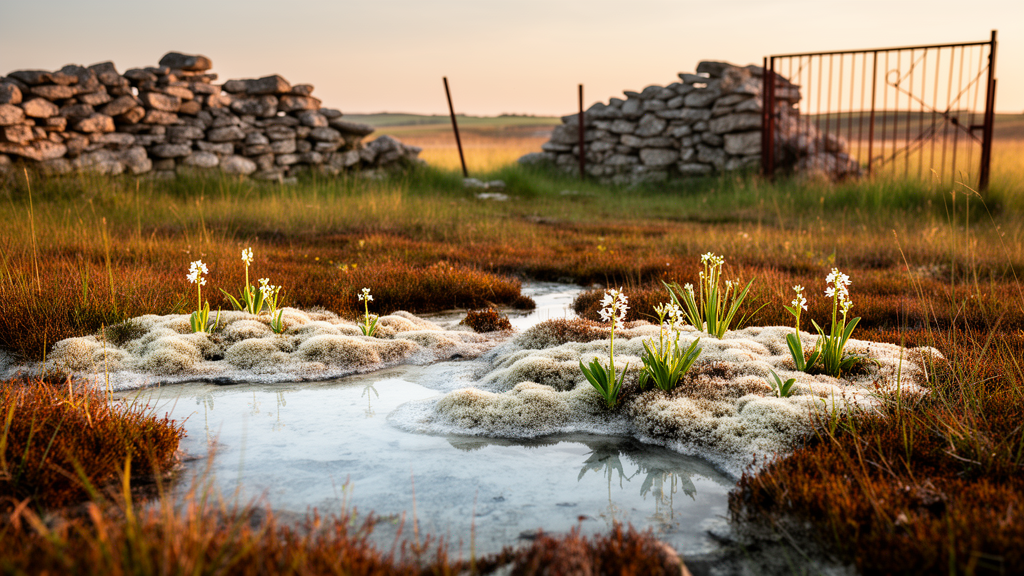
A floristic inventory and historical comparison of the Torbiera di Lipoi alkaline fen in Veneto, northern Italy, identified 319 infrageneric vascular plant taxa belonging to 67 families. The study combined historical records with an exhaustive field survey in spring and summer 2023–2024, finding that the site retains many characteristic and regionally threatened fen plants despite substantial vegetation change following the abandonment of traditional mowing.
The fen is a small alkaline-fen meadow in the Caricion davallianae alliance, with elements of transition mires, at an average elevation of 300 metres above sea level in the pre-Alpine Valbelluna landscape. It lies within the 65-hectare Natura 2000 site “IT3230042 Torbiera di Lipoi,” for which the fen constitutes the core area. Its soils comprise fluvial and alluvial deposits over calcareous moraines associated with the Piave river glacier. The climate is temperate-continental, with a mean annual temperature of about 12 °C and mean annual precipitation of 1,200–1,500 mm, with peaks in autumn and spring.
The meadow was traditionally mowed for straw and hay production until the end of the twentieth century. During subsequent decades, abandonment of that management was followed by natural encroachment and a marked alteration of the site’s physiognomy. Approximately 45% of the fen’s surface was lost between 2003 and 2022. The present landscape is a mosaic of alkaline fen, transition mire, Molinia meadow, tall herb-fringe, wet woodland, oak-hornbeam forest, stable hay-meadow and willow-grove habitats.
For the inventory, researchers examined four literature sources published from 1976 to 1993, specimens held in the Herbarium C. Lasen at the Museo Naturalistico Dolomiti Bellunesi, and field observations collected in 2023 and 2024. These records spanned 50 years, from 1974 to 2024. The pre-abandonment scenario was reconstructed from bibliographic and herbarium data, whereas the current scenario was based on the new field survey. The comparison examined life forms, chorology and conservation value.
This approach had a specific limitation: the precise locations of historical observations were unknown. The authors therefore treated the site as morphologically well defined and considered a comparison between the formerly managed period and vegetation after approximately two decades of abandonment reasonable for conservation, monitoring and management purposes. The historical and recent observations were not equivalent sampling efforts, however, and the study’s analysis of change was qualitative rather than a controlled assessment of causation.
Seventy-seven taxa were found only during the recent survey, 165 were confirmed from historical surveys and 78 were not confirmed. Historical records of Carex acuta, Carex riparia, Galium palustre subsp. elongatum, Galium verum subsp. wirtgeni and Ranunculus tuberosus were considered doubtful and probably reflected misidentification. Seven families accounted for about 55% of the inventory: Poaceae with 37 taxa, Cyperaceae with 32, Asteraceae with 20, Lamiaceae with 16, Ranunculaceae with 16, Rosaceae with 16 and Fabaceae with 14.
Five families recorded historically—Campanulaceae, Lentibulariaceae, Linaceae, Polygalaceae and Potamogetonaceae—were not detected during the recent survey, while Caprifoliaceae, Dioscoreaceae and Onagraceae were newly recorded. Hemicryptophytes, geophytes, phanerophytes and therophytes were the most represented life forms, and their overall proportions remained relatively constant between the compared periods. No hydrophytes were found during the recent survey, while phanerophytes tended to increase. Historical observations in 1985 described Salix cinerea, Alnus glutinosa and Quercus robur as occurring in scattered populations, whereas they were widespread across much of the fen in the recent survey. Frangula alnus and Phragmites australis also colonized the site in recent decades.
The biogeographic composition remained comparatively stable, with Eurasian, European-Caucasian, Eurosiberian, European and Circumboreal species predominating, although Eurasian, Eurosiberian and European species decreased relative to the pre-abandonment period. Alien plants represented 4.4% of the recorded flora, principally North American species, whose proportion increased over time. Ten alien taxa were classified as invasive, one as naturalized, one as casual and two as cryptogenetic. Most occurred in small, scattered populations, although Symphyotrichum lanceolatum formed a relatively large but bounded population in the eastern part of the fen.
Plantago altissima was listed as critically endangered in the Veneto Red List, while seven species were classified as vulnerable: Festuca trichophylla, Gentiana pneumonanthe, Carex lasiocarpa, Carex randalpina, Dactylorhiza incarnata, Equisetum fluviatile and Taraxacum sect. Palustria. Epipactis palustris, Menyanthes trifoliata and Cladium mariscus were near threatened. Two previously recorded red-listed species, Rosa gallica and Utricularia minor, were not found and could be locally extinct, while Potamogeton gramineus was considered regionally extinct. The authors noted that most fen-related vascular species still occurred, although populations were thought to have declined. Cladium mariscus and Carex lasiocarpa, by contrast, were reported to be expanding based on the authors’ field observations.
The findings indicated that the surviving flora still reflected a period when fen habitats were more extensive, suggesting that habitat reduction had not yet produced all the species losses it might eventually cause. The authors concluded that conservation could focus on maintaining the remaining open areas rather than restoring the former management regime or removing newly formed forests, which they noted may also be valuable to animals. They proposed small-scale manual mowing, rapid removal of material outside the fen and seasonal timing intended to limit the spread of alien plants, combined with monitoring to assess effects and adjust measures if unexpected dynamics emerged.
Subject of Research: Floristic inventory and historical vegetation comparison of an alkaline fen in Veneto, northern Italy
Article Title: Inventory of the vascular flora of the alkaline fen “Torbiera di Lipoi” (Veneto, northern Italy)
Article References: Zanatta, K., Lasen, C., Scariot, A., & Nascimbene, J. (2025). Inventory of the vascular flora of the alkaline fen “Torbiera di Lipoi” (Veneto, northern Italy). Italian Botanist, 19, 21-30. https://doi.org/10.3897/italianbotanist.19.132549
Image Credits: AI Generated
DOI: 10.3897/italianbotanist.19.132549
Keywords: floristic inventory, vascular flora, alkaline fen, Torbiera di Lipoi, Veneto, plant diversity, vegetation change, traditional mowing, Natura 2000, Inventory, vascular, flora
Cite Scienmag News
Drew Townsend. (October 20, 2026). Floristic inventory and 50-year comparison document vegetation change in Italy’s Torbiera di Lipoi alkaline fen. Scienmag. https://scienmag.com/floristic-inventory-and-50-year-comparison-document-vegetation-change-in-italys-torbiera-di-lipoi-alkaline-fen/
Drew Townsend. "Floristic inventory and 50-year comparison document vegetation change in Italy’s Torbiera di Lipoi alkaline fen." Scienmag, 20 October 2026, https://scienmag.com/floristic-inventory-and-50-year-comparison-document-vegetation-change-in-italys-torbiera-di-lipoi-alkaline-fen/. Accessed 20 October 2026.
Drew Townsend. "Floristic inventory and 50-year comparison document vegetation change in Italy’s Torbiera di Lipoi alkaline fen." Scienmag. October 20, 2026. https://scienmag.com/floristic-inventory-and-50-year-comparison-document-vegetation-change-in-italys-torbiera-di-lipoi-alkaline-fen/


