


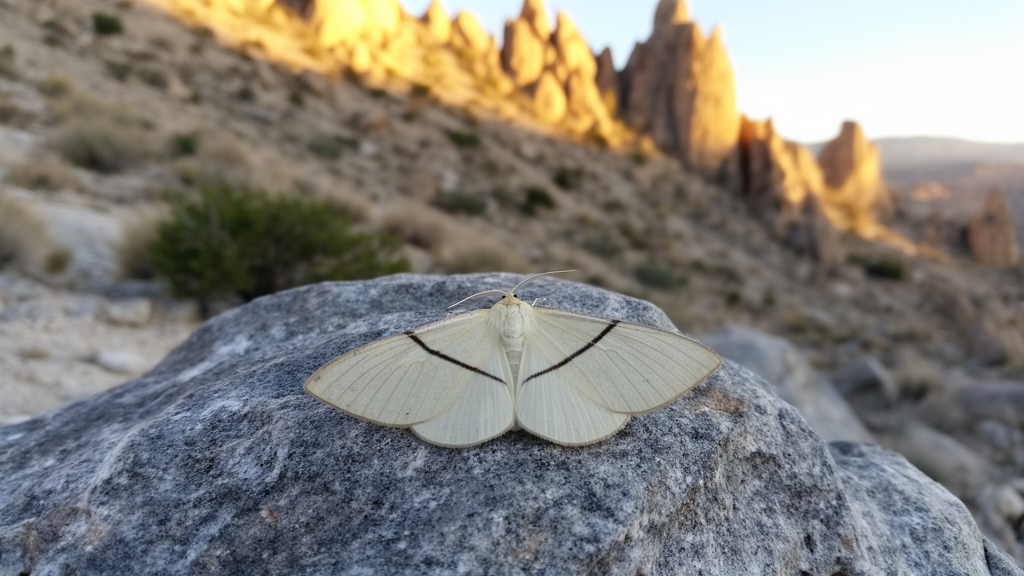
A taxonomic study has described Eretmocera hafeetensis sp. nov. from Jebel Hafeet in the United Arab Emirates, based on collected adults and examinations of male and female genitalia. The moth was first observed in 2010, and the name refers to the mountain where it was found. Its holotype, a male collected at Ain Al Waal on 15 May 2020, is deposited in the Natural History Museum Abu Dhabi; paratypes are held there and in the private collections of Bengt Åke Bengtsson and Huw Roberts.
The discovery adds a third identified species of the genus Eretmocera known from the UAE, alongside E. impactella and E. bradleyi. The family Scythrididae contains small, often cryptic moths and is represented across most of the world, but comparatively few species had been recorded from the Middle East until the late twentieth century. Work in Oman and Yemen around the turn of the century described 45 new species and identified many others, while knowledge of the UAE fauna remained less developed.
Specimens for the description were collected with sweep nets over vegetation. They were either preserved and pinned on site or sent as dry specimens to a laboratory in Sweden, where they were relaxed and mounted for dissection and examination. Male and female genitalia slides were prepared using the procedure described by Robinson in 1976. The slides were photographed with a Canon EOS 500D mounted on a Euromex compound microscope, and the images were stacked and enhanced for the published figures. Field photography also included stacked images of an adult female.
E. hafeetensis can be recognized at rest by a pale, X-shaped marking extending across the two forewings, most clearly in females. The authors report that this pattern is not observed in other species of the genus. Unlike most Eretmocera, its antennae are only insignificantly thickened. The male genitalia resemble those of E. arabica, but the gnathos has diverging posterior prongs; they also resemble those of E. bradleyi, but the uncus bears a row of sclerotized teeth. The female genitalia have a sclerotized structure in segment 8 with posteriorly directed, bristle-bearing extensions and narrow anterior pockets.
Adult males have a wingspan of 9–10 mm. The head, collar, and thorax are blackish brown with a semi-metallic sheen, while yellow markings occur on the dark brown forewings. The abdomen is rich yellow-orange with varying dark brown or black areas. Females have the same general size, coloration, and markings as males, but their antennae lack the erect scales visible in the basal sections of the male antennae. The description is based on the type series and examination of both sexes, rather than on a population-wide analysis of variation.
Most records came from the west flank of Jebel Hafeet, an isolated mountain rising more than 1,140 metres above the surrounding plain near Al Ain. The type locality, Ain Al Waal, lies at 24.067°N, 55.748°E and about 255 metres above sea level. Specimens were found on plants at elevations of approximately 255–370 m. Additional records came from Ain Al Fayda Ladies’ and Children’s Park at 242 m and Wadi Nahyan at 290 m. The Ain Al Waal study area covered about 900 by 700 metres and contained mature trees, scrub vegetation, wadis, semi-permanent pools, deep holes, and caves.
The regional climate has high temperatures and erratic rainfall. The reported mean temperature is 36.4 °C in summer, with daytime values often exceeding 50 °C, while January averages 17.7 °C. In most years with average winter rainfall, the moth was found in good numbers from late April through June, especially on Aerva javanica; one specimen was also recorded in November. Adults were collected on Aerva javanica, Chrozophora oblongifolia, Calotropis procera, Ochradenus aucheri, and Salvadora persica. These are plants on which adults were observed, but the study did not identify the larvae or establish the species’ host plants.
The authors searched the eastern side of Jebel Hafeet and Wadi Tarabat without finding the moth, while an extensive collection in the Hajar Mountains by numerous entomologists from 2008 to 2017 did not detect it among 12 scythridid species recovered from tens of thousands of arthropod specimens. The authors speculate that more concerted searching could reveal it elsewhere on Jebel Hafeet because other parts of the mountain share much of the area’s fauna and flora, but the evidence presented is limited to the reported collecting efforts and observations.
Nearly all specimens were found at Ain Al Waal, making the moth’s known distribution closely associated with that site. The area has so far benefited from limited human disturbance, although a nearby housing development lies only metres away, and Ain Al Fayda park, where the species was observed in 2014, is no longer irrigated and is earmarked for development. The authors state that its long-term prospects are therefore tied to protection of the mountain habitat. Jebel Hafeet received National Park status in 2017, which they hope may support greater monitoring of the site and its fauna.
Subject of Research: Taxonomic description of a new scythridid moth species from Jebel Hafeet in the UAE
Article Title: Description of Eretmocera hafeetensis sp. nov. from UAE ( Lepidoptera , Scythrididae )
Article References: Roberts, H., & Bengtsson, B. Å. (2023). Description of Eretmocera hafeetensis sp. nov. from UAE (Lepidoptera, Scythrididae). Nota Lepidopterologica, 46, 135-144. https://doi.org/10.3897/nl.46.106936
Image Credits: AI Generated
DOI: 10.3897/nl.46.106936
Keywords: Eretmocera hafeetensis, new species, Scythrididae, Jebel Hafeet, United Arab Emirates, taxonomy, moth genitalia, Ain Al Waal, insect distribution, Description, Eretmocera, hafeetensis
Cite Scienmag News
Gavin Prescott. (October 20, 2026). Eretmocera hafeetensis: New Moth Species Described from Jebel Hafeet, UAE. Scienmag. https://scienmag.com/eretmocera-hafeetensis-new-moth-species-described-from-jebel-hafeet-uae/
Gavin Prescott. "Eretmocera hafeetensis: New Moth Species Described from Jebel Hafeet, UAE." Scienmag, 20 October 2026, https://scienmag.com/eretmocera-hafeetensis-new-moth-species-described-from-jebel-hafeet-uae/. Accessed 20 October 2026.
Gavin Prescott. "Eretmocera hafeetensis: New Moth Species Described from Jebel Hafeet, UAE." Scienmag. October 20, 2026. https://scienmag.com/eretmocera-hafeetensis-new-moth-species-described-from-jebel-hafeet-uae/


