


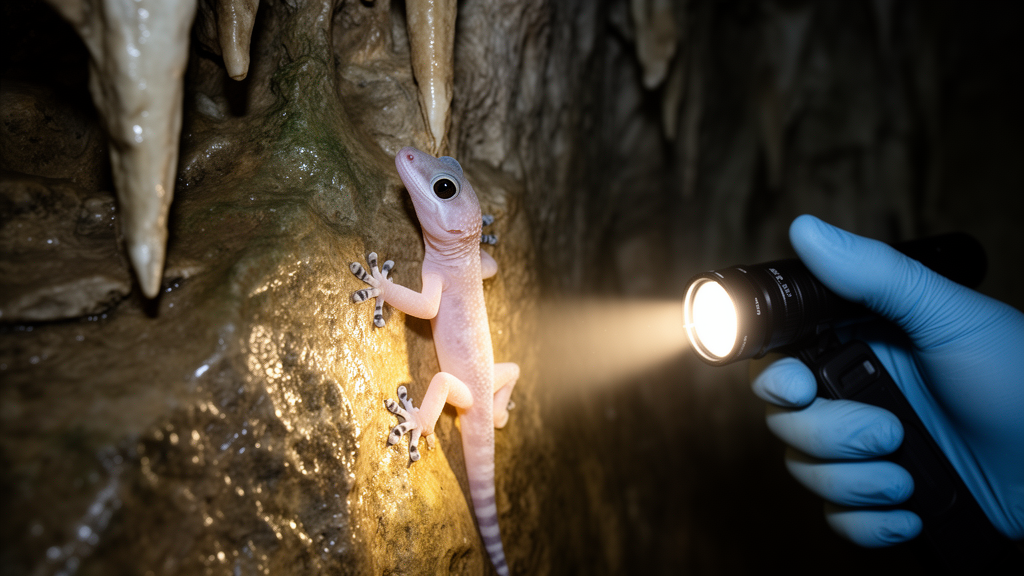
Researchers have described a new species of cave gecko, Goniurosaurus wuzhengjuni, from the Baishou Nature Reserve in northern Guangxi, China. The finding is based on an integrative study of four collected specimens, combining morphological measurements and scalation counts with DNA sequences from three genes. The species is placed in the G. luii species group and is distinguished from its known relatives by a combination of body proportions, scale counts, precloacal pores and coloration.
The genus Goniurosaurus, commonly known as cave geckos, included 25 recognized species when the study began. Its recognized range included Guangxi, Guizhou, Guangdong and Hainan in China, as well as Vietnam and Japan’s Ryukyu Islands. These nocturnal, rock-dwelling reptiles commonly occupy terrestrial microhabitats in karst landscapes, tropical rainforests and seasonal monsoon forests, including forest floors, limestone crevices, caves and sites near riparian zones.
The new material was collected during herpetofaunal surveys conducted in 2025 at Baishou Nature Reserve in Yongfu County, Guilin City, Guangxi. Four adults were collected: one male, designated the holotype, and three females designated as paratypes. The specimens were fixed and preserved in 75% ethanol, and muscle tissue was sampled for molecular analysis before the specimens were deposited in the Herpetological Collection of Guangxi Normal University. The holotype, GXNU2025101603, was collected on 26 October 2025 at an elevation of 323 metres above sea level.
Researchers measured snout–vent length, tail length, axilla-to-groin distance, snout–eye distance, eye–ear distance, head dimensions and numerous scale characters. Molecular analysis sequenced the mitochondrial cytochrome b and 16S ribosomal RNA genes and the nuclear C-mos gene. The concatenated alignment comprised 1,189 base pairs and included 24 Goniurosaurus taxa, with Holodactylus africanus and Gekko chinensis used as outgroups. Maximum-likelihood and Bayesian analyses produced highly congruent trees.
Both phylogenetic analyses placed the four specimens in a well-supported clade within the G. luii group. The clade had a Bayesian posterior probability of 1.00 and a maximum-likelihood bootstrap value of 100. The closest phylogenetic relative identified in the analysis was G. araneus, with support values of 0.98 and 92. Uncorrected genetic distances in the mitochondrial cytochrome b gene ranged from 8.7% to 22.0% relative to other Goniurosaurus species, a range the authors described as indicative of interspecific differentiation.
Adult G. wuzhengjuni have snout–vent lengths of 92.3–109.3 mm. The species has zero or one internasal, seven nasal scales around each nostril, nine or ten sublabials, 47–54 eyelid fringe scales, 21–22 dorsal tubercle rows at midbody and 101–108 scale rows around the midbody. The male holotype has 23 precloacal pores arranged in a continuous transverse series that does not extend onto the proximal thighs. Two enlarged postcloacal tubercles are present on each side.
Several traits distinguish the new species from G. araneus, its closest phylogenetic relative. It has fewer eyelid fringe scales, 47–54 compared with 61–67; fewer midbody scale rows, 101–108 compared with 129–147; and fewer subdigital lamellae under the fourth toe, 17–19 compared with 23–24. Its 23 precloacal pores also exceed the 18–22 recorded for G. araneus, although some other members of the G. luii group have higher counts. Additional comparisons with G. gezhi, G. chengzheng, G. luii, G. huuliensis, G. kwangsiensis, G. catbaensis and G. liboensis further documented differences in scale counts, pores and limb proportions.
The new species has a grayish-white dorsal ground colour on the head, body and limbs, marked by dense, irregular black blotches that are partly fused on the head. It has orange irises, a pale-yellow nuchal loop with a rounded posterior margin, three pale-yellow body bands between the limb insertions and a postsacral band at the base of the tail. The original tail is black with distinct white bands, whereas regenerated tails have irregular white markings. The specific name honours Professor Zhengjun Wu, and the proposed common names are “Wu’s Cave Gecko” and “武氏睑虎”.
G. wuzhengjuni was found in karst terrain with dense arborous vegetation at elevations of 280–351 metres. It is nocturnal and was frequently observed on limestone surfaces near roadside slopes and around limestone accumulations at cave entrances. The study reports that Guangxi now contains eight Goniurosaurus species, nearly one-third of the genus’s known diversity. The authors also note that karst habitats are threatened by fragmentation from land reclamation and urban expansion, while illegal collection and trade associated with the pet trade add pressure on wild populations. The description is a taxonomic study based on four specimens from one locality; it does not establish population size or the species’ wider geographic distribution.
Subject of Research: Taxonomic description and phylogenetic analysis of a new Goniurosaurus cave gecko from Guangxi, China
Article Title: A new species of Goniurosaurus ( Sauria , Gekkota , Eublepharidae ) from Guangxi, China
Article References: Chen, H.-L., Yu, J.-Y., Li, Y.-B., Li, Y.-H., & Chen, Z.-N. (2026). A new species of Goniurosaurus (Sauria, Gekkota, Eublepharidae) from Guangxi, China. Zoosystematics and Evolution, 102(2), 611-620. https://doi.org/10.3897/zse.102.177343
Image Credits: AI Generated
Keywords: new species, Goniurosaurus wuzhengjuni, cave gecko, Guangxi, China, morphological analysis, DNA sequencing, phylogenetics, karst habitat, taxonomy, species, Goniurosaurus
Cite Scienmag News
Margaret Porter. (October 20, 2026). New cave gecko species identified from Guangxi, China, using morphology and DNA analysis. Scienmag. https://scienmag.com/new-cave-gecko-species-identified-from-guangxi-china-using-morphology-and-dna-analysis/
Margaret Porter. "New cave gecko species identified from Guangxi, China, using morphology and DNA analysis." Scienmag, 20 October 2026, https://scienmag.com/new-cave-gecko-species-identified-from-guangxi-china-using-morphology-and-dna-analysis/. Accessed 20 October 2026.
Margaret Porter. "New cave gecko species identified from Guangxi, China, using morphology and DNA analysis." Scienmag. October 20, 2026. https://scienmag.com/new-cave-gecko-species-identified-from-guangxi-china-using-morphology-and-dna-analysis/


