


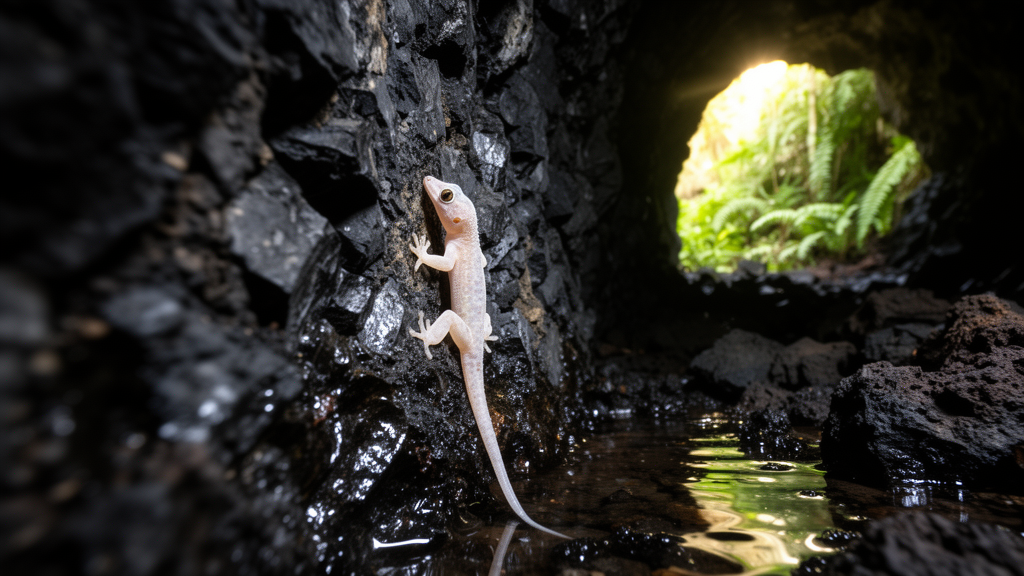
A field study documented the gecko Cyrtodactylus ziegleri in lava caves within Dak Nong UNESCO Global Geopark in Vietnam, providing the first confirmed record of the species from lava caves. The animals were found during surveys conducted from 2020 to 2023, about 55 km from the species’ type locality in Chu Yang Sin National Park, Dak Lak Province.
Researchers surveyed 13 of the geopark’s 50 lava caves, using visual encounter surveys to search for C. ziegleri. They also measured oxygen concentration, light intensity, air temperature, relative humidity, wind speed and sound intensity near observed geckos, and recorded other animals encountered in the caves. Geckos were collected by hand, photographed, preserved first in 90% ethanol and then stored in 70% ethanol. The complete dataset is available through figshare.
Identification combined morphological examination under a stereomicroscope with molecular analysis of a 549-base-pair fragment of the mitochondrial cytochrome c oxidase subunit 1 gene. The sequences were compared with available Cyrtodactylus sequences, and phylogenetic trees were constructed using Bayesian inference and maximum likelihood. The authors considered Bayesian posterior probabilities of at least 0.95 and ultrafast bootstrap support of at least 95% to indicate strong support.
Both phylogenetic analyses placed the lava-cave population within C. ziegleri, with strong statistical support: a Bayesian posterior probability of 1.00 and an ultrafast bootstrap value of 100%. The lava-cave specimens had pairwise genetic distances of 0.7–4.6% from C. ziegleri, compared with 6.1% divergence from the closest relative included in the analysis, C. phnomchiensis.
The cave population’s morphology largely corresponded to the original description of C. ziegleri, although the animals were smaller than the type series: 56.0–72.8 mm versus 84.6–93.0 mm. Small differences also occurred in the number of internasals, postcloacal tubercles on each side, and lamellae beneath the fourth finger and fourth toe. The researchers considered these differences insufficient to distinguish the population as a separate species.
Specimens were recorded in caves C1, C3 and C6.1, while the microhabitat table also included an occurrence in C2. Geckos were observed on ceilings and in rock crevices between 0 and 50 m inside the caves, during both daytime and nighttime surveys. Recorded microhabitat values at the eight occurrence sites included mean oxygen concentrations of 20.27% in C1, 20.2% in C2, 20.63% in C3 and 20.7% in cave 6.1. The lowest oxygen measurement, 17.7%, occurred 180 m inside cave C1.
Animals recorded alongside the geckos included bats, crickets, crabs, snails, frogs identified as Fejervarya limnocharis and Micryletta sp., and other lizards identified as Scincella sp. Cave C1 had one entrance, an explored length of up to 195 m and a depth of 4.5 m. C3 also had one entrance and reached 716.3 m in explored length and 7.3 m in depth. Cave C6.1 had three entrances, an explored length of 293.7 m and a depth of 4.6 m.
The lava-cave population had an average genetic divergence of 0.4%. This was higher than the values reported for other C. ziegleri populations, including clades 1 and 2 in Chu Yang Sin National Park and the population in Nam Nung Nature Reserve, where the reported values ranged from 0.0% to 0.2%. The authors suggested that this difference may reflect limited connectivity between the cave population and populations outside the caves, while presenting ecological isolation and adaptation to cave conditions as interpretations of the observed divergence rather than demonstrated outcomes.
Surveys also recorded several human-related pressures, including garbage, fire remnants, tourism and poaching. The researchers noted that fires can affect cave air pollution, vegetation, humidity and temperature, while tourism can alter cave microenvironments through carbon dioxide, temperature changes, noise, dust and microorganisms. These are potential pathways of impact, and the study did not directly measure their consequences for the gecko population. The findings establish a cave-associated occurrence and a modest genetic difference within C. ziegleri, but the survey covered 13 caves and cannot establish how widely the gecko is distributed throughout the geopark or how the observed divergence has developed over time.
Subject of Research: Field confirmation of Cyrtodactylus ziegleri in Vietnamese lava caves
Article Title: Discovery of Cyrtodactylus ziegleri Nazarov, Orlov, Nguyen & Ho, 2008 ( Reptilia , Squamata , Gekkonidae ) in lava caves of Vietnam (Dak Nong UNESCO Global Geopark)
Article References: Nguyen, V. D. H., Tran, T. G., Nguyen, T. M. N., Hoang, H. D., & Nguyen, T. T. P. (2025). Discovery of Cyrtodactylus ziegleri Nazarov, Orlov, Nguyen & Ho, 2008 (Reptilia, Squamata, Gekkonidae) in lava caves of Vietnam (Dak Nong UNESCO Global Geopark). Subterranean Biology, 53, 119-128. https://doi.org/10.3897/subtbiol.53.141956
Image Credits: AI Generated
DOI: 10.3897/subtbiol.53.141956
Keywords: Cyrtodactylus ziegleri, Dak Nong, lava caves, Vietnam, geckos, Gekkonidae, field survey, molecular phylogenetics, genetic divergence, cave fauna, Discovery, Cyrtodactylus
Cite Scienmag News
Margaret Porter. (October 20, 2026). Field study confirms Cyrtodactylus ziegleri in Dak Nong lava caves. Scienmag. https://scienmag.com/field-study-confirms-cyrtodactylus-ziegleri-in-dak-nong-lava-caves/
Margaret Porter. "Field study confirms Cyrtodactylus ziegleri in Dak Nong lava caves." Scienmag, 20 October 2026, https://scienmag.com/field-study-confirms-cyrtodactylus-ziegleri-in-dak-nong-lava-caves/. Accessed 20 October 2026.
Margaret Porter. "Field study confirms Cyrtodactylus ziegleri in Dak Nong lava caves." Scienmag. October 20, 2026. https://scienmag.com/field-study-confirms-cyrtodactylus-ziegleri-in-dak-nong-lava-caves/


