


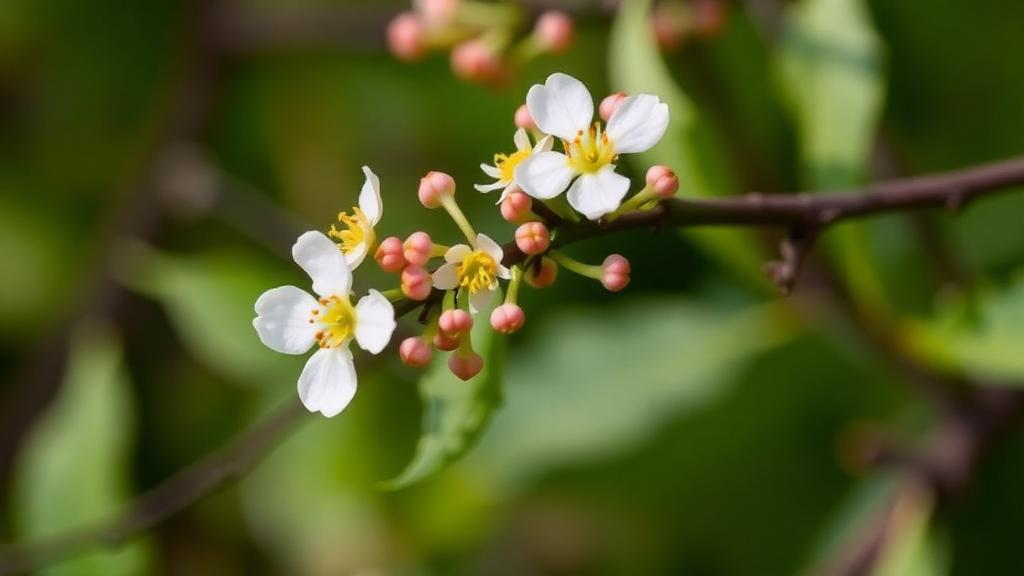
The flowers of two Mediterranean buckthorn species smell so different that their chemical fingerprints could become a reliable tool for telling them apart, a new study finds. The work, published in Italian Botanist, analysed for the first time the floral volatile organic compounds (VOCs) of Rhamnus alaternus and the Gymnesian endemic Rhamnus ludovici-salvatoris, along with the hybrid between them, Rhamnus × bermejoi. The results show that floral scent chemistry is not just a byproduct of pollination biology but a potentially powerful taxonomic character in a genus where species boundaries have long been frustratingly blurry.
Rhamnus is a wide-ranging genus of the temperate and subtropical Northern Hemisphere, comprising more than 100 species, 37 of which grow in the Mediterranean region. Within the genus, section Alaternus includes Mediterranean and Macaronesian species such as R. alaternus, R. lojaconoi, R. ludovici-salvatoris, R. glandulosa and R. integrifolia. Rhamnus alaternus, an evergreen tree often planted as an ornamental, is morphologically highly variable and, problematically for botanists, has a documented capacity to hybridise. In the Balearic Islands it coexists with its close relative R. ludovici-salvatoris, and distinguishing the two — especially where hybrids or stunted, environmentally stressed specimens are involved — has taxonomic and nomenclatural consequences, from confusing reports of the endemic species in the eastern Iberian Peninsula to uncertainty over the true distribution of their hybrid.
To test whether scent could resolve these ambiguities, researchers sampled 35 plants — 14 female and 21 male — from 13 wild sites across the Balearic Islands and the eastern Iberian Peninsula, together with cultivated hybrids obtained by manual artificial hybridisation. The hybrid material came from the locality of Tirant in northern Minorca, the only known site where R. × bermejoi coexists with both parental species. Floral volatiles were collected using headspace solid phase micro-extraction: ten flowers from each plant were sealed in vials at 25 °C, and a polydimethylsiloxane-divinylbenzene fibre was exposed to the air above them for 30 minutes to adsorb the emitted compounds.
The trapped volatiles were then analysed by gas chromatography coupled to mass spectrometry within 24 hours of collection. Compounds were identified by matching mass spectra against the Wiley and NIST08 libraries, cross-checked with calculated retention indices, and the principal components were verified against synthetic standards. Because total emission varied strongly between individuals, the team used relative amounts — each compound’s peak area as a proportion of the total — and excluded likely artefacts. Statistical treatment included permutational multivariate analysis of variance on Bray-Curtis dissimilarities, non-metric multidimensional scaling to visualise group separation, analysis of similarities to test for sex-related differences, and similarity percentage analysis to pinpoint the compounds driving the divergence between species.
The results were striking. Flowers produced 41 detectable volatile compounds, 22 of which were abundant and frequent enough to matter. No relevant volatiles were traced to the flower pedicels, confirming that the signals genuinely originate in floral tissue. The two species proved significantly different both qualitatively and quantitatively. Rhamnus alaternus emitted an ensemble of terpenoids absent from its relative: the monoterpenes ocimene and linalool with related compounds such as linalool oxides, linalyl formate and hotrienol; the sesquiterpenes alpha- and beta-caryophyllene; and the ionones alpha-ionone and dihydro-beta-ionone, which together reached nearly half of the total emission in some samples. Acetic acid hexyl ester was also exclusive to this species.
Rhamnus ludovici-salvatoris, by contrast, showed a remarkably uniform profile dominated by benzoid esters. Methyl salicylate accounted for 83.3% of its floral aroma and methyl benzoate for 9.2%, with farnesene and alpha-farnesene rounding out its signature compounds. SIMPER analysis showed that just four compounds — methyl salicylate, (Z)-3-hexen-1-ol acetate, the ionone complex and beta-caryophyllene — explain 75% of the differences between the two species. A good illustration of the quantitative contrast is (Z)-3-hexen-1-ol acetate, a so-called green volatile, which made up 25.92% of the emission in R. alaternus but a negligible 0.65% in R. ludovici-salvatoris, and even then appeared in fewer than half the samples.
Perhaps the most telling finding concerned chemical consistency. Rhamnus alaternus proved chemically heterogeneous: some individuals showed single compounds at levels up to 89.9%, while other plants entirely lacked those same components. The endemic R. ludovici-salvatoris was the opposite — despite a larger number of samples, its major compounds appeared in 85 to 100% of individuals. This pattern mirrors known genetic diversity, which is much higher in populations of R. alaternus than in the narrow endemic. Neither species differed in scent between male and female flowers, ruling out sex-based chemical dimorphism.
The hybrid R. × bermejoi turned out to lean chemically toward R. alaternus. Its volatile profile was far more similar to that parent than to R. ludovici-salvatoris, and crucially, no novel compounds appeared — the hybrids produced only combinations of compounds inherited from the parental species, in amounts tending toward the R. alaternus condition. Since hybrids across the plant kingdom sometimes generate new metabolites or transgressive emission rates, the absence of novelty here suggests that hybridisation has not chemically reconfigured these plants, and that scent alone cannot separate the hybrid from one of its parents.
The ecological picture that emerges is equally interesting. Both species are pollinated mainly by Hymenoptera, particularly the honey bee Apis mellifera, and the dominant compound classes in each — terpenoids in R. alaternus, benzoids in R. ludovici-salvatoris — are known bee attractants. The shared pollinator is therefore the likely vector mediating hybridisation. Unlike cases where hybrids emit a richer scent palette that attracts additional pollinators and erodes reproductive isolation, the hybrids here show no such expansion, which may help explain why they remain rare. Methyl salicylate and methyl benzoate, beyond attracting pollinators, also act as airborne stress signals in plants, hinting that the endemic species’ scent may partly reflect its physiological condition under Mediterranean conditions, where its lower photosynthetic efficiency and inability to resprout have contributed to population decline.
The authors conclude that floral volatile compounds can serve as an effective discriminatory character among species of section Alaternus, even though they cannot distinguish the hybrid from R. alaternus. The suggestion now awaits testing on plants from other populations of R. alaternus and on the section’s remaining members, including R. lojaconoi and the Macaronesian endemics R. glandulosa and R. integrifolia. If floral scent proves as discriminating across the wider group, botanists may have gained a new, chemically grounded instrument for charting species boundaries — and for untangling the hybrid swamps that have long clouded them.
Subject of Research: Taxonomic use of floral volatile organic compounds in Rhamnus sect. Alaternus and its hybrid
Article Title: Can floral volatile organic compounds contribute to the taxonomy of the Rhamnus sect. Alaternus ?
Article References: Llorens, L., Ferriol, P., Tomàs, J., García, M. T., & Gil, L. (2023). Can floral volatile organic compounds contribute to the taxonomy of the Rhamnus sect. Alaternus?. Italian Botanist, 16, 149-164. https://doi.org/10.3897/italianbotanist.16.116255
Image Credits: AI Generated
DOI: 10.3897/italianbotanist.16.116255
Keywords: Rhamnus alaternus, Rhamnus ludovici-salvatoris, floral volatiles, volatile organic compounds, taxonomy, hybridisation, Mediterranean flora, Balearic Islands, terpenoids, benzoids, pollination, chemotaxonomy
Cite Scienmag News
Drew Townsend. (October 19, 2026). Floral Scents Offer a New Way to Tell Lookalike Buckthorn Species Apart. Scienmag. https://scienmag.com/floral-scents-offer-a-new-way-to-tell-lookalike-buckthorn-species-apart/
Drew Townsend. "Floral Scents Offer a New Way to Tell Lookalike Buckthorn Species Apart." Scienmag, 19 October 2026, https://scienmag.com/floral-scents-offer-a-new-way-to-tell-lookalike-buckthorn-species-apart/. Accessed 19 October 2026.
Drew Townsend. "Floral Scents Offer a New Way to Tell Lookalike Buckthorn Species Apart." Scienmag. October 19, 2026. https://scienmag.com/floral-scents-offer-a-new-way-to-tell-lookalike-buckthorn-species-apart/


