


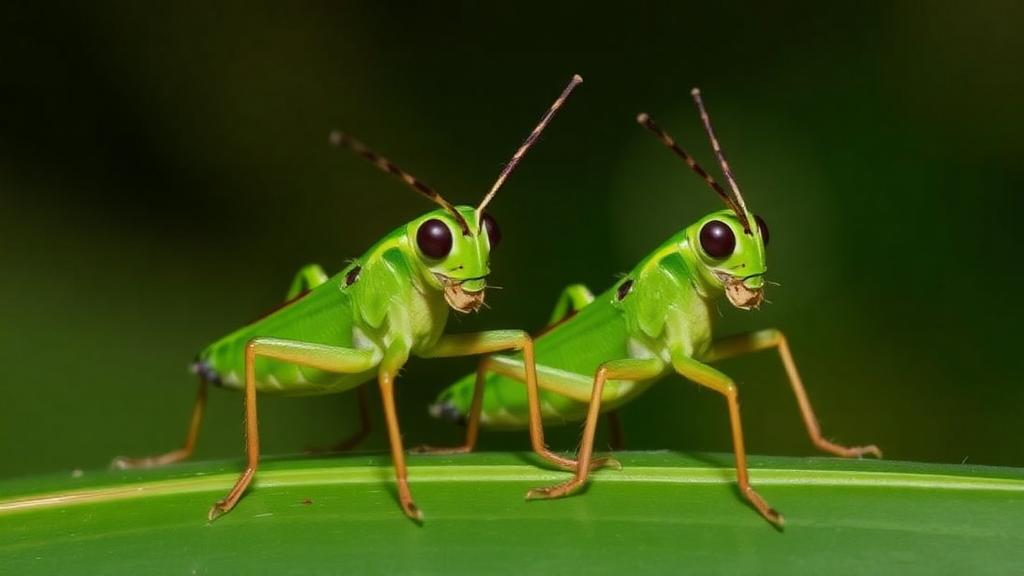
Deep in the rainforests of Cameroon, a group of small, flightless grasshoppers has been quietly evolving in isolation, and scientists have only now caught up with them. A new study published in the Journal of Orthoptera Research describes four brand-new species of these forest-dwelling insects and, in a twist that surprised even the researchers, elevates some of them to an entirely new genus. The findings double down on a warning that scientists have been repeating for fifty years: Africa’s equatorial forests hide a wealth of grasshopper diversity that remains almost entirely undocumented, and it is disappearing faster than it can be catalogued.
The genus Pterotiltus, first established in 1893, has long been a taxonomic headache. Its twelve previously known species live exclusively in the wet forests of West and Central Africa, stretching from Ghana through Cameroon and the Congo Basin into Central Uganda. Yet museum drawers hold remarkably few specimens. The insects inhabit dense forest understory that is difficult to penetrate, and their populations are scattered across an enormous altitudinal range, from sea level up to more than 2,000 meters. As far back as 1972, the French entomologist Marc Descamps flagged Pterotiltus as an African genus urgently requiring revision, a call that has gone largely unanswered until now.
The new work, led by entomologist Oumarou Ngoute C., is based on specimens collected across six localities in Cameroon’s lowland and highland rainforests, including Campo National Park on the coast and Nki National Park in the country’s remote southeast. In the southern lowlands, the team encountered two striking new species. Pterotiltus ngoylaensis, found at around 500 meters in Nki National Park, is predominantly green with black and yellow markings and sports eyes that are conspicuously violet in life, a trait unique within the entire genus. Pterotiltus campoensis, discovered near sea level in Campo National Park, breaks the mold in a different way: it is the only known member of the genus dominated by vivid red and blue-black coloration rather than green.
Both lowland species share the hallmark adaptations that led one reviewer to describe Pterotiltus as the culmination of adaptation to forest life among its subfamily, the Oxyinae. All species in the group are flightless, their wings reduced to tiny ridges or minute flaps that never extend beyond the thorax. Their ovipositors have evolved smooth, rod-like valves, an adaptation for laying eggs in highly specialized sites, and researchers have previously documented one species gluing its eggs directly onto the leaves of its food plants. These are insects that have traded the open grasslands of their relatives for a life spent clambering through the herb layer of the forest floor.
The real surprise came from the highlands of western Cameroon. There, at elevations between roughly 1,300 and 2,400 meters, the team collected grasshoppers that outwardly resembled Pterotiltus but carried a suite of anatomical differences too substantial to ignore. The males averaged just 12 to 14 millimeters in length, notably smaller than their lowland cousins. Their forewings, though tiny, were actually present and sometimes brightly colored, rather than almost entirely lost. Most tellingly, the fine structures of the reproductive system told a different evolutionary story in both sexes.
Male grasshoppers in this group are classified largely by the architecture of the epiphallus, a sclerotized structure at the top of the phallic complex, and the valvular plate that covers the aedeagus. In lowland Pterotiltus, the outer lophi of the epiphallus are long, slender, blade-like, and curved forward, while the valvular plate is foliose, elaborately ornamented with cuticular folds that often take species-specific forms. In the highland insects, the lophi curve upward and inward instead, ending in horn-like points or bifid tips, and the valvular plate is simple and unadorned. The females clinched the case: their subgenital plates bear two robust, rearward-directed projections that are completely absent in Pterotiltus.
On the strength of these differences, the researchers erected a new genus, Parapterotiltus, with the previously enigmatic species Pterotiltus minimus, described from a single male back in 1929, as its type. The study also finally describes the female of that species for the first time, nearly a century after the male was named. Two additional new species join the genus: Parapterotiltus minimoides, so named because it is almost indistinguishable from P. minimus in outward appearance, and Parapterotiltus bamboutos, a black-bodied species known only from the slopes of Mount Bamboutos. Remarkably, the two lookalike species occur together at some of the same sites between 1,000 and 1,600 meters, separated not by geography but by anatomy that only becomes obvious under the microscope.
The taxonomic detective work involved meticulous measurement. The team quantified body proportions, tarsal segment lengths, tibial spine counts, and ratios of sexual dimorphism, normalizing measurements against pronotum length so that species of different sizes could be compared fairly. Dissections of genitalia required relaxing pinned specimens, macerating tissue in potassium hydroxide, and staining structures with acid fuchsin, a reminder that species boundaries in this group rest on anatomy invisible to anyone walking through the forest. The researchers are now preparing a full revision of Pterotiltus, with the current paper serving as its foundation.
There is an urgent conservation dimension to the discovery. Parapterotiltus bamboutos is known from a single, very small population on Mount Bamboutos, one of the most degraded mountains in Cameroon, where human activity has destroyed nearly all remaining forest pockets and replaced them with crops. The authors warn that conservation measures are needed urgently, though a 2010 photograph from nearby Mount Kupe hints the species may survive elsewhere along Cameroon’s volcanic line. The lowland species fare somewhat better, since both Nki and Campo Ma’an National Parks offer protected habitat, but deforestation across southern Cameroon continues at an accelerating pace, and these strictly forest-dependent insects have nowhere else to go.
The study also carries a broader lesson for how biodiversity is catalogued in the tropics. Because external appearance in these grasshoppers is so uniform, species have historically been defined by subtle differences in size and color, and ecologists working with incomplete identifications have faced an unenviable choice between excluding uncertain records or risking inaccuracy. The new work shows that the real diversity is written in the genitalia, structures so varied between species that they can even justify splitting a genus in two. As the authors note, the poorly surveyed highlands of western Cameroon may hold more undescribed taxa still, provided the forests they depend on last long enough for anyone to find them.
Subject of Research: Taxonomic description of new flightless grasshopper species and a new genus from Cameroon's rainforests
Article Title: New species of Pterotiltus from Cameroon, and a new genus, Parapterotiltus ( Orthoptera , Acrididae , Oxyinae )
Article References: Oumarou Ngoute, C., & Rowell, C. H. F. (2024). New species of Pterotiltus from Cameroon, and a new genus, Parapterotiltus (Orthoptera, Acrididae, Oxyinae). Journal of Orthoptera Research, 33(1), 127-146. https://doi.org/10.3897/jor.33.96043
Image Credits: AI Generated
DOI: 10.3897/jor.33.96043
Keywords: grasshoppers, Cameroon, new species, Orthoptera, taxonomy, biodiversity, rainforest, Parapterotiltus, Pterotiltus, entomology, conservation, Africa
Cite Scienmag News
Gavin Prescott. (October 19, 2026). Four New Flightless Grasshoppers Emerge from Cameroon’s Vanishing Forests. Scienmag. https://scienmag.com/four-new-flightless-grasshoppers-emerge-from-cameroons-vanishing-forests/
Gavin Prescott. "Four New Flightless Grasshoppers Emerge from Cameroon’s Vanishing Forests." Scienmag, 19 October 2026, https://scienmag.com/four-new-flightless-grasshoppers-emerge-from-cameroons-vanishing-forests/. Accessed 19 October 2026.
Gavin Prescott. "Four New Flightless Grasshoppers Emerge from Cameroon’s Vanishing Forests." Scienmag. October 19, 2026. https://scienmag.com/four-new-flightless-grasshoppers-emerge-from-cameroons-vanishing-forests/


