


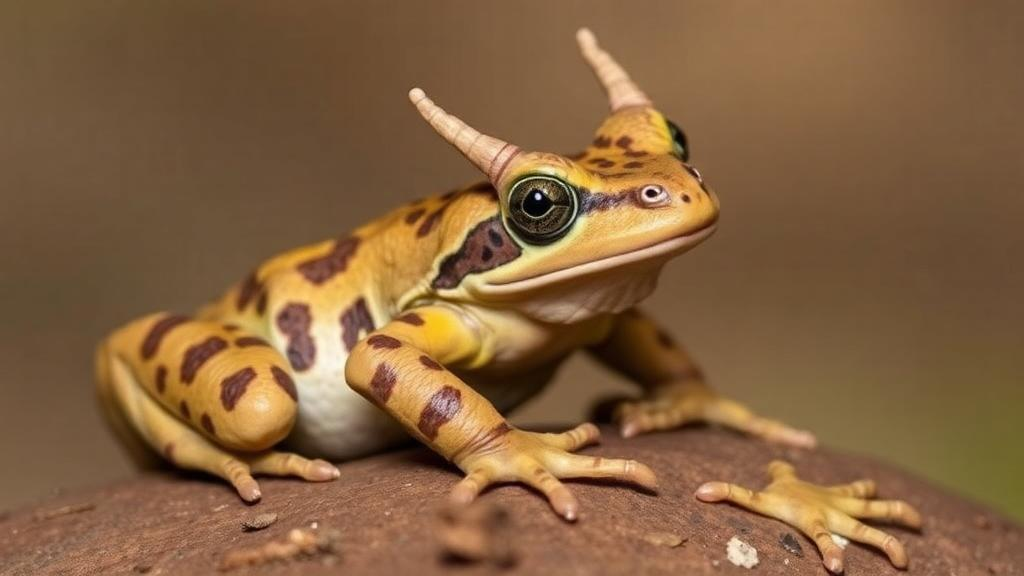
The horned frogs of South America, famous for their enormous mouths, armored skulls and a habit of burying themselves in the soil until the rains return, have long puzzled scientists with their tangled family tree. A new study published in Frontiers of Biogeography has now assembled the most complete evolutionary picture yet of the frog family Ceratophryidae, combining DNA sequences with skeletal anatomy to reconstruct where these animals came from, when their lineages split apart, and how climate shaped the diversity we see today. The results point to a surprising cradle: the semi-arid Cerrado savannas of Brazil, roughly 19 million years ago.
Ceratophryidae is a small family by frog standards, containing just twelve living species in three genera. Ceratophrys, the largest genus, includes eight species of the iconic horned frogs, while Chacophrys contains a single species and Lepidobatrachus, the aquatic Budgett’s frogs, holds three. Together they range from the Caribbean lowlands of Colombia and Venezuela down to the Pampean grasslands of central Argentina, occupying habitats as varied as tropical rainforest, humid grassland and dry scrub. Despite decades of research on their morphology, chromosomes and behavior, the family’s deeper evolutionary history remained poorly resolved, with different studies proposing conflicting arrangements of the three genera.
To untangle this history, the researchers compiled a massive dataset drawing on 256 anatomical characters together with six mitochondrial and eight nuclear genes, totaling up to 8,428 characters per specimen. Eleven of the twelve known species were included; Ceratophrys testudo was left out because it has not been collected since its original description in 1945. The team used maximum likelihood methods to build the phylogeny, then applied a Bayesian molecular clock calibrated with fossil species such as Ceratophrys ameghinorum and Lepidobatrachus australis to convert the branching pattern into a timeline of divergence events.
The resulting tree settled a long-standing debate. Ceratophrys, the horned frogs proper, emerged as the sister group to a clade uniting Chacophrys and Lepidobatrachus, with maximum statistical support. Adding morphology to the genetic data strengthened node support across the tree, a reminder that anatomical characters can rescue relationships that molecular markers alone struggle to resolve, particularly when genetic variation is low or convergent evolution blurs the signal. Within Ceratophrys, the analysis confirmed that C. cranwelli and C. ornata are sister taxa, and placed C. stolzmanni in a position that differs from some earlier hypotheses.
The molecular clock told a story of Miocene origins. The crown group of Ceratophryidae, meaning the common ancestor of all living species, dates to approximately 19.2 million years ago, early in the Miocene epoch. The genus Ceratophrys itself arose around 17.2 million years ago, while Chacophrys and Lepidobatrachus separated from each other near 13.7 million years ago. A burst of recent diversification followed in the Pliocene, between roughly 5.3 and 2.6 million years ago, when three lineages of Lepidobatrachus and four lineages of Ceratophrys split from their closest relatives. Every divergence within the family falls within the Neogene period.
Where did this radiation begin? By modeling how ancestral distributions change across the evolutionary tree, the researchers identified the Cerrado, the vast tropical savanna of central Brazil, as the most probable ancestral area for the entire family, and also for the genera Chacophrys and Lepidobatrachus. The dispersal-extinction-cladogenesis model best explained the data, revealing five dispersal events followed by five vicariance events, in which ancestral populations were split by emerging geographic barriers. From the Cerrado, early horned frogs spread into the Choco rainforests of the Pacific coast, the Amazon basin, the Atlantic Forest and temperate South America.
Some of these splits map neatly onto dramatic geological events. The divergence between C. cornuta in Amazonia and C. calcarata in the Choco, estimated at around 10.4 million years ago, coincides with the uplift of the Eastern Andes Cordillera during the middle Miocene, which would have severed a once-continuous lowland distribution. Similarly, the separation of C. stolzmanni near 14.4 million years ago aligns with mountain building in southern Ecuador, while the split between C. aurita and its relatives may reflect the epeirogenic uplift of the Brazilian Shield. The frogs’ limited dispersal abilities and strong habitat dependence made them especially vulnerable to such landscape-scale fragmentation.
Climate, too, left its fingerprints on the family. Using nearly 2,900 verified occurrence records and nineteen bioclimatic variables, the team tested which environmental factors distinguish each species’ ecological niche. Temperature seasonality proved the dominant driver for seven species, including all three Lepidobatrachus species, Chacophrys pierottii and several Ceratophrys, while annual precipitation mattered most for C. joazeirensis. A phylogenetic principal components analysis showed that C. cornuta, the inhabitant of humid Amazonian rainforest, sits far apart from all its relatives in environmental space, whereas the Cerrado-dwelling species cluster together in niches defined by aridity and strongly seasonal temperatures.
These findings refine an earlier hypothesis that the family diversified mainly in semi-arid environments with three independent transitions to humid habitats. The new analysis suggests instead two independent shifts toward wetter environments, one involving the ancestors of C. cornuta and C. calcarata and another associated with C. aurita of the Atlantic Forest. Even closely related sister species occupy measurably different climates: C. joazeirensis lives in the drier Cerrado woodlands while its sister C. aurita inhabits the wetter Atlantic Forest, a niche difference attributed largely to average rainfall.
The study also connects evolution to anatomy and survival strategy. All ceratophryids can encase themselves in a cocoon of shed skin to survive dry spells, and captive frogs have endured this state for up to twenty months. The researchers propose that cocoon production arose in the family’s common ancestor in the early Miocene and was subsequently lost in C. cornuta and C. calcarata, both of which moved into perpetually humid tropical forests where such protection became unnecessary. Taken together, the work portrays a family born in seasonal savannas, shaped by rising mountains and shifting rainfall, and still carrying the signature of its arid origins in every burrow it digs.
Subject of Research: Phylogeny, historical biogeography and climate niche differentiation of Ceratophryidae frogs in South America
Article Title: Phylogeny, historical biogeography and climate niche differentiation in extant species of Ceratophryidae ( Anura , Hyloidea ) frogs in South America
Article References: van der Kamp, A. A. W., & Ortega-Andrade, H. M. (2024). Phylogeny, historical biogeography and climate niche differentiation in extant species of Ceratophryidae (Anura, Hyloidea) frogs in South America. Frontiers of Biogeography, 17, Article e132672. https://doi.org/10.21425/fob.17.132672
Image Credits: AI Generated
Keywords: Ceratophryidae, horned frogs, Cerrado, phylogeny, historical biogeography, Miocene, vicariance, dispersal, climate niche, temperature seasonality, South America, molecular clock
Cite Scienmag News
Gavin Prescott. (October 19, 2026). Horned Frogs Traced Back to a Miocene Birthplace in Brazil’s Cerrado. Scienmag. https://scienmag.com/horned-frogs-traced-back-to-a-miocene-birthplace-in-brazils-cerrado/
Gavin Prescott. "Horned Frogs Traced Back to a Miocene Birthplace in Brazil’s Cerrado." Scienmag, 19 October 2026, https://scienmag.com/horned-frogs-traced-back-to-a-miocene-birthplace-in-brazils-cerrado/. Accessed 19 October 2026.
Gavin Prescott. "Horned Frogs Traced Back to a Miocene Birthplace in Brazil’s Cerrado." Scienmag. October 19, 2026. https://scienmag.com/horned-frogs-traced-back-to-a-miocene-birthplace-in-brazils-cerrado/


