


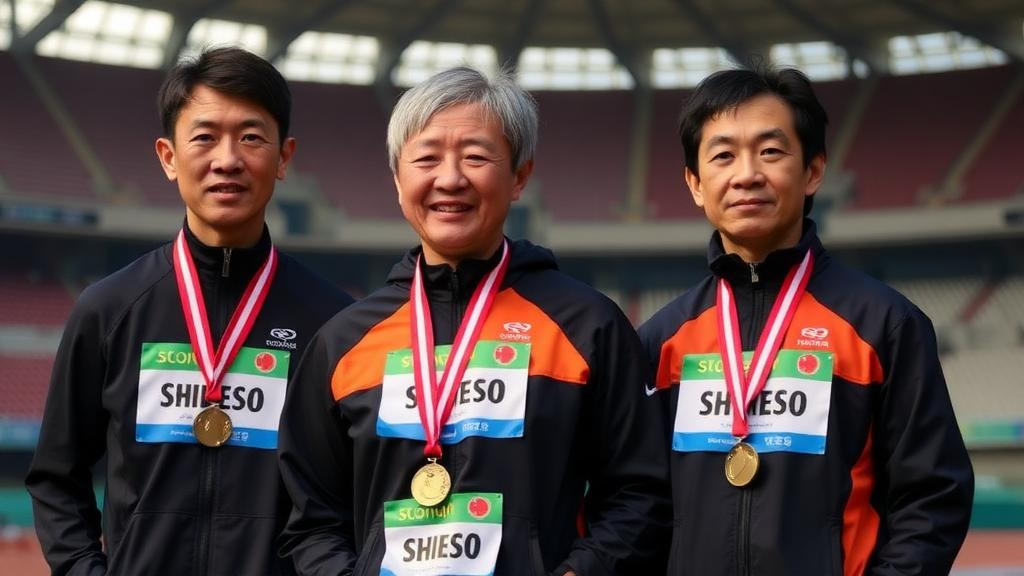
Every year, between 3,000 and 6,000 Chinese athletes hang up their competitive careers, and roughly 90 percent of them must chart their own course afterward, without a guaranteed job waiting. For a new study published in Frontiers in Sports and Active Living, researchers sat down with 20 retired athletes, aged 34 to 57, who once trained with professional sports teams in Liaoning Province, a traditional powerhouse of Chinese competitive sport. Their in-depth interviews reveal a starkly unequal picture of post-retirement life, in which family money, medals, personal grit and even the reputation of a destination city combine to decide who climbs the social ladder and who stalls.
The research team, led by Shuai Hao, Haotian Xing and Haibo Tian at Shaoxing University and Zhejiang Yuexiu University, framed the problem through Bourdieu’s capital theory, which holds that economic, cultural, social and symbolic resources can be converted into one another to shape a person’s social position. They also drew on athlete career transition theory. Social mobility here means the shifts athletes experience after leaving the elite sport system in four observable dimensions: occupational status, economic income, social identity and access to social networks. Rather than sorting participants into rigid categories, the researchers inferred mobility patterns from how these dimensions changed relative to each athlete’s pre-retirement baseline.
Recruitment was deliberately purposive, combining referrals from former coaches and retired sport administrators with snowball sampling. Athletes had to be at least 30 years old, retired for more than one year, and notably, not Olympic champions, a choice that excluded the most privileged outliers and focused attention on the broader mass of professional athletes. The final sample of 20 was evenly split between men and women, covered sports from football and gymnastics to weightlifting and speed skating, and included ten athletes still working in Liaoning and ten who had moved to other provinces. Most held an athlete grade of Level 1 or above, and the vast majority now work in occupations entirely different from their athletic careers.
Interviews ran from May to October 2023, lasting between 41 and 85 minutes, and opened with a simple question about when each athlete began professional training. All conversations were conducted in Mandarin, transcribed verbatim, and analyzed through open and axial coding within a thematic analysis framework. Three researchers coded independently, then met to reach consensus. Selected quotations were translated into English and verified through back-translation by an independent bilingual researcher, a standard technique for preserving meaning across languages.
Five major themes emerged from the data. The first, an unavoidable family background, proved strikingly powerful. One 43-year-old former athletics competitor described how his father, drawing on extensive industry experience and a broad network of contacts, actively made connections and introduced him to senior figures, giving him access to firsthand information and job opportunities. Another participant recounted a teammate whose father was a police officer with significant authority, which secured the athlete a security guard position after retirement. Family economic resources mattered too: one former rower came from a highly profitable sea cucumber farming business and moved into managing the family enterprise, while a 37-year-old judoka recalled that his parents sold a portion of their cultivated land to fund the opening of a women’s fitness club when his startup hit funding trouble.
Family cultural background shaped values as well, creating what the researchers call intergenerational transmission of career paths. A 40-year-old former track and field athlete, now a police officer, explained that his father is a university professor specializing in business planning, and that this influence led him to pursue self-study before retiring. Families that prioritize educational inheritance tend to steer children toward education careers, while families emphasizing economic gains encourage entry into business, the study found. In Bourdieu’s terms, pre-existing family capital and habitus form differentiated mobility thresholds, explaining why athletes who trained under identical institutional conditions can end up on opposite ends of the social spectrum.
The second theme, established sports expertise, cuts both ways. Competitive achievements and sport-related skills remain valuable capital, particularly for athletes who stay in the sports industry, where medals function as symbolic capital that commands social status and identity recognition. But the interviews also exposed the risk of rigid athletic-identity lock-in. One 39-year-old former rower admitted that after so many years in the sports team he was not adept at communicating with strangers, failed many job interviews, and ended up working as a shopping mall security guard. A 37-year-old former triathlete described how professional athletes live a different path from ordinary people: while peers do schoolwork, athletes train; while peers build relationships with classmates and teachers, athletes forge bonds with teammates and coaches. Sport type also matters, as a 39-year-old former weightlifter pointed out: entertaining and easily accepted sports make employment easier, while weightlifting has no obvious place in a fitness club, unlike tennis, basketball or table tennis.
The third theme, substantial personal efforts, offers the most hopeful finding. Consistent with the screening hypothesis, in which employers use educational qualifications as indicators of capability, most respondents described higher education as the key to securing a stable job. A 57-year-old former footballer was blunt: if an individual’s educational level is comparatively low and does not meet basic employment criteria, there will be absolutely no prospect. Yet athletes showed that effort can compensate for inherited disadvantages. The 43-year-old former athletics competitor saved all his salary and bonuses as an assistant coach, was admitted to Beijing Sport University upon retirement, and eventually became a university professor. A 35-year-old former gymnast spent all her retirement benefits studying traditional Chinese medicine and massage, obtained a masseuse qualification, and smoothly became a university teacher. Another participant taught himself fruit preservation and transportation and registered an online store selling fruits from his own home.
The fourth theme concerns attractions shaping mobility choices, the pull factors that draw athletes toward specific cities and jobs. City reputation, or the city label, carries real weight in Chinese society, and many interviewees indicated that eastern coastal cities hold greater appeal. A 52-year-old former gymnast working in Shanghai praised the municipality’s advanced technology and thriving economy, noting that the more dynamic economy in South China offers more opportunities and higher coaching income. A 40-year-old former tennis player described a school position in the Shenzhen Development Zone with a very high salary and solved housing and transportation problems. Environmental attractions also played a role, from lakes, rivers and quality boats for a former kayaker to convenient transportation, well-developed facilities and rich cultural environments.
The fifth theme, the balance of bureaucratic culture and relational society, is the study’s most distinctive contribution, described as a China-specific empirical extension of social-capital thinking. Participants reported experiences suggesting that formal recruitment processes can be undermined by administrative discretion: one 34-year-old former fencer said teacher recruitment announcements seemed pre-determined, with details released only after the process was completed, while the 57-year-old footballer recalled two individuals without relevant professional backgrounds being appointed as assistant coaches before a major competition, with collective appeals failing to change the arrangement. The researchers stress these are subjective perceptions rather than independently verified conditions. At the same time, service-oriented officials and strong social relationships, from superiors and teammates to relatives, could powerfully enable mobility: one participant’s parents knew numerous high-ranking officials, and a prestigious institution offered her a dual teaching and coaching position before she even finished university studies.
The discussion section weaves these threads into a chained multi-factor restriction mechanism. Institutional rules set athletes’ initial capital endowment, individual conditions determine capital conversion ability, and regional policy and industrial structure shape the channels and efficiency of conversion. Liaoning’s economy, dominated by traditional heavy industry with an underdeveloped modern sports sector, offers limited high-end positions, and most market-based roles available to retired athletes are low-paying grassroots fitness instructor jobs, with winter sports facing seasonal off-season employment barriers. The superposition of disadvantages correlates with horizontal or downward mobility among ordinary athletes, while elite medal winners show evidence consistent with rapid upward mobility, a pattern the authors interpret as sponsored mobility within the Chinese sports system, where institutional resources depend on symbolic capital rather than comprehensive quality.
The authors acknowledge limitations: the small purposive sample does not support statistical generalization, the cross-sectional design cannot capture long-term dynamics, and snowball sampling may under-represent socially isolated athletes, while self-reports carry recall and self-selection bias. Still, the practical implications are concrete. They recommend reforming the segregated sports and education training system to build cultural capital early, creating hierarchical and personalized pre-retirement transition services for elite and grassroots athletes, addressing policy implementation gaps, and accelerating cultivation of the local modern sports industry. For the thousands of athletes retiring each year into self-directed career paths, the study suggests that where they land is never decided by talent on the field alone, but by the quiet accumulation of family capital, institutional medals, personal reinvention and the pull of distant cities.
Subject of Research: Social Mobility of Retired Athletes in China
Article Title: What factors impact the social mobility of athletes retired from Liaoning Province professional sports teams? A qualitative research approach
Article References: Hao, S., Xing, H., & Tian, H. (2026). What factors impact the social mobility of athletes retired from Liaoning Province professional sports teams? A qualitative research approach. Frontiers in Sports and Active Living, 8, 1943882. https://doi.org/10.3389/fspor.2026.1943882
Image Credits: AI Generated
DOI: 10.3389/fspor.2026.1943882
Keywords: social mobility, retired athletes, Liaoning Province, qualitative research, Bourdieu capital theory, career transition, sports sociology, China, factors, impact, social, mobility
Cite Scienmag News
Courtney Benton. (October 19, 2026). Family Ties, Medals and Grit: What Really Decides Where Retired Chinese Athletes Land. Scienmag. https://scienmag.com/family-ties-medals-and-grit-what-really-decides-where-retired-chinese-athletes-land/
Courtney Benton. "Family Ties, Medals and Grit: What Really Decides Where Retired Chinese Athletes Land." Scienmag, 19 October 2026, https://scienmag.com/family-ties-medals-and-grit-what-really-decides-where-retired-chinese-athletes-land/. Accessed 19 October 2026.
Courtney Benton. "Family Ties, Medals and Grit: What Really Decides Where Retired Chinese Athletes Land." Scienmag. October 19, 2026. https://scienmag.com/family-ties-medals-and-grit-what-really-decides-where-retired-chinese-athletes-land/


