


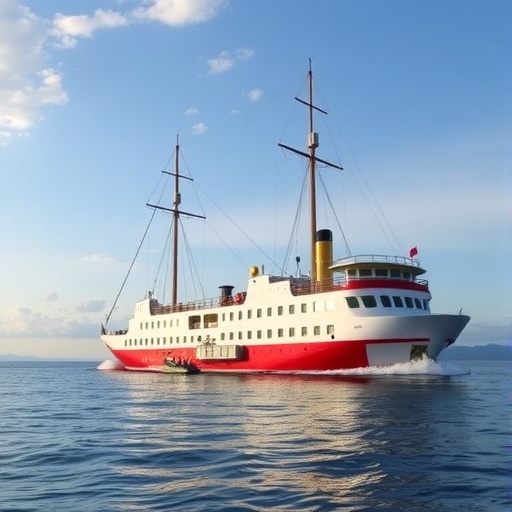
A groundbreaking expedition is set to commence as 14 Master’s students from the West African Master’s program in Climate Change and Marine Sciences embark on a scientifically intensive 2,840 nautical mile journey aboard the research vessel POLARSTERN. Departing from Mindelo, Cabo Verde, and destined for Bremerhaven, Germany, this expedition, designated PS154/2, represents not merely a voyage but a crucial intersection of education, rigorous research, and interdisciplinary collaboration. For many of these students, this marks their inaugural hands-on experience working on a research vessel, where they will engage deeply with the practicalities of marine science.
The journey offers a rare and invaluable chance to integrate theoretical knowledge with practical expertise, as the students will operate alongside ten seasoned scientists. Equipped with advanced oceanographic instruments such as rosette water samplers and filtration systems, the cohort will immerse themselves in the nuanced processes of data collection and analysis under the challenging conditions at sea. Their scientific inquiry will encompass multidisciplinary approaches, focusing on the physical, biogeochemical, and biological dynamics of marine ecosystems, which play a pivotal role in global climate regulation and biodiversity.
The Floating University initiative, embedded within the Master’s curriculum at the Universidade Técnica do Atlântico (UTA) in Cabo Verde, leverages the exceptional research voyage from the Falkland Islands to Germany, passing through Mindelo, to facilitate intensive maritime education. This initiative is orchestrated by the Alfred Wegener Institute’s Helmholtz Centre for Polar and Marine Research (AWI), which operates the POLARSTERN. The program underscores the critical importance of experiential learning in fostering the next generation of climate and marine scientists, offering a unique maritime classroom to study oceanographic phenomena firsthand.
Dr. Björn Fiedler, the expedition’s chief scientist and marine chemist at GEOMAR, emphasizes the educational philosophy behind this journey: immersing students in a complex research environment where international collaboration and scientific precision are paramount. The experience aims to cultivate proficiency in conducting ocean research, managing sophisticated instrumentation, and producing data of a quality meriting robust scientific interpretation. This intensive training is expected to catalyze further research aspirations and initiatives within the West African coastal and marine context.
Central to the cruise’s scientific mandate is the evaluation of marine environmental variables at depths reaching 4,900 meters, enabling detailed documentation of oceanic transformation on both regional and potentially global scales. Core measurements will include ocean temperature profiles, pH and carbon dioxide concentrations, and other critical indicators of ocean health and biogeochemical cycles. These data are essential in understanding the ocean’s role in sequestering anthropogenic carbon and regulating climate through natural processes.
The expedition’s trajectory follows two key long-term monitoring sites— the Cape Verde Ocean Observatory (CVOO) and the European Station for Time-Series in the Ocean (ESTOC) located near the Canary Islands. These observatories are instrumental in providing longitudinal datasets that reveal trends in oceanographic parameters such as oxygen levels, water temperature, and zooplankton biodiversity. At the CVOO mooring, continuous monitoring of oxygen concentrations at depths of 3,500 meters since 2006 offers critical insights into deep-sea oxygenation processes, crucial for understanding impacts of ocean deoxygenation linked to climate change.
In addition to fixed-point observations, the research team will deploy three Argo floats—autonomous drifting instruments designed to collect data on temperature, salinity, and ocean currents from the surface to depths of 2,000 meters. These floats contribute to the global Argo program, a sophisticated international network of approximately 4,000 floats that provide continuous, real-time oceanographic data crucial for climate modeling and marine ecosystem assessments. The German Federal Maritime and Hydrographic Agency (BSH) oversees the Argo program within Germany, ensuring data quality and integration into global databases.
The expedition epitomizes international scientific collaboration, bringing together individuals from 16 different countries and forging professional networks that extend far beyond the two-week voyage. Tobias Hahn, scientific coordinator for WASCAL at GEOMAR, remarks on the transformative power of this melting pot of cultures and expertise, fostering a global alumni network equipped to address marine scientific challenges in West Africa. The alumni are positioned to play pivotal roles in future large-scale research efforts such as the forthcoming FUTURO campaign, aimed at elucidating climate change impacts on regional marine ecosystems.
Operational challenges aboard the POLARSTERN will require the students to navigate the complexities of working in a dynamic ocean environment. This includes mastering the deployment and retrieval of scientific equipment, adhering to rigorous data protocols, and interpreting multifaceted datasets collected during the daily oceanographic stations. The ability to assimilate these technical skills while maintaining scientific rigor underlines the educational and research significance of the expedition.
Data integration and analysis will be further enhanced following the students’ arrival in Germany, where many will undertake research internships at the GEOMAR Helmholtz Centre for Ocean Research Kiel. Here, students will refine their projects, applying both field data and advanced laboratory techniques to deepen understanding of marine chemistry, biology, and climate interactions. The extended research training ensures the development of a cadre of well-prepared scientists ready to contribute meaningfully to climate resilience and marine conservation in West Africa and beyond.
The expedition PS154/2 emerges at a critical juncture in global environmental science, where climate change effects on ocean systems pose profound risks to biodiversity, fisheries, and coastal communities. By combining rigorous hands-on training with cutting-edge research, this journey not only advances scientific knowledge but also empowers a new generation of scientists dedicated to unraveling complex ocean-climate interdependencies. The insights gleaned from this voyage will undoubtedly feed into broader strategic frameworks for sustainable ocean governance and climate adaptation policies.
This expedition exemplifies the intersection of education, advanced marine science, and global environmental stewardship. It highlights the indispensable role of comprehensive ocean observation systems, enduring international partnerships, and an unwavering commitment to scientific excellence. Through this endeavor, the students of the West African Master’s program are not only gaining first-hand experience; they are actively shaping the future of marine climate science in a region disproportionately vulnerable to climate perturbations.
News Publication Date:
Not specified
Web References:
https://mediasvc.eurekalert.org/Api/v1/Multimedia/6264d489-17ca-44a3-919a-b03984d73771/Rendition/low-res/Content/Public
Cite Scienmag News
Violet Maxwell. (April 30, 2026). ‘Floating University’ Embarks on a New Voyage. Scienmag. https://scienmag.com/floating-university-embarks-on-a-new-voyage/
Violet Maxwell. "‘Floating University’ Embarks on a New Voyage." Scienmag, 30 April 2026, https://scienmag.com/floating-university-embarks-on-a-new-voyage/. Accessed 7 September 2026.
Violet Maxwell. "‘Floating University’ Embarks on a New Voyage." Scienmag. April 30, 2026. https://scienmag.com/floating-university-embarks-on-a-new-voyage/


