


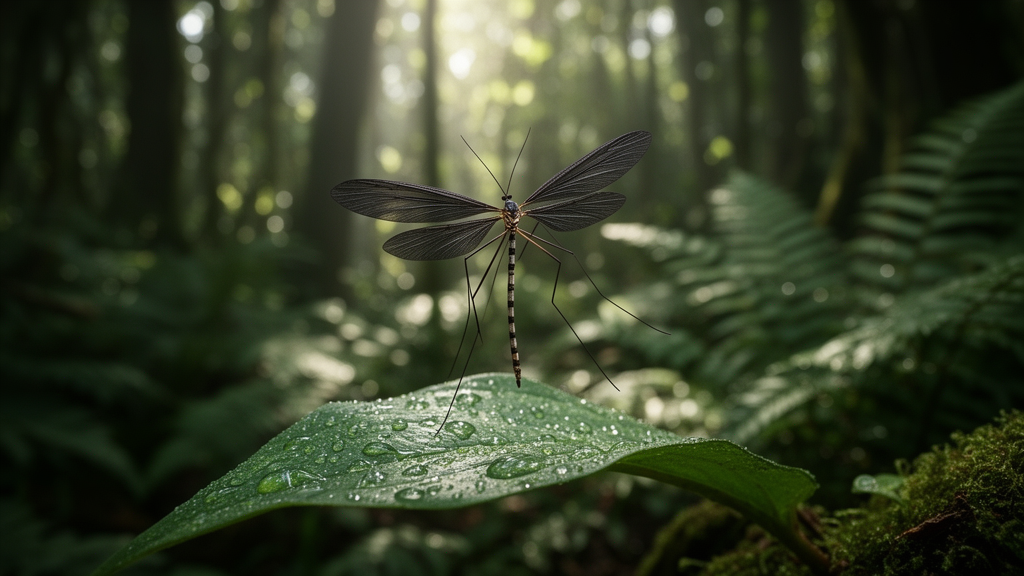
Researchers have described five new species of Ptychoptera, the ghostly insects known as phantom crane flies, from across South and Southeast Asia, while also untangling a series of long-standing identification errors that had obscured the true diversity of the genus. The study, published in the journal ZooKeys, raises the number of recognized Oriental Ptychoptera species to 29 and the global total to 95, and delivers the first record of the entire family Ptychopteridae from Singapore. Phantom crane flies belong to the family Ptychopteridae, a small lineage within the lower Diptera.
The larvae are equally distinctive: they possess fully developed heads, short inflated thoracic segments bearing ventral prolegs, and cylindrical abdominal segments whose final three segments form a conical anal division housing an elongate respiratory siphon. Pupae are fusiform, equipped with two prominent thoracic respiratory organs, one of which is enlarged and longer than the body itself. Today the family is divided into four subfamilies, two of them entirely extinct.
The fossil subfamilies Proptychopterininae and Eoptychopterinae contain 12 and 61 described species respectively, while the extant subfamilies Ptychopterinae and Bittacomorphinae include 4 fossil plus 92 extant species and 5 fossil plus 13 extant species respectively. Within Ptychopterinae, the genus Ptychoptera is the dominant lineage, characterized by antennae with 13 or 14 flagellomeres, a complete transverse suture on the scutum, wings in which vein M forks into M1 and M2, and a simple spine-like apical ventral spur on the fore tibia. Male genitalia are marked by a dorsally rotated aedeagus, while females bear a bilobate epigynium concealed beneath tergite VII and heavily sclerotized, beak-like cerci.
The scale of recent discovery in Asia is striking. Between 2005 and 2025, 28 new Ptychoptera species were described worldwide, increasing the total number of known species by roughly 30 percent. The vast majority of these, 21 species, came from the Eastern Palaearctic and Oriental regions, lifting the known Asian fauna from 25 to 46 species, an 84 percent increase.
Yet this burst of description has been geographically lopsided: 15 of the new species came from China and 5 from Japan, while only a single species had previously been recorded from Southeast Asia, in the Philippines. The new study directly addresses that gap. The five new species span a remarkable range of habitats and countries.
Ptychoptera hantu Kolcsár & Fasbender comes from Singapore's Central Catchment Nature Reserve and represents the first record of Ptychopteridae from the country. Ptychoptera phutphi Kolcsár & Fasbender was collected in western Thailand, Ptychoptera pseudosimilis Fasbender in Arunachal Pradesh, India, Ptychoptera vietnamensis Paramonov in northwestern Vietnam, and Ptychoptera srilankaensis Paramonov in central Sri Lanka. The species names themselves carry cultural weight: hantu is the Malay word for ghost, and phutphi is the Thai word ภูตผี, both nodding to the family's common English name, phantom crane flies, and to the insects' secretive lives in shaded forest habitats.
The Singaporean species was found in the Central Catchment Nature Reserve, the nation's most ecologically rich forest-stream system, where shaded headwater and blackwater habitats with organic-rich soils and stable humidity support exceptionally high but largely undocumented insect diversity. Recent photographs posted on iNaturalist from Upper Seletar Reservoir Park, including images of a mating pair, confirmed the species is still living in Singapore's forest remnants, making it a flagship for the hidden biodiversity of the island's remaining wetlands. Beyond the new species, the study delivers substantial taxonomic housekeeping.
Ptychoptera annandalei Brunetti, 1918, originally described from Myanmar's Shan State, and Ptychoptera perbona Alexander, 1946, from northern Burma, were both redescribed from fresh, well-preserved material. The redescription of P. annandalei proved decisive: examination of undistorted genitalia from newly collected Thai specimens revealed that Ptychoptera cordata Zhang & Kang, 2021, is in fact a junior synonym of P. annandalei. The characters thought to separate the two species, such as the apparent overlap of the gonostylus branches and the shape of the parameres, turned out to be artifacts of viewing the same structures from different angles.
Similarly, Ptychoptera perbona flaviventris Alexander, 1946 was synonymized with the nominate subspecies after re-examination of paratype material showed that the supposed diagnostic differences were illusory. These corrections highlight a technical problem that has haunted Ptychoptera taxonomy for decades. Much of the historical material, particularly from the collection of the influential dipterist C. P. Alexander, was slide-mounted in ways that crushed and flattened the complex, three-dimensional male genitalia.
Important structures such as the aedeagus and hypandrium were often omitted from the slides altogether. Comparing new specimens with these flattened preparations has been notoriously difficult, and the authors show that this has directly led to misinterpretations, including the erroneous species and subspecies now synonymized. The new work relies on freshly collected specimens preserved in ethanol or point-mounted, with genitalia macerated in potassium hydroxide, neutralized in acetic acid, and imaged from multiple angles using high-resolution stereomicroscopy and compound microscopy with differential interference contrast.
The study also formalizes a species group that had long been suspected but never established. Fasbender had tentatively suggested in 2014 that Ptychoptera formosensis, P. persimilis, and what is now P. pseudosimilis might form a clade, but limited material prevented formal placement. With the new species and recently described Chinese taxa, the authors now define the Ptychoptera formosensis species group to include ten species: P. formosensis, P. annandalei, P. emeica, P. lii, P. lushuiensis, P. persimilis, P. pseudosimilis, P. tianmushana, P. vietnamensis, and P. yunnanica.
The group is diagnosed by a suite of male genital characters, including digitiform epandrial structures, the presence of spathate lobes on the hypandrium, the absence of gonocoxal lobes, a crescent-shaped divided basal lobe of the gonostylus, and a distinctive forked apical lobe whose branches are subequal in length and usually crossed, giving the gonostylus a bifid appearance. To date the group is known only from the Oriental region and adjacent areas of Palaearctic China. Not every new species fits neatly into existing frameworks.
Ptychoptera hantu does not belong to any currently recognized species group, distinguished by ventrally directed apices of the gonostylus and very small, bare spathate lobes. Ptychoptera phutphi, with its T-shaped epandrial clasper apex and a primary branch of the gonostylus that bends dorsally at nearly a right angle, a feature found in no other Ptychoptera, also defies placement. Ptychoptera srilankaensis is perhaps the most puzzling: its reduced, knob-like epandrial clasper and spine-bearing gonostylus strikingly resemble the North American P. pendula group, while a pair of broad setose lobes on the hypandrium may be homologous with the spathate lobes of other species.
The authors also caution that some species pairs, such as P. persimilis and P. lushuiensis, may ultimately prove synonymous once better material becomes available, and they note that DNA barcoding yielded viable COI sequences from only two specimens, both uploaded to GenBank. With most Oriental species still known solely from their type series, the authors frame this work as the first step toward a comprehensive revision of Southeast Asian Ptychopteridae and call for a global online catalogue of the family, spanning both extinct and extant diversity.
Subject of Research: Taxonomic description of five new Oriental Ptychoptera species and revision of the Ptychoptera formosensis species group
Article Title: Descriptions of five new Oriental Ptychoptera Meigen, 1803 ( Diptera , Ptychopteridae )
Article References: Kolcsár, L.-P., Fasbender, A., Paramonov, N., Srisuka, W., & Ang, Y. (2026). Descriptions of five new Oriental Ptychoptera Meigen, 1803 (Diptera, Ptychopteridae). ZooKeys, 1287, 91-152. https://doi.org/10.3897/zookeys.1287.183917
Image Credits: AI Generated
DOI: 10.3897/zookeys.1287.183917
Keywords: Ptychoptera, Ptychopteridae, phantom crane flies, Diptera, taxonomy, new species, Singapore, Oriental region, male genitalia, species group, synonymization, Southeast Asia
Cite Scienmag News
Gavin Prescott. (October 26, 2026). Five new phantom crane fly species emerge from Asia’s hidden forests. Scienmag. https://scienmag.com/five-new-phantom-crane-fly-species-emerge-from-asias-hidden-forests/
Gavin Prescott. "Five new phantom crane fly species emerge from Asia’s hidden forests." Scienmag, 26 October 2026, https://scienmag.com/five-new-phantom-crane-fly-species-emerge-from-asias-hidden-forests/. Accessed 26 October 2026.
Gavin Prescott. "Five new phantom crane fly species emerge from Asia’s hidden forests." Scienmag. October 26, 2026. https://scienmag.com/five-new-phantom-crane-fly-species-emerge-from-asias-hidden-forests/


