


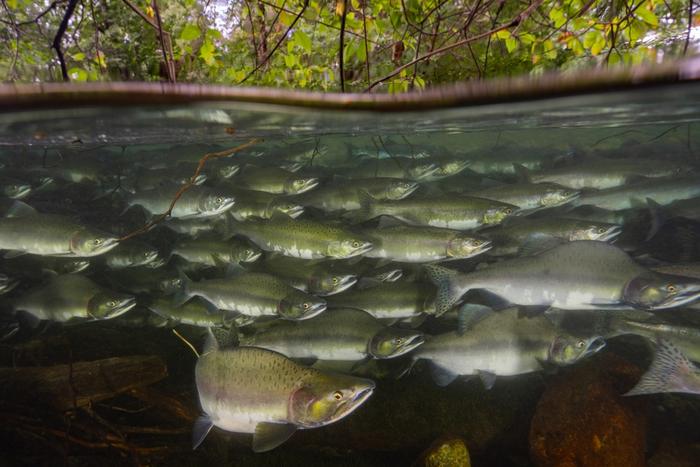
Swimming through turbulent water is easier for schooling fish compared to solitary swimmers, according to a study published June 6th in the open-access journal PLOS Biology by Yangfan Zhang of Harvard University, Massachusetts, US, and colleagues.

Credit: Fernando Lessa (CC-BY 4.0,
Swimming through turbulent water is easier for schooling fish compared to solitary swimmers, according to a study published June 6th in the open-access journal PLOS Biology by Yangfan Zhang of Harvard University, Massachusetts, US, and colleagues.
Locomotion is key to many aspects of animal behavior, from reproduction to feeding to migration, and so many species have developed adaptations to make moving around more efficient. In this study, Zhang and colleagues propose the “turbulent sheltering hypothesis,” which suggests that traveling in schools allows fish to shield each other from disruptive water currents, thus making it easier to swim through rough waters.
To test this hypothesis, the researchers ran trials with giant danios (Devario aeqipinnatus), observing these fish swimming alone or in groups of eight in both turbulent and steadily flowing water. High-speed cameras allowed researchers to observe the movements of the fish as they swam, and a respirometer allowed for measurements of fish respiration rates and energy expenditure.
These trials revealed that schooling fish expended up to 79% less energy while swimming in turbulent water compared to solitary fish. Schooling fish also clustered more closely together in turbulent water compared to steady water, while solitary fish had to beat their tails much more vigorously to maintain the same speed in more turbulent currents.
These results lend support to the “turbulence sheltering hypothesis,” indicating that locomotion efficiency might be a driving factor behind the evolution of schooling behavior. This information is valuable for understanding fish ecology, fundamentals of hydrodynamics and it might also be applied to the design and maintenance of habitats meant to harbor protected fish species or to hinder invasive ones. The authors note that future studies might build off of these findings to explore energy dynamics of group movements in further aquatic or aerial animals.
The authors add, “What is the function of schooling behaviour in fishes? We show that being in a school substantially reduces the energetic cost for fish swimming in a turbulent environment, compared to swimming alone, providing support for the hypothesis that schooling behaviour protects individual fish from the increased energetic cost associated with swimming in turbulence.”
#####
In your coverage, please use this URL to provide access to the freely available paper in PLOS Biology:
Citation: Zhang Y, Ko H, Calicchia MA, Ni R, Lauder GV (2024) Collective movement of schooling fish reduces the costs of locomotion in turbulent conditions. PLoS Biol 22(6): e3002501.
Author Countries: United States
Funding: Funding provided by the National Science Foundation grant 1830881 (GVL), the Office of Naval Research grants N00014-21-1-2661 (GVL), N00014-16-1-2515 (GVL), 00014-22-1-2616 (GVL), and a Postdoctoral Fellowship of the Natural Sciences and Engineering Research Council of Canada (NSERC PDF – 557785 – 2021) followed by a Banting Postdoctoral Fellowship (202309BPF-510048-BNE-295921) of NSERC & CIHR (Canadian Institutes of Health Research) (YZ). The funders had no role in study design, data collection and analysis, decision to publish, or preparation of the manuscript.
Journal
PLoS Biology
Method of Research
Experimental study
Subject of Research
Animals
COI Statement
Competing interests: The authors have declared that no competing interests exist.
Cite Scienmag News
Drew Townsend. (June 6, 2024). Fish in schools have an easier time swimming in rough waters. Scienmag. https://scienmag.com/fish-in-schools-have-an-easier-time-swimming-in-rough-waters/
Drew Townsend. "Fish in schools have an easier time swimming in rough waters." Scienmag, 6 June 2024, https://scienmag.com/fish-in-schools-have-an-easier-time-swimming-in-rough-waters/. Accessed 4 September 2026.
Drew Townsend. "Fish in schools have an easier time swimming in rough waters." Scienmag. June 6, 2024. https://scienmag.com/fish-in-schools-have-an-easier-time-swimming-in-rough-waters/

