


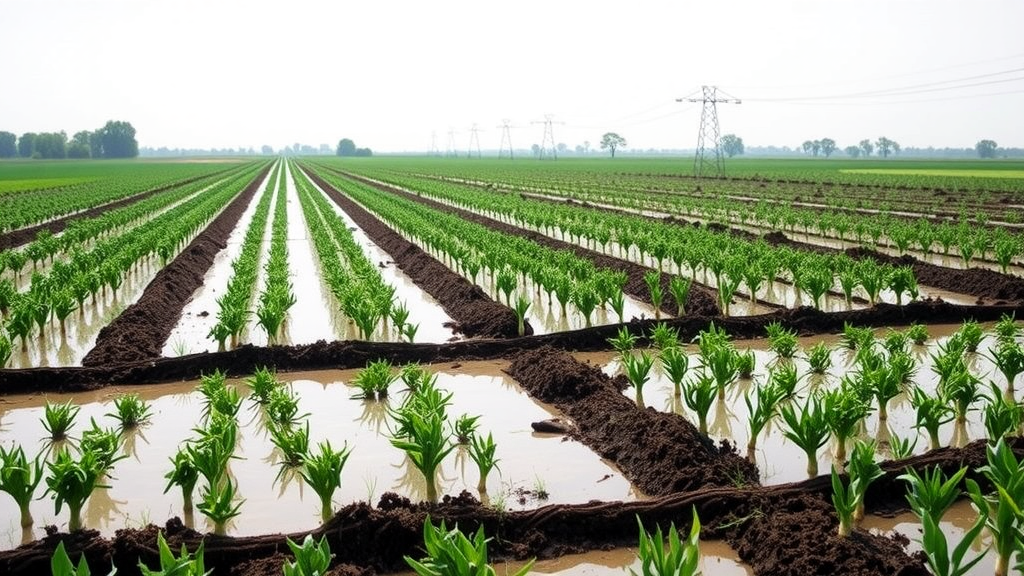
For half a century, scientists have tried to answer one of the most deceptively simple questions in global water science: how much water does humanity actually withdraw from rivers, lakes, reservoirs and aquifers to irrigate the world’s crops? A new perspective article published in Nature Water argues that, despite an explosion of data, models and computing power over the past fifty years, the answer has not become more precise. Instead, the range of plausible estimates for global irrigation water withdrawals has widened, a counterintuitive finding that carries serious implications for water policy, food security planning and climate change adaptation.
The central message of the analysis is that uncertainty in this field is not a static problem that steady scientific progress can be expected to eliminate. Early attempts in the 1970s and 1980s produced relatively narrow but poorly constrained estimates, built on sparse national statistics and coarse assumptions about crop water requirements. As more independent datasets, remote sensing products and global hydrological models emerged, each brought its own definitions, assumptions and data sources. Rather than converging on a single figure, the community of estimates has dispersed, revealing how deeply methodological choices shape the reported numbers.
Part of the difficulty lies in what irrigation water withdrawals actually measure. Withdrawals are the water taken from a source, whether surface water or groundwater, to supply fields. They are not the same as consumption, the fraction of withdrawn water that is evaporated or incorporated into crops and therefore unavailable downstream. Nor are they the same as the water actually delivered to fields, since conveyance losses, leakage from canals and on-farm inefficiencies separate the amount withdrawn from the amount a crop uses. Different research communities emphasize different parts of this chain, and inconsistent terminology has allowed studies that appear to address the same quantity to report fundamentally different things.
The technical machinery behind global estimates has grown enormously in sophistication. Global hydrological models now simulate the land surface at resolutions of a few tens of kilometers, coupling water balance calculations with crop growth modules and irrigated area maps derived from satellite imagery. Remote sensing missions track vegetation greenness, land surface temperature and gravimetric signals of changing water storage, offering independent checks on model behavior. Machine learning approaches have been layered on top of these physical models, trained on national statistics to reproduce reported withdrawals. Yet each of these tools introduces its own structural assumptions, and the article argues that this proliferation of methods has multiplied the number of defensible answers rather than eliminating weak ones.
Data scarcity remains a foundational obstacle. Few countries publish detailed, sub-national records of irrigation withdrawals, and those that do often use reporting standards that change over time or differ across agencies. In many of the most water-stressed regions of the world, including parts of South Asia, the Middle East and sub-Saharan Africa, substantial irrigation is supplied by millions of small-scale pumps tapping shallow aquifers, and this abstraction is largely invisible to official statistics. Where groundwater use is unregulated or unmetered, models must infer it indirectly, for example from satellite observations of declining aquifer storage, electricity consumption or agricultural censuses. Each inference route carries its own error structure, and the resulting estimates can differ by factors large enough to swallow the signal that policymakers are trying to detect.
The choice of irrigated area maps compounds the problem. Global datasets of irrigated land disagree substantially on both the total extent of irrigation and its spatial distribution, particularly in regions where irrigated and rainfed agriculture intermingle at scales finer than satellite pixels can resolve. Because withdrawal estimates are typically calculated as irrigated area multiplied by a water requirement per unit area, errors in the area baseline propagate directly and linearly into the final number. Estimates of irrigation efficiency, the ratio of water beneficially used by crops to water withdrawn, span an equally wide range, and small differences in assumed efficiency can shift global totals by hundreds of cubic kilometers per year, comparable to the annual flow of major river systems.
Climate variability adds another layer of divergence. Irrigation demand rises in hot, dry years and falls in cool, wet ones, so the year chosen as a reference point matters. Some datasets report withdrawals for a nominal year that is actually synthesized from data spanning a decade; others average across multiple years. Because studies rarely harmonize their reference periods, comparisons among them may partly reflect differences in climate conditions rather than genuine disagreement about water use. The article emphasizes that this temporal mismatch is one of the most underappreciated sources of spread among published estimates, and one that careful harmonization could substantially reduce.
The consequences of this unresolved uncertainty are far from academic. Global water scarcity assessments, which estimate how many people face chronic shortages or how many river basins are over-allocated, depend directly on withdrawal estimates. Climate impact assessments project future irrigation demand to gauge stress on water systems under warming. Food system analyses link irrigation water use to the production of specific crops and the virtual water embedded in trade. When the underlying withdrawal estimates vary widely, all of the downstream conclusions inherit that spread, and debates about whether a region is approaching physical water limits can hinge as much on methodological choices as on hydrological reality.
The authors do not conclude that fifty years of research have been wasted. On the contrary, they argue that the widening range of estimates represents genuine progress: the community now understands far better where the uncertainties lie, which assumptions are most fragile, and why different approaches disagree. Early narrow estimates conveyed false confidence; the modern envelope of estimates, however uncomfortable, is more honest about the state of knowledge. The task ahead is to convert that improved understanding of uncertainty into actionable information, for example by reporting ranges and confidence statements rather than single headline numbers, and by making the assumptions behind each estimate transparent and comparable across studies.
Several pathways toward more reliable estimates emerge from the analysis. Sustained investment in ground-based measurement, including metering of groundwater pumping and standardized national reporting, would anchor models to reality where they are currently weakest. Open sharing of national statistics, model code and input datasets would allow the community to trace discrepancies to their origins. Systematic model intercomparison experiments, in which multiple research groups estimate withdrawals using identical inputs and definitions, could isolate which assumptions drive the largest differences. And closer integration of remote sensing with in-situ observations offers a way to constrain the spatial patterns of water use that ground records alone cannot resolve. Whether the next fifty years finally narrow the uncertainty will depend on treating the problem not as a data gap to be filled piecemeal, but as a measurement science in its own right, with the rigor, standardization and sustained investment that rigorous measurement demands.
Subject of Research: Global irrigation water withdrawal estimates and the uncertainty surrounding them
Article Title: Fifty years of research have deepened uncertainties in global irrigation water withdrawals
Article References: Puy, A., Aguiló-Rivera, C., Linga, S. N., Clarke, N., Richards, O., Flinders, S., & Melsen, L. A. (2026). Fifty years of research have deepened uncertainties in global irrigation water withdrawals. Nature Water. https://doi.org/10.1038/s44221-026-00710-0
Image Credits: AI Generated
DOI: 10.1038/s44221-026-00710-0
Keywords: irrigation, water withdrawals, water resources, global hydrology, uncertainty, agriculture, food security, groundwater, water management, hydrological modeling, Fifty, years
Cite Scienmag News
Violet Maxwell. (September 21, 2026). Fifty Years of Irrigation Studies Have Made Water Use More Uncertain, Not Less. Scienmag. https://scienmag.com/fifty-years-of-irrigation-studies-have-made-water-use-more-uncertain-not-less/
Violet Maxwell. "Fifty Years of Irrigation Studies Have Made Water Use More Uncertain, Not Less." Scienmag, 21 September 2026, https://scienmag.com/fifty-years-of-irrigation-studies-have-made-water-use-more-uncertain-not-less/. Accessed 4 October 2026.
Violet Maxwell. "Fifty Years of Irrigation Studies Have Made Water Use More Uncertain, Not Less." Scienmag. September 21, 2026. https://scienmag.com/fifty-years-of-irrigation-studies-have-made-water-use-more-uncertain-not-less/


