


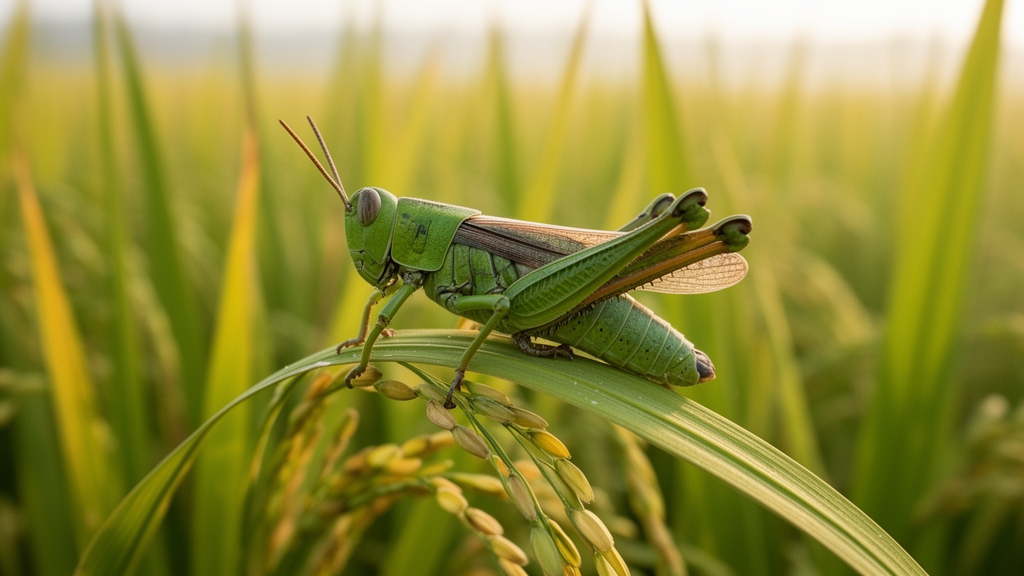
The study examined whether environmental conditions, grass height, sex, body and wing measurements, predator approach and successive escape attempts were associated with the animals’ choice of flying or jumping. Across repeated encounters with a human predator model, the grasshoppers generally also tended to repeat the locomotion mode used in the preceding escape. These findings describe associations in one field population and do not establish the causes of the observed behavior.
Researchers conducted the experiments in the Biodiversity Conservation Zone of Kyushu University from October 6 to November 17, 2016. Six sites with mean grass height of 30 cm or less were classified as low-grass sites, while one 432 m² site with grass exceeding 30 cm was classified as high-grass. One investigator served as the predator model and approached each target three consecutive times, wearing the same clothing and equipment throughout.
The approach was paced with an electronic metronome at approximately one step per second. A high-speed camera recording at 120 frames per second and a conventional camera captured escape behavior. Wire ring markers established positions for flight initiation distance, the distance between predator and grasshopper when escape began, and distance fled, the distance covered during the escape.
Escapes involving wing flapping were classified as flight, and escapes without wing flapping as jumping. After the third escape, researchers captured each grasshopper and measured its body length, body weight and wing length. They then marked and released it to avoid sampling the same individual again.
The final dataset included 131 females and 148 males: 52 females and 63 males were observed at the high-grass site, and 79 females and 85 males at the low-grass sites. Grasshoppers missing a hind leg were excluded, and data collection stopped when the investigator lost sight of a target. The researchers used generalized linear models with a quasi-binomial error structure and logit link to examine the first escape, with jumping coded as 1 and flying as 0, and fitted maximum-likelihood models to the transitions between consecutive escape attempts.
Females jumped more frequently than males at both high- and low-grass sites, with significant differences across the three escape attempts. The first-escape difference at the high-grass site had p = 0.016, while the other comparisons had p < 0.001. This result concerns a difference between females and males; it does not mean that females jumped more often than they flew.
Females were also larger and heavier on average: their mean body length was 32.707 ± 2.340 mm and mean body weight 0.806 ± 0.150 g, compared with 26.697 ± 1.589 mm and 0.404 ± 0.055 g for males. Generalized linear models of the first escape found that both sexes flew more frequently as air temperature rose, while jumping became more frequent as relative humidity increased. In the female model, the temperature coefficient was −0.333 (p = 0.001), the humidity coefficient was 0.066 (p = 0.006) and the wing-length coefficient was −0.355 (p = 0.023), with jump coded as 1 and flight as 0.
Females with longer wings flew more often, whereas those with greater estimated wing loading jumped more often. Grass height, body length and body weight were not significantly related to locomotion mode in the first escape. Grasshoppers that flew traveled farther than those that jumped for both sexes, at both grass-height classes and during all three approaches.
Flight initiation distance did not differ significantly between the two modes during the first attempt. In later attempts, however, some groups of jumpers had shorter flight initiation distances than flyers, with the specific differences depending on sex, grass height and attempt number. The authors proposed hiding as one possible explanation for delaying escape, but the statistical analysis did not directly model that proposal.
A maximum-likelihood model evaluated whether locomotion modes in consecutive escapes were independent and whether their baseline probabilities were equal. In nearly all sex- and site-specific comparisons, grasshoppers selected the same mode more often than expected under independence. The exception was the transition from the second to third escape among females at the high-grass site, where the estimated dependence was positive but not significant.
Females also had a lower baseline probability of flying in their second than first escape, while that probability did not differ significantly between consecutive attempts in the other comparisons. The authors offered three non-exclusive explanations for repeated use of a mode: a prior mode may have enabled successful escape, switching between flight and jump may impose physiological or neural preparation constraints, and individuals may differ consistently in their escape decisions. The field design has an important limitation because the predator model was a person, and data could not be collected from grasshoppers that escaped so rapidly that the investigator lost sight of them.
This could bias the sample toward individuals with lower observed escape performance. The study was also conducted at seven grassland sites in one conservation area during a single autumn period, so the findings should not be generalized automatically to other populations, habitats or seasons. Within those limits, the results show that locomotion mode is associated with sex, temperature, humidity, wing characteristics, escape distances and previous escape decisions.
Subject of Research: Field study of flight-versus-jump escape decisions in Japanese rice grasshoppers
Article Title: To fly or to jump: Factors related to the mode of locomotion for escape by the Japanese rice grasshopper Oxya yezoensis
Article References: Kuga, T., & Kasuya, E. (2026). To fly or to jump: Factors related to the mode of locomotion for escape by the Japanese rice grasshopper Oxya yezoensis. Journal of Orthoptera Research, 35(1), 41-48. https://doi.org/10.3897/jor.35.146467
Image Credits: AI Generated
Keywords: Japanese rice grasshopper, escape behavior, locomotion mode, flight initiation distance, distance fled, grassland field study, temperature, relative humidity, wing loading, predator approach, jump, Factors
Cite Scienmag News
Alan Morgan. (October 20, 2026). Field study links Japanese rice grasshopper escape mode with sex, weather and morphology. Scienmag. https://scienmag.com/field-study-links-japanese-rice-grasshopper-escape-mode-with-sex-weather-and-morphology/
Alan Morgan. "Field study links Japanese rice grasshopper escape mode with sex, weather and morphology." Scienmag, 20 October 2026, https://scienmag.com/field-study-links-japanese-rice-grasshopper-escape-mode-with-sex-weather-and-morphology/. Accessed 20 October 2026.
Alan Morgan. "Field study links Japanese rice grasshopper escape mode with sex, weather and morphology." Scienmag. October 20, 2026. https://scienmag.com/field-study-links-japanese-rice-grasshopper-escape-mode-with-sex-weather-and-morphology/


