


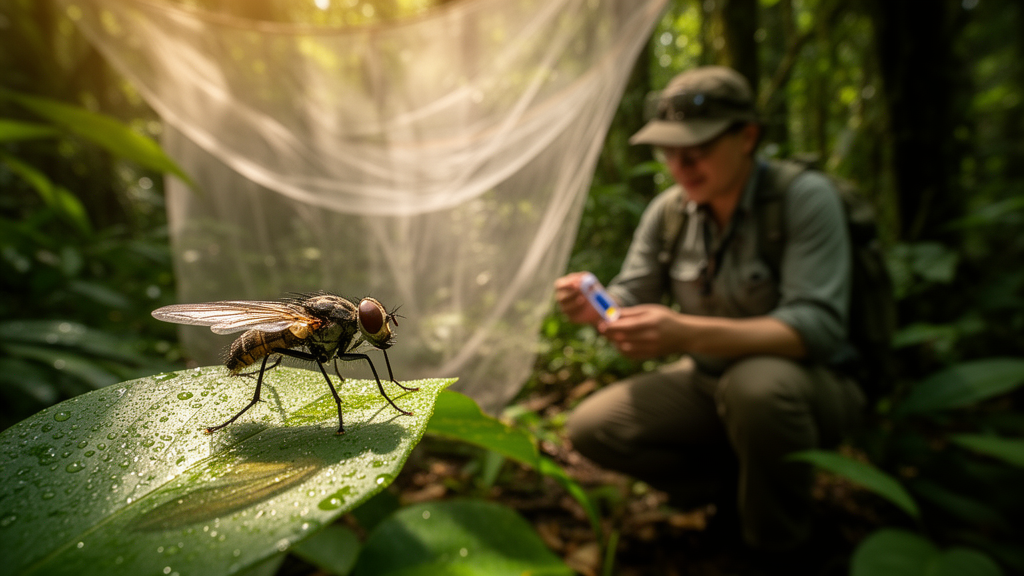
A field study at Los Amigos Biological Station in southeastern Peru detected vertebrate DNA in 106 of 240 carrion flies collected across 24 rainforest sites in November 2023. Using an extraction-free direct PCR workflow, researchers identified 27 mammalian taxa from nine orders and 18 families, along with four anuran taxa, and found that at least one vertebrate was detected at every site.
The study tested whether DNA deposited or regurgitated by carrion flies could support surveys of terrestrial vertebrate diversity without directly observing or capturing animals. It also examined two ways to pool fly samples for sequencing and a field collection method designed to reduce the time required to survey large numbers of locations.
Sampling took place at Los Amigos Biological Station in the Madre de Dios region of the western Amazon, where the landscape includes old-growth terra firme forest, floodplain forest, dense stands of Guadua bamboo and Mauritia flexosa palm swamps. The researchers collected flies at 24 locations along six trail segments, three in floodplain habitat and three in terra firme habitat, over three days.
At each site, the team netted 10 flies directly from a white plastic grocery bag loosely tied around an open bag of rotting pork. Each fly was placed in a sterile 1.5- or 2-milliliter tube. After 3–5 hours at ambient temperature to allow flies to regurgitate or deposit vertebrate DNA, the flies were removed and preserved in 90% ethanol for morphological identification. The remaining tubes were dried with silica gel, stored at minus 20 degrees Celsius and later transferred to Utah State University, where they were held at minus 70 degrees Celsius. Because carrion flies were often difficult to identify beyond family level, the most common families were Calliphoridae, Sarcophagidae, Mesembrinellidae and Tachinidae.
In the laboratory, direct PCR lysis buffer and proteinase K were added to the tubes, followed by vortexing, incubation and heat treatment. The resulting solution was used directly as the PCR template, without macerating whole flies, dissecting their digestive tracts, or formally extracting and purifying DNA. The PCR targeted an approximately 138-base-pair fragment of the mitochondrial 16S rRNA gene and included blocking primers for human and domestic pig DNA. The authors noted that environmental DNA extraction kits typically cost US$3–8 per sample and that extracting 24 samples commonly takes 2–4 hours, although the study did not directly compare extraction-free PCR with conventional extraction.
Following quality filtering, denoising and chimera removal, the individual-fly and template-pool libraries retained 2,547,579 reads, while the PCR-product-pool library retained 3,086,005 reads. The researchers used BLAST and a naïve Bayes classifier to assign operational taxonomic units, supplementing uncertain assignments with local expertise and a published species checklist. After human and domestic-species sequences, the bobcat positive control and sequences that could not be assigned to family level were removed, 40 operational taxonomic units representing 31 wild vertebrate taxa remained. These included 27 mammalian taxa and four anurans, although 26 mammalian taxa were assigned to species known from the study area, three only to genus and two only to family. Two family-level assignments were designated presumed species based on local fauna knowledge and reference-sequence limitations.
Vertebrate DNA was recovered from 44.2% of individual flies, and some flies carried DNA from several vertebrates: 63 contained one taxon, 31 contained two, 10 contained three, one contained four and one contained five. Black spider monkey was detected in 40 of 240 flies, Bolivian squirrel monkey in 31 and lowland tapir in 14. The researchers described the eastern pygmy marmoset detection as uncertain because the species had not been observed at the study site, the top BLAST match was 93.4% to a related species and the naïve Bayes classifier supported only a genus-level assignment. They proposed DNA from a dead marmoset drifting downriver as one possible explanation for its detection in 10 flies, not a confirmed cause. A white-lipped peccary assignment was also inferred from local context after both classifiers produced a problematic match to Chacoan peccary, while a tayra assignment was inferred from a mustelid-level classification and local fauna knowledge.
The pooling comparison showed substantial differences between approaches. Template pooling, which combined lysis-buffer templates before the initial PCR, detected a mean of 2.25 vertebrate species per site, compared with 4.96 from individually sequenced flies, and reproduced the individual-fly species list at only one of 24 sites. PCR-product pooling, in which individual flies were first amplified and their products combined before indexing, detected a mean of 5.04 species per site and 29 species overall, the same total as the individual-fly analysis. Rarefying the PCR-product pools to the template-pool read depth changed only two site-level detections, indicating that sequencing depth alone did not explain the difference between the pooling methods.
The findings show that extraction-free carrion-fly iDNA can recover a broad range of rainforest vertebrates, including arboreal primates, at one Peruvian research site while reducing laboratory processing relative to maceration or digestive-tract extraction. Post-PCR pooling also closely reproduced individual-fly detections in this setting and may reduce sequencing costs. The study was limited to 240 flies from one site over three days, and capture rates may vary with location, weather, season and day. Taxonomic precision was constrained by the short 16S marker and incomplete reference sequences, while the absence of a direct comparison with formal DNA extraction prevents claims that the workflows are equivalent in every setting.
Subject of Research: Evaluation of extraction-free carrion-fly iDNA metabarcoding for surveying rainforest mammals
Article Title: An efficient iDNA method for surveying rainforest mammals with carrion flies
Article References: Rodgers, T. W., Basto, A., Castro, R., Groves, E. M. R., Xu, C. C. Y., Hernández, E., Mock, K. E., & Forsyth, A. (2026). An efficient iDNA method for surveying rainforest mammals with carrion flies. Metabarcoding and Metagenomics, 10, Article e174834. https://doi.org/10.3897/mbmg.10.174834
Image Credits: AI Generated
Keywords: carrion flies, invertebrate-derived DNA, environmental DNA, mammal surveys, Amazon rainforest, direct PCR, DNA metabarcoding, sample pooling, biodiversity monitoring, 16S rRNA, efficient, iDNA
Cite Scienmag News
Margaret Porter. (October 20, 2026). Peruvian rainforest study detects 27 mammalian taxa from carrion-fly DNA in 240 flies. Scienmag. https://scienmag.com/peruvian-rainforest-study-detects-27-mammalian-taxa-from-carrion-fly-dna-in-240-flies/
Margaret Porter. "Peruvian rainforest study detects 27 mammalian taxa from carrion-fly DNA in 240 flies." Scienmag, 20 October 2026, https://scienmag.com/peruvian-rainforest-study-detects-27-mammalian-taxa-from-carrion-fly-dna-in-240-flies/. Accessed 20 October 2026.
Margaret Porter. "Peruvian rainforest study detects 27 mammalian taxa from carrion-fly DNA in 240 flies." Scienmag. October 20, 2026. https://scienmag.com/peruvian-rainforest-study-detects-27-mammalian-taxa-from-carrion-fly-dna-in-240-flies/


